The Propinquity Effect: How Repeated Glimpses Build (or Break) Neighborhood Trust

A suburban street, a person walking a dog at the same time each day, a neighbor watching from a porch, calm and familiar scene. Image Title: Propinquity Effect – How Repeated Glimpses Build (or Break) Neighborhood Trust Caption: Every wave, every walk, every routine is a vote in your neighborhood reputation. Propinquity builds trust without words.

What the Propinquity Effect Really Means Propinquity — physical or psychological proximity — is one of the most powerful forces in social psychology. The mere exposure effect, first documented by Robert Zajonc, shows that repeated, passive exposure to a stimulus increases liking for it. In neighborhoods, this means that every time a neighbor sees you … Read more
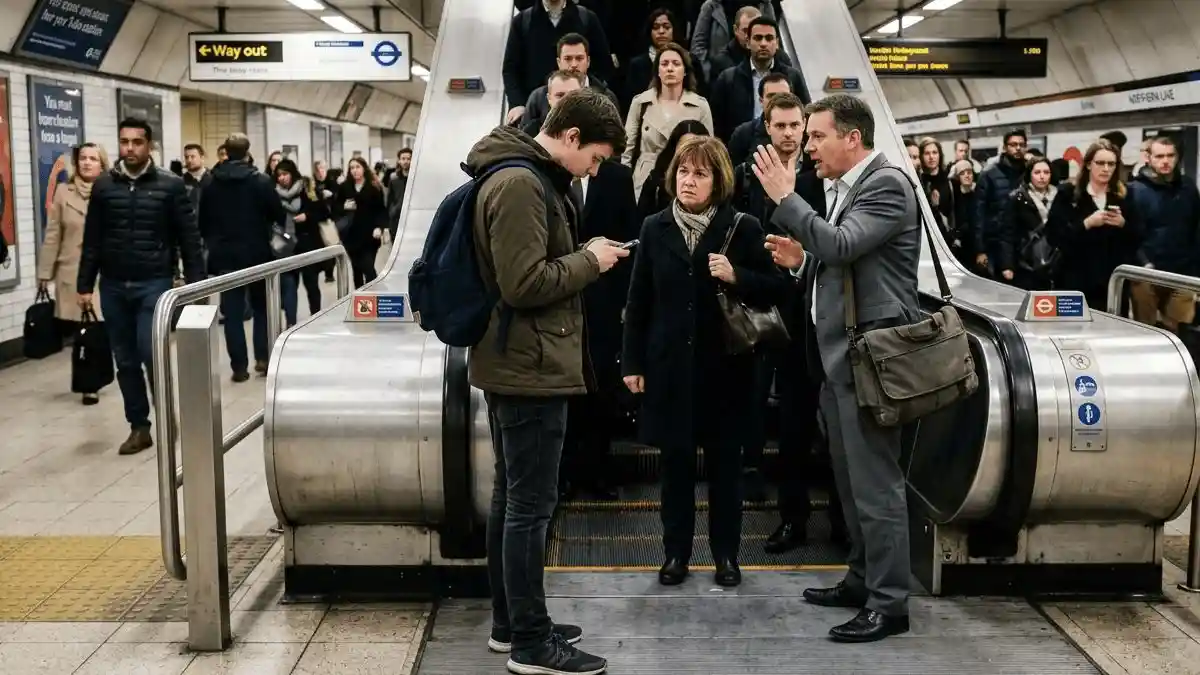
Spatial Awareness as an IQ Metric: Why Cluelessness Signals Low Social Competence

A busy transit station, one person frozen at the top of an escalator looking at a phone, causing a backup of annoyed commuters behind them.

Why Situational Awareness Feels Intelligent You have seen them: the person who stops dead at the top of an escalator, the group that blocks the entire sidewalk, the commuter who freezes in front of the turnstile while ten people queue behind. Your immediate thought is not anger — it is confusion. How can someone be … Read more

Micro-Etiquette & Social Proof: The Compound Interest of Tiny Neighborhood Habits

A residential street, a neighbor returning a trash bin from the curb, another neighbor waving from a porch, calm and tidy scene.

Why Small Habits Shape Big Opinions A wave to the mail carrier. A held gate for a neighbor with groceries. A trash bin returned from the curb before noon. These acts take three seconds. They cost nothing. Yet over months and years, they compound into a reputation that no single conversation could ever build. This … Read more

The Civic Contract: The Psychology of Hyper-Awareness in Dark, Shared Spaces

A dark movie theater from the back, audience silhouettes facing the screen, one person’s phone screen glowing brightly, standing out as a disruption.

Why Silence Feels Mandatory in Theaters A movie theater is a psychological paradox. You are surrounded by strangers, yet you have all agreed to pretend they are not there. You sit in the dark, facing the same direction, sharing an emotional experience — but any deviation from the silent, still norm triggers immediate, intense judgment. … Read more

The Red Alert: The Psychological Danger and Desire Behind Wearing Bold Colors

A person wearing a red blazer or red tie standing confidently in a modern office, drawing attention from others in neutral clothing.

Why Red Grabs Attention Instantly Red is the most psychologically urgent color on the spectrum. Your brain processes red faster than any other color. This is not cultural. It is biological. Red light has the longest wavelength and penetrates the retina most directly. Evolution hardwired this response: red signals blood, danger, ripeness, and readiness. When … Read more

The Armor Effect: How Minimalist vs. “Loud” Fashion Belies Your Core Personality Trait

Two people side by side — one in minimalist neutral clothing, one in bold colorful patterns — each standing confidently, representing different emotional armor.

Why Fashion Becomes Emotional Armor Clothing is never neutral. Every outfit is a layer of psychological protection. Some people build walls with quiet, repetitive uniforms — the same black turtleneck, the same gray hoodie, the same minimalist dress. Others build walls with noise — logos, patterns, bright colors, constant rotation. Both are armor. Both protect … Read more

Enclothed Cognition: The Brain Chemistry Behind Why “Dressing Up” Alters Your IQ and Focus

A person putting on a blazer in front of a mirror, showing a shift from casual to formal attire, with a focused expression.

What Is Enclothed Cognition? Enclothed cognition is the systematic effect that clothing has on the wearer’s psychological processes. Unlike the halo effect (how others see you), enclothed cognition is about how you see yourself. When you put on a lab coat, you become more attentive. When you wear a suit, you think more abstractly. When … Read more

The Comfort Conundrum: Does Dressing Casual Casualize Your Work Ethic?

A person working from home at a desk, wearing comfortable but neat casual clothing (not pajamas), looking focused and productive.

Why Comfort Changes Behavior Comfort feels harmless. But comfort is information. When you wear soft pants, a loose hoodie, and slippers, your brain receives a clear signal: “This is rest territory. Threats are low. Effort can be low.” The problem is not the clothing itself. The problem is that your brain cannot fully separate physical … Read more

Impulse vs. Identity: The Dark Psychology of Fast Fashion and Why We Revenge-Shop

A person surrounded by online shopping bags and packages on a bed, looking overwhelmed rather than happy, representing emotional shopping consequences

Why People Emotionally Shop Shopping is never just about acquiring things. It is about regulating feelings. When you feel anxious, bored, lonely, or angry, the brain seeks relief. Fast fashion offers the cheapest, fastest relief available. A $15 shirt delivers a dopamine spike within seconds — no therapy, no meditation, no difficult conversation required. The … Read more