Why Situational Awareness Feels Intelligent
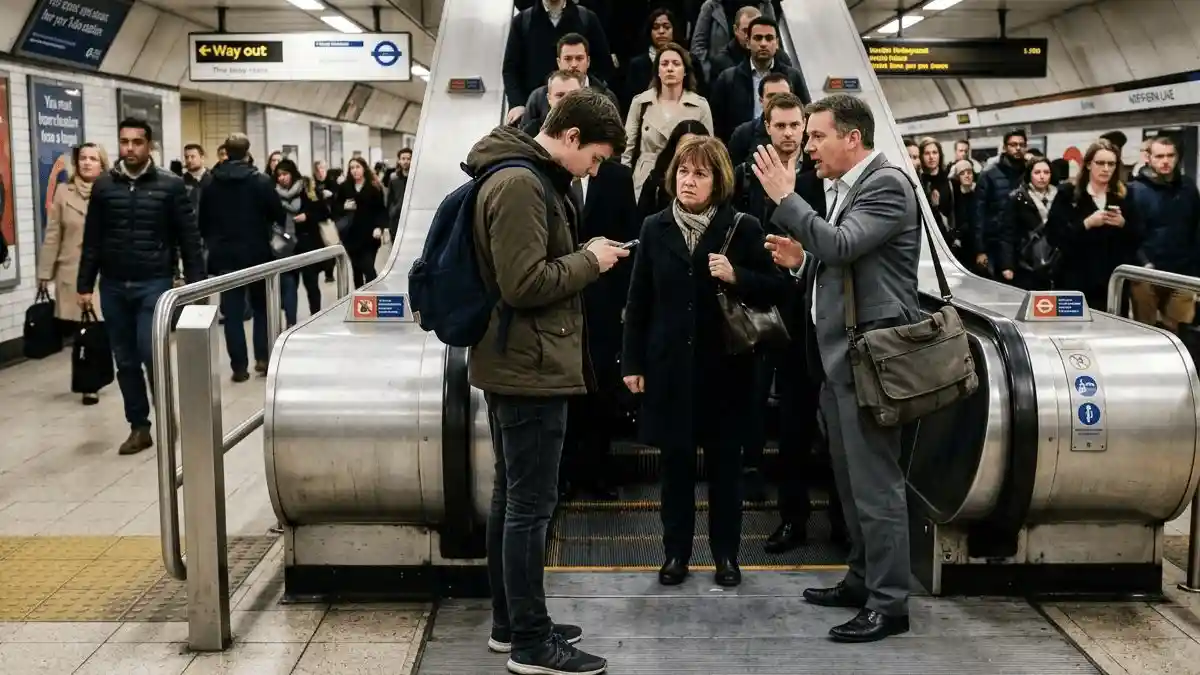
You have seen them: the person who stops dead at the top of an escalator, the group that blocks the entire sidewalk, the commuter who freezes in front of the turnstile while ten people queue behind. Your immediate thought is not anger — it is confusion. How can someone be so unaware?
Spatial awareness — the ability to perceive your environment, anticipate the movement of others, and navigate without causing friction — is so fundamental to public functioning that its absence registers as a form of low social intelligence. Observers do not just see a mistake. They see a character flaw.
The brain uses spatial awareness as a proxy for general competence. People who navigate smoothly are assumed to be smarter, more reliable, and higher status. People who block, freeze, or meander are assumed to be oblivious, selfish, or low‑IQ — even when no such correlation exists.
The Psychology of Blocking Movement
Blocking occurs when a person positions themselves in a way that obstructs the natural flow of pedestrian traffic. Common blocking behaviors include:
COMMON BLOCKING BEHAVIORS
- Stopping immediately after exiting an escalator or stairway
- Standing in a doorway while checking a phone
- Walking three abreast on a narrow sidewalk
- Leaving a suitcase or bag in a high‑traffic area
- Hesitating at the bottom of an escalator, causing a pile‑up
Each of these acts is a flow violation. The blocker has failed to anticipate how their position affects others. The result is frustration, delay, and sometimes collisions.
The brain interprets blocking as:
HOW THE BRAIN INTERPRETS BLOCKING
- Low situational awareness
- Egocentrism (failure to consider others)
- Low cognitive capacity (cannot multitask movement and phone use)
UPSIDES
- ✓ Pulling over to the side to check phone (Respectful, aware – High Social Competence)
- ✓ Walking single‑file on a crowded path (Cooperative, intelligent – High Social Competence)
DOWNSIDES
- ✕ Stopping at the top of an escalator (Dangerously oblivious – Very Low Rating)
- ✕ Walking slowly while blocking the entire sidewalk (Selfish, unaware – Low Rating)
- ✕ Freezing at a turnstile while others wait (Anxious, low processing speed – Low Rating)
- ✕ Standing in a doorway on phone (Entitled, no spatial sense – Very Low Rating)
Cognitive Loading and Public Freezing
Public freezing — suddenly stopping or hesitating in a high‑traffic area — is often caused by cognitive overload. The person is trying to process too much information at once: navigating, checking directions, responding to a message, managing anxiety.
When cognitive load exceeds capacity, the brain prioritizes the most urgent task (often the phone) and temporarily suspends environmental monitoring. The person freezes because they have no spare attention for movement.
However, observers do not see cognitive overload. They see cluelessness. The frozen person is judged as unintelligent or inconsiderate, even though the cause is a temporary attention bottleneck.
EXPERT TIP
- The solution is simple: pull over before you stop. Step to the side of the flow, then check your phone, then rejoin. This small act signals high social competence.
Why Smooth Navigation Signals Competence
Smooth navigation — moving through crowds without hesitation, collision, or friction — is a form of fluid intelligence. It requires:
REQUIREMENTS FOR FLUID NAVIGATION
- ✓ Rapid environmental scanning
- ✓ Prediction of others’ trajectories
- ✓ Real‑time adjustment of speed and direction
- ✓ Inhibition of the urge to stop suddenly
People who navigate smoothly are perceived as:
OBSERVER PERCEPTIONS OF SMOOTH NAVIGATORS
- More intelligent
- More confident
- More trustworthy
- Higher status
In fact, studies of first impressions show that smooth pedestrian movement influences hiring recommendations, dating interest, and social trust — even when the observer has no other information about the person.
Social Frustration Toward Oblivious Behavior
Oblivious behavior — blocking, freezing, weaving — triggers a specific form of social frustration called pedestrian resentment. This is not mild annoyance. It is a strong negative emotion because the oblivious person has violated the expectation of mutual awareness.
Pedestrian resentment includes:
SIGNS OF PEDESTRIAN RESENTMENT
- Internal monologue (“How can they not see me?”)
- Passive‑aggressive sighs or shoulder bumps
- Verbal comments (“Excuse you” or “Really?”)
- In extreme cases, confrontation
The oblivious person rarely understands why others are upset. They did not intend harm. But intent does not erase impact. In public spaces, impact is all that matters.
Predictability and Human Comfort
The human brain craves predictability. When you walk through a crowd, you constantly predict where each person will be in the next second. This prediction allows you to navigate without collisions.
Oblivious behavior — sudden stops, erratic turns, blocking — breaks predictability. The brain cannot predict what an oblivious person will do next, so it shifts into high‑alert monitoring. This is exhausting.
By contrast, predictable movement (steady pace, clear direction, no sudden stops) allows everyone’s brain to relax. The predictable pedestrian is a good neighbor in shared space.
Moving With Urban Fluidity
Urban fluidity is the ability to move through dense environments with ease, awareness, and courtesy. It is a learnable skill.
Components of urban fluidity:
COMPONENTS OF URBAN FLUIDITY
- ✓ Scanning — Look 20‑30 feet ahead, not just at your feet
- ✓ Pacing — Match the speed of those around you
- ✓ Lane discipline — Stay to the right (or left) and pass on the other side
- ✓ Anticipatory yielding — Move aside before someone has to ask
- ✓ Phone management — Step out of the flow before using your phone
People who master urban fluidity are never the ones causing friction. They are the ones who make crowded spaces feel manageable.
Final Thoughts
Spatial awareness is not about being polite. It is about being competent. Your ability to move through public space without blocking, freezing, or colliding is read by strangers as a measure of your intelligence and social value.
Do not stop in doorways. Do not freeze at the top of escalators. Pull over before you check your phone. Move with purpose and predictability.
The crowd will thank you — silently, invisibly, but absolutely.
Related Articles

Sponsored


You May Also Like

The Pheromone Myth vs. Reality: The Actual Science of Scent …

Erik Erikson’s 8 Psychosocial Stages – See How We Grow Throu…
Evolutionary Psychology: How Your Stone Age Mind Shapes Mode…

Neuroticism – Emotional Reactivity, Anxiety & Sensitivit…
The Illusion of Self-Control: Why Willpower Fails and System…