

Quick Jump
“I know what to do, but I can’t start.”
For many adults with Attention-Deficit/Hyperactivity Disorder (ADHD), this is a frustratingly familiar experience.
The task may look simple on paper: pay a bill, reply to an email, start a report, clean the room, read a chapter for class, or submit an assignment. You know what needs to be done. You may even want to do it. Yet, starting can feel strangely difficult.
This mental freeze is often called “task paralysis.” While not a formal medical diagnosis, it cleanly captures the frustrating gap between intention and action.
The important point is that ADHD is not simply about “not paying attention.” It affects core executive functions such as planning, organizing, managing time, regulating attention, and initiating tasks.
KEY TAKEAWAYS
- Executive Dysfunction: ADHD affects the brain’s executive functions involved in planning, organization, attention regulation, and task initiation.
- Hidden Complexity: A simple task can still feel overwhelming when it involves multiple unseen mental steps.
- Descriptive Terms vs. Diagnoses: Concepts like “task paralysis,” “time blindness,” and “RSD” describe common lived experiences, but they are not formal diagnostic symptoms.
- Effort vs. Ability: Struggling with task initiation does not mean a person is lazy, careless, or unmotivated.
- Variable Attention: Attention and motivation fluctuate based on interest, novelty, urgency, and immediate reward.
- Differential Considerations: Similar task initiation struggles occur with anxiety, depression, burnout, sleep deprivation, and other conditions.
Why Can Simple Tasks Feel So Difficult With ADHD?
Simple Does Not Always Mean Easy
A task can be objectively simple while still requiring several sequential mental steps. Consider a student who needs to submit an assignment:
“Submit my assignment.”
That sounds like one action. In reality, the brain must execute a complex sequence:
THE HIDDEN MENTAL STEPS
- ✓ Locate the assignment.
- ✓ Check whether it is finished.
- ✓ Open the file document.
- ✓ Review the text for errors.
- ✓ Make necessary corrections.
- ✓ Convert the file to the required format.
- ✓ Navigate to the submission portal.
- ✓ Upload the file.
- ✓ Verify that the upload succeeded.
- ✓ Click “Submit.”
For someone experiencing ADHD-related executive function challenges, managing all of those hidden steps simultaneously can trigger overwhelming cognitive load. The primary struggle is rarely understanding what to do—it lies in starting, sequencing, sustaining, and finishing the task.
What Is ADHD in Adults?
ADHD stands for Attention-Deficit/Hyperactivity Disorder. It is a neurodevelopmental disorder that begins during childhood, although it may not be recognized or diagnosed until adolescence or adulthood.
AREAS AFFECTED BY ADHD
- Attention and focus regulation
- Organization and planning
- Working memory
- Impulse control
- Time management
- Task initiation
- Emotional regulation
Not every person with ADHD experiences every single one of these difficulties.
ADHD Is Not Simply “Being Distracted”
A common stereotype is that someone with ADHD simply cannot concentrate. This is inaccurate.
A person with ADHD experiences difficulty directing and regulating attention consistently. They may struggle through a 10-minute routine task, yet become deeply absorbed in a complex personal project for hours.
For example, a college student might struggle to read a short textbook chapter, but spend three hours meticulously researching a topic they find personally fascinating. This contrast can be confusing to outside observers and to the individual themselves, but it is not a conscious choice to struggle with the textbook.
The Three Presentations of Adult ADHD
ADHD is officially classified into three primary presentations:
ADHD PRESENTATIONS
- Predominantly Inattentive Presentation: Characterized by losing everyday objects, forgetting appointments, missing details, difficulty organizing tasks, appearing not to listen, struggling to complete multi-step actions, and being easily distracted. Physical hyperactivity is often minimal or absent.
- Predominantly Hyperactive-Impulsive Presentation: Features internal or physical restlessness, difficulty sitting still, talking frequently, interrupting others, acting without considering consequences, difficulty waiting, and general impatience.
- Combined Presentation: The individual meets significant diagnostic criteria for both inattentive and hyperactive-impulsive categories.
Note: The older term “ADD” is no longer used as a separate formal diagnosis. ADHD is the current overarching clinical term.
What Happens in the ADHD Brain?
ADHD involves functional and structural differences in brain networks responsible for attention, executive function, motivation, and behavioral regulation.
Research highlights differences in neurotransmitter systems—particularly dopamine and norepinephrine—which play central roles in motivation, reward processing, attention, and cognitive control.
However, ADHD cannot be reduced to a simple formula like “Low Dopamine = ADHD.” The brain’s neurochemistry is far more complex. Current scientific consensus indicates that ADHD results from multiple interacting biological, genetic, and environmental factors. Genetics play a substantial role, as the condition frequently runs in families.
Understanding Executive Function and Motivation
The Executive Function Connection
Executive functions are the cognitive skills that allow us to manage behavior to achieve goals. They include:
KEY EXECUTIVE FUNCTIONS
- ✓ Planning and prioritizing
- ✓ Working memory retrieval
- ✓ Inhibitory control
- ✓ Cognitive flexibility (switching tasks)
- ✓ Progress monitoring
- ✓ Time management
- ✓ Task initiation and completion
When these executive processes are inconsistent, a person can fully understand an instruction but remain unable to take the first physical step to execute it.
Example in Practice:
A teacher says: “Please finish the worksheet before class ends.”
A student with ADHD understands the instruction perfectly, but executive friction interferes:
- “Where is my worksheet?“ → (Spends 3 minutes searching)
- “Which question should I start with?“ → (Spends 5 minutes deciding)
- “This is repetitive.“ → (Attention drifts away)
- “I’ll just check one notification.“ → (10 minutes vanish)
The student may eventually finish, but the mental energy required to reach the finish line is significantly higher than an observer realizes.
Motivation, Reward, and Urgency
Differences in reward processing mean that factors like immediate feedback, novelty, personal interest, and urgency exert a massive influence on ADHD attention span and motivation.
Important ≠ Automatically Motivating
- “I need to study for tomorrow’s exam.” → High importance, low immediate reward (hard to start).
- “I have five minutes to beat this game level.” → High immediate feedback, clear goal (captures attention instantly).
The difference is not a lack of intelligence or willpower; it is a difference in how the brain processes immediate stimulation and urgency.
The “Interest-Based” Attention Pattern
In ADHD communities, you will often hear references to an “interest-based nervous system.” While this is a popular descriptive phrase rather than a formal medical term, it accurately describes a common real-world pattern.
6 FACTORS DRIVING ADHD ATTENTION
- ✓ Interest: Personal passion or curiosity
- ✓ Novelty: Unfamiliar or fresh tasks
- ✓ Urgency: Imminent deadlines
- ✓ Challenge: Problem-solving or competition
- ✓ Emotional Relevance: Deep personal meaning
- ✓ Immediate Reward: Quick feedback loops
This framework explains why someone can show laser-like focus during a crisis or engaging hobby, yet experience severe freeze when tasked with routine paperwork minutes later.
Why ADHD Makes Procrastination Worse
Everyone procrastinates on occasion. However, ADHD-related procrastination involves additive layers of executive dysfunction, impaired working memory, and emotional dysregulation.
Large or Boring Task
       │
       ▼
"I don't know where to start."
       │
       ▼
Task Avoidance
       │
       ▼
Temporary Relief ──► Guilt & Anxiety ──► Task Feels Immense
                                               │
                                               ▼
                                      Deadline Approaches
                                               │
                                               ▼
                                       Urgency Spikes
                                               │
                                               ▼
                                        Task Initiated
Knowing that delaying a task will lead to negative consequences rarely makes the physical act of starting any easier.
Why Do Deadlines Suddenly Help?
When an approaching deadline is hours away, the brain experiences a surge of urgency. This external pressure elevates focus, sharpens perceived importance, and temporarily bypasses executive dysfunction.
COSTS OF RELYING ON LAST-MINUTE URGENCY
- Chronic anxiety and elevated stress
- Sleep deprivation
- Rushed, error-prone output
- Severe cognitive exhaustion
- Persistent cycles of shame and guilt
Living in constant emergency mode is an unsustainable strategy for task completion.
ADHD and Hyperfocus
A common myth asserts: “If someone can focus on a project for five hours straight, they can’t have ADHD.”
This is incorrect. Many individuals with ADHD experience hyperfocus—a state of intense, deep concentration on a specific activity. While hyperfocus is not an official diagnostic criterion, it is widely documented in clinical settings.
Hyperfocus typically occurs when an activity provides high novelty, intense interest, or immediate reward (e.g., researching a niche passion, coding, gaming, or crafting). ADHD is not an absolute inability to focus; it is an instability in regulating where focus goes and shifting it on demand.
Emotional Experiences and Rejection Sensitivity
Emotional Regulation in ADHD
While ADHD is officially diagnosed via patterns of inattention and hyperactivity-impulsivity, emotional regulation plays a critical role in daily life. Adults with ADHD frequently report:
- Low frustration tolerance
- Sudden emotional overstimulation
- Impulsive emotional reactions
- Difficulty recovering from daily stressors
Scenario: Misplacing keys 5 minutes before leaving home.
GOOD
- ✓ Standard Response: “Frustrating. Let me look around.”
BAD
- ✕ Dysregulated Response: “Why does this always happen? I’m useless. The whole day is ruined.”
Rejection Sensitivity vs. RSD
Many adults with ADHD experience heightened emotional sensitivity to criticism, perceived failure, or rejection.
You may see the term Rejection Sensitive Dysphoria (RSD) online. While RSD is a widely recognized term within ADHD support groups to describe extreme emotional sensitivity, it is not an official clinical diagnosis in the DSM-5.
Distinguishing popular mental health terminology from established medical diagnostic criteria is important to ensure accurate assessment and treatment.
How ADHD Affects Everyday Life
✅ In the Workplace
Adults with ADHD may experience:
- Missed deadlines and forgotten meetings
- Difficulty prioritizing complex project phases
- Inconsistent performance levels
- Friction with routine administrative or reporting tasks
An individual might thrive in high-intensity, fast-changing environments (e.g., emergency response, creative fields, or startup environments) while struggling significantly with predictable, repetitive maintenance work.
✅ In Education
Students often face challenges with:
- Breaking down major term papers
- Retaining dense reading material
- Accurately estimating preparation time for exams
- Managing long-term assignment schedules
Academic intelligence and executive function skills are entirely separate capacities. A student can possess exceptional intellectual ability while struggling to turn in work on time.
✅ Household Management
Everyday routines require sustained executive function. Basic household responsibilities like washing dishes, sorting laundry, meal planning, paying bills, and returning messages can feel disproportionately exhausting because they are repetitive, multi-step, and offer little dopamine reward.
✅ Time Management and “Time Blindness”
“Time blindness” is a non-clinical term used to describe the ongoing struggle to accurately estimate elapsed time, gauge how long a future task will take, or keep track of schedules.
The 5-Minute Illusion:
“I will leave the house in five minutes.”
- Then: find shoes → locate keys → respond to one message → fill water bottle → grab wallet.
- Result: 20 minutes have passed, leading to unexpected lateness despite good intentions.
✅ Relationships and Self-Esteem
Executive function slips can strain personal relationships:
- “You forgot to pick up the groceries, so you don’t care about me.”
Forgetting a task is often a failure of working memory, not a lack of affection. Understanding the underlying mechanism helps couples target practical systems rather than assigning moral blame.
Furthermore, receiving years of critical feedback (“You’re lazy,” “You never follow through,” “Just try harder”) causes many adults with undiagnosed ADHD to internalize deep self-doubt, anxiety, and shame.
ADHD vs. Procrastination, Laziness, Anxiety, and Burnout
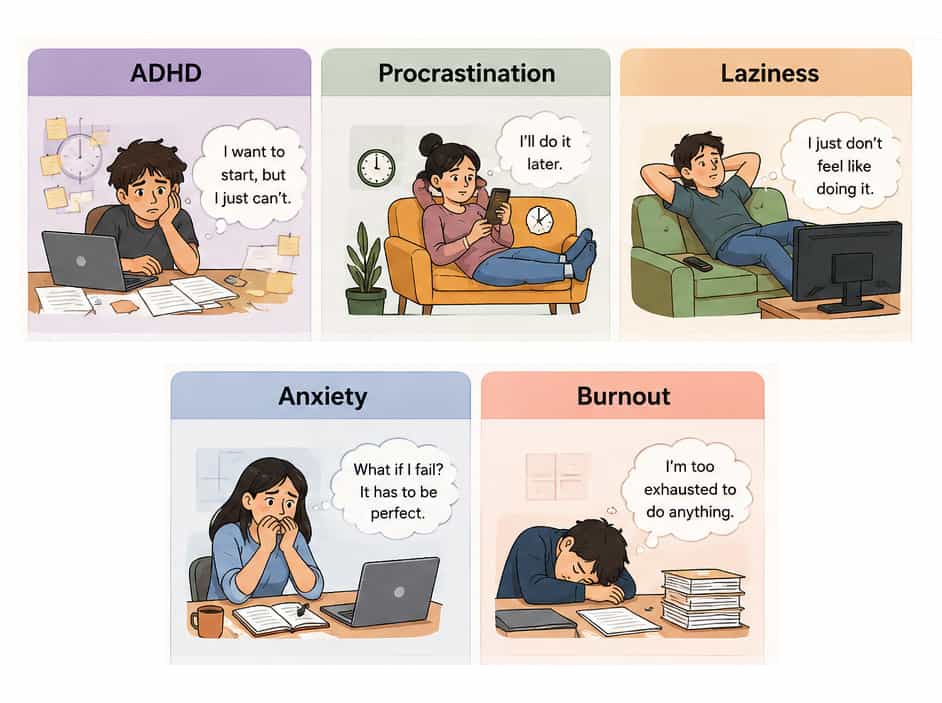
Because task initiation problems look identical from the outside, differential diagnosis is essential.
DIFFERENTIAL COMPARISON
- ADHD: Executive dysfunction affecting task initiation, attention regulation, and working memory.
- Ordinary Procrastination: Consciously delaying an unpleasant, low-priority, or tedious task.
- Anxiety: Task avoidance driven by fear of failure, perfectionism, or perceived threat.
- Burnout: Reduced functional capacity due to prolonged physical, mental, or emotional depletion.
- Sleep Deprivation: Temporary impairment of working memory, impulse control, and focus due to exhaustion.
Is ADHD Procrastination Just Laziness?
No. “Lazy” is a moral character judgment implying a conscious choice to avoid effort. ADHD is a neurodevelopmental condition involving functional differences in self-regulation.
However, not all procrastination stems from ADHD. Identifying the true cause requires looking at lifelong patterns, severity, duration, and pervasive impact across multiple settings.
How Is ADHD Diagnosed in Adults?
There is no single blood test, brain scan, or quick online checklist that can diagnose ADHD. A comprehensive evaluation by a qualified medical or mental health professional includes:
DIAGNOSTIC EVALUATION COMPONENTS
- ✓ Detailed Clinical Interview: Evaluating current symptoms and daily impacts.
- ✓ Childhood History: Verifying that symptoms were present prior to age 12, even if undiagnosed at the time.
- ✓ Multi-Setting Assessment: Assessing how difficulties manifest at work, home, and in social environments.
- ✓ Differential Screening: Ruling out or identifying co-occurring conditions like anxiety, depression, sleep disorders, or thyroid issues.
When to Seek an Evaluation
Consider scheduling a professional assessment if persistent issues with focus, time management, task initiation, memory, and organization significantly interfere with your career, academic standing, financial health, or personal relationships.
Practical Strategies to Help Adults With ADHD
The goal of ADHD management is to reduce the executive load required to start and complete tasks.
ACTIONABLE COPING STRATEGIES
- 1. Break Tasks Into Tiny Steps: Shrinking the first step (e.g., “pick up 3 shirts” instead of “do laundry”) reduces cognitive barrier-to-entry.
- 2. Externalize Working Memory: Use visual timers, digital alerts, whiteboards, and simple task lists instead of relying on memory.
- 3. Make Time Visible: Use visual analog clocks or countdown timers to ground abstract schedules into concrete realities.
- 4. Reduce Task Friction: Lay out clothes or keep study tools in a single open basket to decrease physical steps required to start.
- 5. Utilize Body Doubling: Work in the passive presence of another person to provide ambient structure and focus.
- 6. Pursue Comprehensive Support: Combine professional strategies like CBT, ADHD coaching, and medical management.
A Real-World Comparison: Two Student Approaches
Consider two students assigned a 1,500-word essay due on Friday:
Student A (Standard Executive Functioning)
 Monday     ► Outline assignment
 Tuesday    ► Gather references
 Wednesday  ► Draft text
 Thursday   ► Edit & revise
 Friday     ► Submit file

Student B (ADHD Task Initiation Challenges)
 Monday     ► Intends to start; feels overwhelmed by steps
 Tuesday    ► Tries to focus; struggles to choose an angle
 Wednesday  ► Opens file; loses focus to urgent distractions
 Thursday   ► Stress increases; guilt inhibits starting
 Friday AM  ► Approaching deadline triggers panic/urgency
 Friday PM  ► Hyperfocus kicks in; completes essay in one burst
Both students may possess identical knowledge and intellectual capability. The difference lies in executive control, task initiation, time perception, and response to pressure.
While Student B completed the task, relying on panic-fueled work cycles causes long-term strain and burnout.
FAQs
Can adults have ADHD without physical hyperactivity?
Yes. Adults with a Predominantly Inattentive Presentation struggle primarily with focus, working memory, task completion, and organization rather than visible physical restlessness.
Why can I hyperfocus on hobbies but struggle with work tasks?
Attention regulation in ADHD is strongly tied to immediate dopamine feedback, novelty, and interest. Boring or repetitive tasks do not naturally stimulate the brain’s attention networks, making task initiation difficult.
Is task paralysis an official medical symptom?
No. Task paralysis is an informal, highly descriptive phrase used to explain the cognitive freeze between wanting to start a task and taking physical action.
Can anxiety mimic ADHD symptoms?
Yes. Chronic anxiety can cause severe brain fog, restlessness, poor concentration, and avoidance. An evaluation helps differentiate between primary anxiety, primary ADHD, or co-occurring conditions.
Is Rejection Sensitive Dysphoria (RSD) a formal diagnosis?
No. RSD is a popular term coined in community discussions to describe strong emotional reactions to perceived rejection. While clinically relevant as an emotional experience, it is not an official DSM-5 diagnosis.
Final Takeaway
ADHD is far more than a simple inability to pay attention. For many adults, the most challenging aspect of the condition is the persistent gap between knowing what needs to be done and being able to execute the first step.
A task can be simple on paper, yet demand significant executive function, sequencing, working memory, and emotional regulation.
Understanding this mechanism allows us to shift away from an unhelpful question:
“Why can’t I just do it?”
And replace it with a productive, action-oriented approach:
“What specific friction is blocking this first step, and what external tool will make starting easier?”
That perspective shift does not cure ADHD or excuse personal responsibility, but it provides a clearer, practical, and science-backed path toward sustainable success.
Medical Disclaimer: The information provided in this article is for educational and informational purposes only and is not intended as medical advice, formal diagnosis, or treatment. ADHD shares overlapping symptoms with several other mental health conditions. Always consult a qualified healthcare professional or licensed clinician for individual medical evaluations and treatment plans.
Related Articles

Sponsored


You May Also Like

Why Introverts and Extroverts Think Differently: The Science…

Erik Erikson’s 8 Psychosocial Stages – See How We Grow Throu…

The Psychology Behind the Viral Punch Monkey Story

Why Our Closest Relations Misread Our Micro-Behaviors

Spatial Awareness as an IQ Metric: Why Cluelessness Signals …
