Cognitive Dissonance 101: Why We Justify Bad Habits When We Know Better
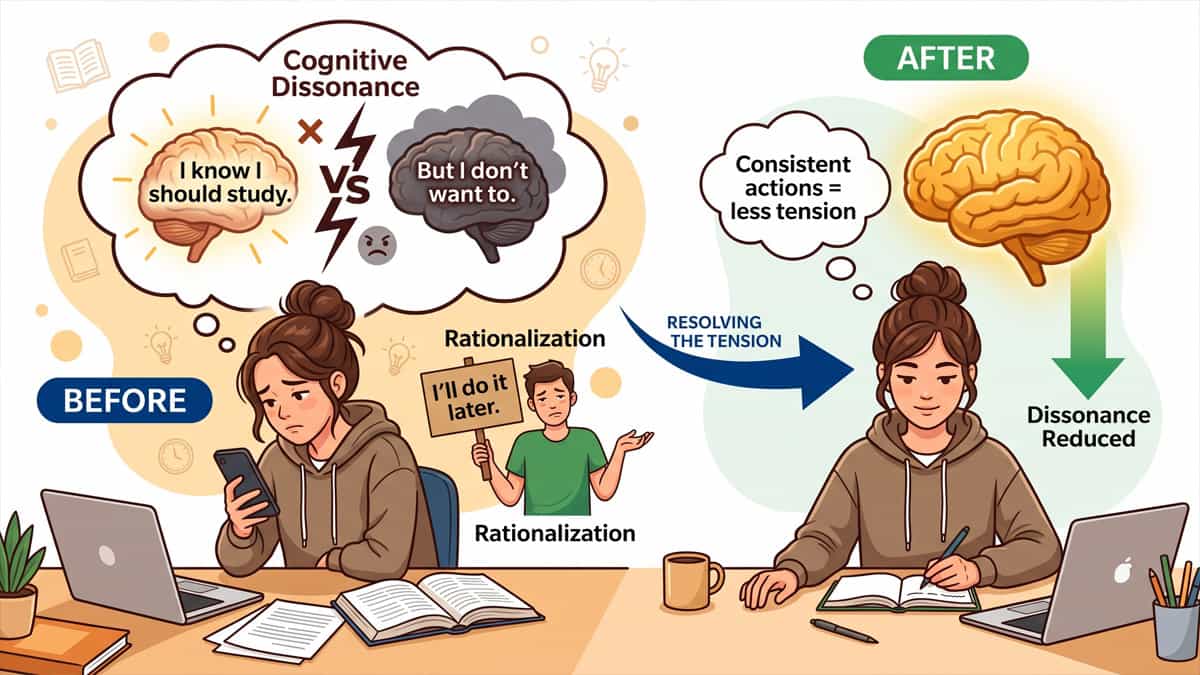
Cognitive dissonance theory illustration showing how students justify bad habits like procrastination through rationalization and how to achieve belief-behavior consistency

It’s 2:00 AM. You’re scrolling through social media—again. You know you have an 8:00 AM lecture tomorrow. You know you’ll be exhausted. You know you’ll regret this. And yet, your thumb keeps moving. The next morning, you drag yourself to class—or maybe you don’t. You tell yourself: “The professor just reads from the slides anyway.“ … Read more

Social Loafing: Why Group Projects Feel Unfair (and How to Fix Them)

College students showing unequal effort during a group project

The professor announces a group project, and a quiet dread instantly settles over the room. You know the drill: one person takes charge, two nod along, and one disappears entirely until the night before the deadline. When grades come back, everyone gets the same mark, even though the effort was completely unequal. This dynamic is … Read more

Why Humans Judge Profile Pictures Instantly

People forming instant impressions about a person's profile picture in less than one second.

The Neurological Split-Second Where People Judge Your Profile Picture The average person spends less than one second looking at a profile picture before deciding whether to trust, like, or ignore the person behind it. In that blink of an eye, your brain processes facial angles, eye contact, background context, lighting quality, and emotional expression — … Read more

The Psychology of “Authentic” Content and Reels

A person recording a video with a smartphone in a slightly messy but cozy living room, natural light, candid smile.

Why Perfect Content Is Losing Power For years, social media rewarded perfection. Flawless lighting, curated feeds, and meticulously edited reels earned likes, shares, and followers. But something has shifted. Audiences are tired of perfection. They are skeptical of influencers who never have a bad hair day. And they are increasingly drawn to content that feels … Read more

Why Low-Effort Text Creates High-Status Perception

Minimal social media profile with a short mysterious bio creating a high-status digital aura

Why Bios Matter More Than People Admit Your profile picture gets the first second. Your bio gets the next five. And in those five seconds, a stranger decides whether you are interesting, trustworthy, and worth following — or just another attention‑seeker. Most people overestimate the importance of listing achievements and underestimate the power of restraint. … Read more

The Biomechanics of “Owning the Room” without Speaking

A person standing calmly in a crowded nightclub, relaxed posture, open shoulders, slow scanning, standing out from the moving crowd around them.

Why Movement Gets Judged Before Words In a nightclub, conversation is nearly impossible. The music is too loud, the crowd is too dense, and the lighting is too low. In this high‑stimulus environment, your voice is irrelevant. Your movement does all the talking. The human brain is exquisitely tuned to read kinetic signals — posture, … Read more

What the Speed and Rhythm of Your Walk Signals to the Sidewalk

A person walking confidently down a city sidewalk, long smooth stride, relaxed arm swing, looking ahead, other pedestrians in the background.

Why Humans Judge Walking Patterns Instantly Before you are close enough to recognize a face, before your posture is fully visible, the way you walk has already been assessed. From fifty yards away, your gait—stride length, rhythm, arm swing, and pace—broadcasts a stream of data to every observer on the sidewalk. The brain processes this … Read more

The Halo of Cleanliness: How Subconscious Olfactory Cues Dictate Social Trust

A person in fresh, clean clothing standing confidently in a bright office or coffee shop, others nearby smiling and relaxed.

Why Clean Smells Create Trust Trust is not built through logic alone. It is built through thousands of tiny sensory cues — and few are as powerful as the smell of cleanliness. When you meet someone whose scent is fresh, soapy, or neutral, your brain releases a subconscious signal: “Safe. Hygienic. Reliable.” This happens in … Read more

The Synchronization Principle: How Mirroring and Body Language Outpace Physical Appearance

Two people sitting across from each other at a small table, leaning in with similar postures, smiling and engaged in conversation.

What Is Behavioral Mirroring? Behavioral mirroring is the unconscious tendency to copy the postures, gestures, facial expressions, and vocal patterns of the person you are interacting with. When two people are in sync, one leans forward and the other follows. One speaks softly and the other matches. One laughs and the other smiles. This synchronization … Read more