Cognitive Dissonance 101: Why We Justify Bad Habits When We Know Better
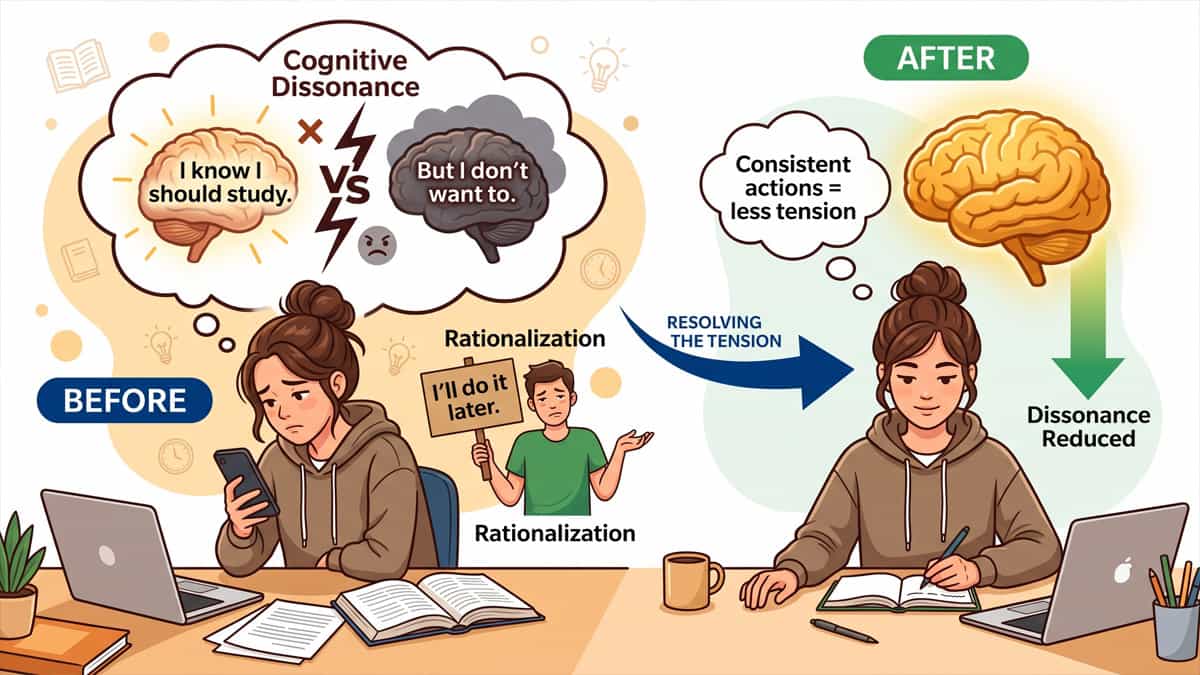
Cognitive dissonance theory illustration showing how students justify bad habits like procrastination through rationalization and how to achieve belief-behavior consistency

It’s 2:00 AM. You’re scrolling through social media—again. You know you have an 8:00 AM lecture tomorrow. You know you’ll be exhausted. You know you’ll regret this. And yet, your thumb keeps moving. The next morning, you drag yourself to class—or maybe you don’t. You tell yourself: “The professor just reads from the slides anyway.“ … Read more
Exam Pressure and Peak Performance: Understanding the Yerkes-Dodson Law

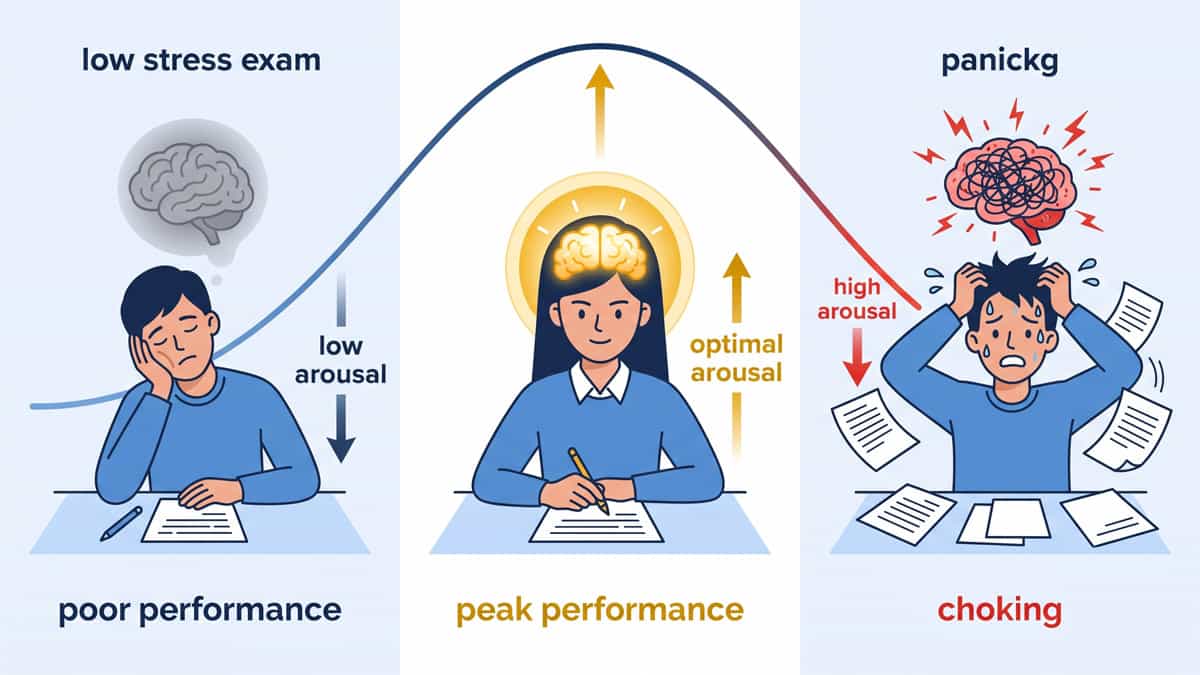
Yerkes-Dodson law illustration showing the inverted-U curve of exam pressure, optimal arousal theory, and how anxiety affects student performance and test scores

You walk into the exam hall. Your heart is pounding. Your palms are sweating. Your mind is racing with everything you studied—and everything you didn’t. The pressure is immense. This is it. Or consider the opposite scenario: you show up to class, the professor hands out the exam, and you feel… nothing. Zero anxiety. Zero … Read more

The Smartphone “Brain Drain”: Why Having Your Phone on the Desk Cuts Focus

Smartphone brain drain effect illustration showing how phone presence on desk reduces cognitive load and working memory capacity during lectures

You’re in a lecture. Your phone is face-down on the desk, screen dark, notifications silenced. You haven’t touched it in forty-five minutes. You’re not distracted. Or are you? Here’s the unsettling truth uncovered by cognitive psychology: your phone doesn’t need to ring, buzz, or light up to drain your mental bandwidth. Its mere presence on … Read more

Why Rereading Notes Fails: The Science of Retrieval Practice & The Testing Effect

A college student sitting at a modern university library desk surrounded by highlighted psychology textbooks, notebooks, and a laptop, looking thoughtfully confused while trying to recall studied material.

You highlighted three chapters. You reread the textbook twice. A week later, the exam asked one question, and your mind went blank. If this sounds familiar, you’re not alone—and it’s not your fault. The strategies most students rely on—rereading, highlighting, and cramming—feel productive. But cognitive science has been clear for over sixty years: rereading is … Read more

ADHD in Adults: Why Simple Tasks Can Feel So Difficult

An overwhelmed adult with ADHD sitting frozen at a cluttered desk, unable to start a simple task.

“I know what to do, but I can’t start.” For many adults with Attention-Deficit/Hyperactivity Disorder (ADHD), this is a frustratingly familiar experience. The task may look simple on paper: pay a bill, reply to an email, start a report, clean the room, read a chapter for class, or submit an assignment. You know what needs … Read more

Positive Synonyms: 101 Powerful Alternatives to “Good” That Will Sharpen and Elevate Your Prose

Positive synonyms with 101 powerful alternatives to good

Let’s face it: “good,” “great,” and “nice” are the plain toast of the English language. They fill the space, but they leave your readers completely uninspired. When you describe a meal as “good,” a performance as “great,” or a person as “nice,” you are robbing your audience of texture, emotion, and clarity. But here is … Read more

Negative Synonyms: 101 Powerful Alternatives to “Bad” That Sharpen Your Writing

Negative Synonyms: 101 powerful alternatives to bad

Let’s be honest: we all rely on a handful of lazy words. When we want to describe something unfavorable, our brain defaults to “bad,” “negative,“ or “awful.” But these words are like plain white rice—they fill the space, but they add absolutely no flavor. Whether you are drafting a scathing editorial, giving performance feedback, describing … Read more

Why Our Closest Relations Misread Our Micro-Behaviors

A family sitting at a dinner table, one person looking slightly tired or thoughtful, another family member looking concerned or suspicious, misinterpretation in the air.

Why Families Jump to Conclusions Faster A stranger on the street sees you lost in thought and thinks nothing of it. Your spouse sees the same distant expression and thinks: “They are angry with me.” Your mother sees it and thinks: “Something is wrong — are you sick?” This is hyper‑familiarity bias — the tendency … Read more

Why Scent Memories Outlast Visual First Impressions

A person holding a vintage perfume bottle, eyes closed, smiling as if remembering something deeply emotional and personal.

Why Smell Bypasses Rational Thinking Of the five senses, only one connects directly to the brain’s emotional core without a detour through the analytical filter. That sense is smell. When you see a face, that visual signal travels to the thalamus, then to the visual cortex for processing, and only later reaches the amygdala (emotion) … Read more

How Environmental Alertness Shifts Public Respect

Two pedestrians on a sidewalk — one walking with head down looking at phone, shoulders curved; another walking with head up, relaxed shoulders, scanning ahead.

Why Posture Changes Public Perception You have seen them everywhere: heads down, shoulders curved, eyes locked on a glowing screen. They drift across sidewalks, bump into slow walkers, and step into crosswalks without looking up. This is text neck — and it is destroying public respect. Posture is not just about spinal health. It is … Read more