
We’ve been sold a powerful myth: that success and discipline are the results of sheer willpower. We are told that to eat healthier, work smarter, or break bad habits, we simply need to “try harder.” Yet the evidence—and our lived experience—tells a different story.
The answer to lasting change isn’t a lack of character, but a misunderstanding of how self-control truly works. Relying on willpower alone is a recipe for failure; to win, you must become a thoughtful architect of your own environment.
What Willpower Actually Is (And Isn’t)
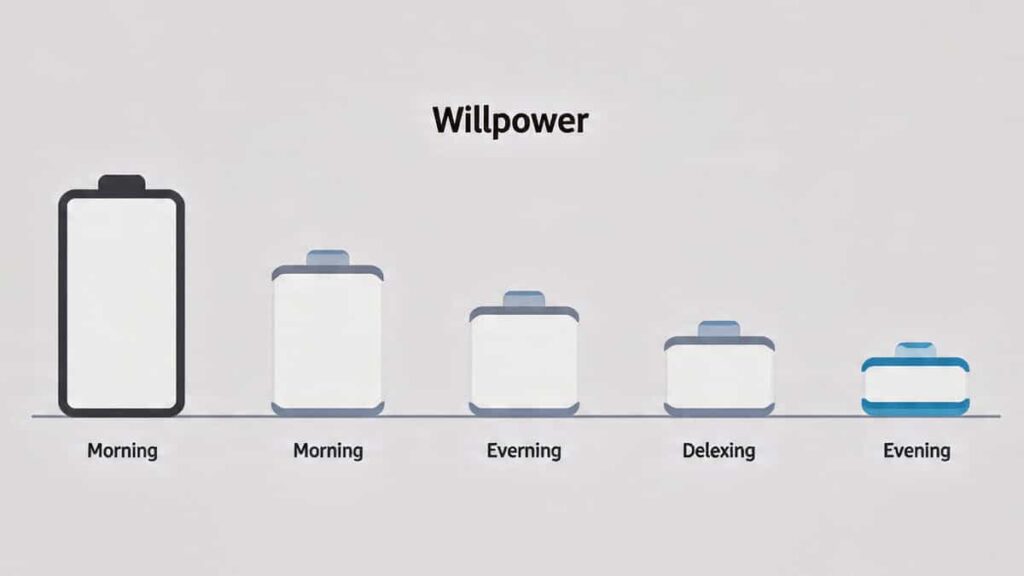
Willpower is better understood as mental energy for self-regulation. It’s the capacity to direct attention, suppress impulses, and make deliberate choices. However, this capacity fluctuates based on stress and cognitive load1.
Every choice you make, from what to wear to how to respond to an email, draws from the same finite pool. In psychology, this is known as decision fatigue. By the time evening arrives, your “self-control tank” is often empty. This is closely linked to how our attention and cognitive processes are managed throughout the day.
Environment Beats Motivation Every Time
Your surroundings exert a gravitational pull on your behavior. Motivation is a fleeting state; environment is a constant force. People who maintain healthy habits rarely do so through heroic self-denial. Instead, they shape their physical and digital spaces to make good choices easy and bad choices inconvenient.
This is the foundation of behavioral conditioning: adjusting the triggers in your environment to automate the desired response.
Habits vs. Identity: The Real Behavior Driver
Lasting change occurs not when you focus on what you do, but on who you believe you are.
- Effort-based: “I am trying to eat healthy.” (Requires constant willpower)
- Identity-based: “I am a healthy eater.” (Requires zero willpower)
When your actions align with your self-image, choices feel congruent rather than sacrificial. This internal alignment is often a reflection of your core personality traits.
Designing Systems That Make Failure Hard
High performers don’t rely on discipline; they automate their priorities. By creating a personal behavior framework, you can use your limited willpower to build systems that eventually run on autopilot.

The Hidden Cost of Constant Self-Control
Over-relying on willpower leads to burnout, rebound behavior, and a toxic cycle of guilt. It places the brain in a constant state of conflict, which can significantly impact the mind-body connection. Good design doesn’t demand willpower—it conserves it.
Stop trying harder. Start designing smarter. Self-control is about structuring your life so you encounter fewer temptations. For deeper insights into sustainable change, explore how behavior modification therapy uses these structured systems to create lasting habits.
Note: This article is for educational purposes only and does not constitute professional clinical advice.
Related Articles


Sponsored


You May Also Like

The Comfort Conundrum: Does Dressing Casual Casualize Your W…

The Seat Selection Algorithm: The Primal Psychology of Share…

You Are Not a Robot: A Deep Dive into Humanistic Psychology

How to Stop Procrastinating (Practical System That Works)

Genetic Factors in Depression: Unraveling the DNA of Your Mo…