We have all been there. You are trying to fall asleep, but your brain decides to replay an awkward conversation from three years ago. Or you receive one piece of constructive criticism, yet you cannot stop thinking about it for the rest of the day.
It often feels like your mind has a mind of its own. While positive thoughts float away like clouds, negative thoughts stick to us like velcro. But why is that? If thinking negatively makes us feel bad, why is it so difficult to simply stop?
The answer lies not in weakness, but in the very wiring of the human brain. Understanding this mechanism is the first step toward regaining your peace of mind.
KEY TAKEAWAYS
- Negative thoughts persist because of evolutionary survival wiring, not personal weakness.
- Brain pathways strengthen through repetition, making negative thinking a default habit.
- Suppressing negative thoughts actively keeps them front and center in your mind.
- Managing physical states like fatigue and stress restores executive mental control.
The Brain’s Built-in Alarm System (Negativity Bias)
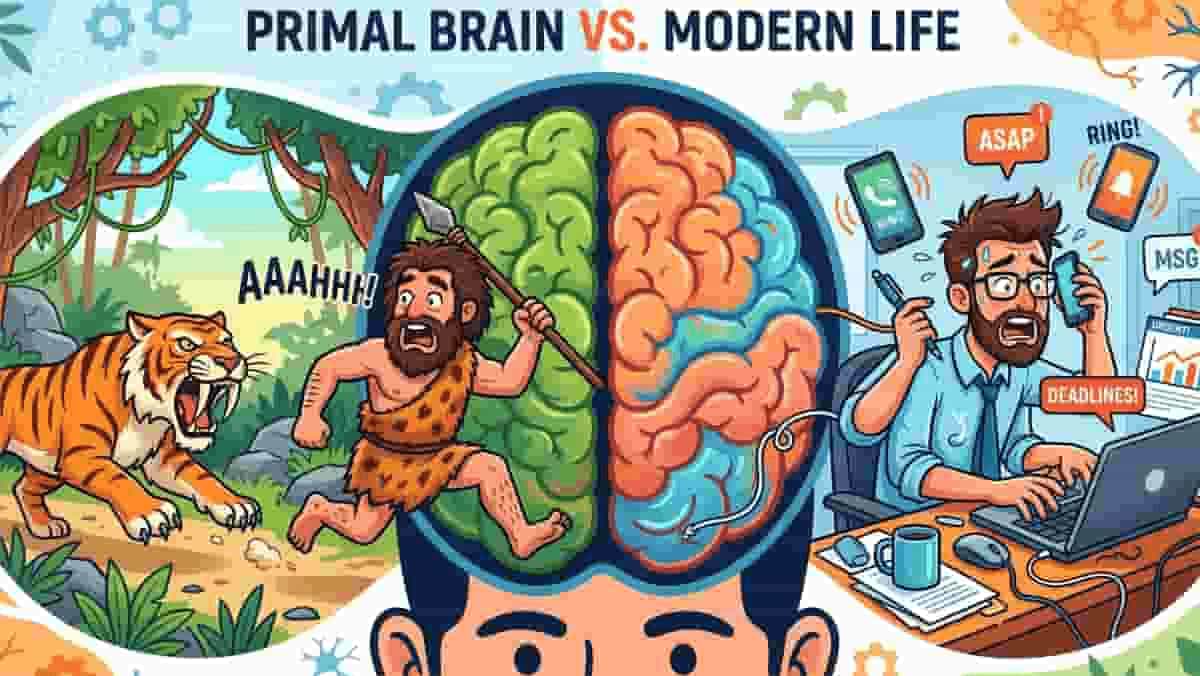
Thousands of years ago, our ancestors did not need to remember where the tasty berries were to survive; they needed to remember where the tiger was. As a result, the human brain evolved to pay more attention to threats than to rewards.
This is called the negativity bias. Psychologically speaking, a negative event has a much greater impact on our mental state than a positive one. You might get nine compliments on a presentation, but the one piece of mild criticism will be the only thing you remember at dinner.
Your brain is not trying to be mean. It is trying to protect you. It flags negative experiences as “high priority” files that must be reviewed repeatedly so you can avoid danger in the future. Unfortunately, in the modern world, this ancient alarm system triggers over spilled coffee or a misunderstood text message, keeping you stuck in a loop.
The Path of Least Resistance (Mental Habits)
Thinking is physical. Every time you have a specific thought, neurons (brain cells) fire together to form a pathway. The more you think a certain way, the stronger that pathway becomes.
Think of your mind as a grassy hill. The first time you have a negative thought, you walk a small path. By the thousandth time you worry or self-criticize, that path has become a deep, muddy trench. It is the path of least resistance. Your thoughts naturally slide into that groove because it is easier for the brain to travel a familiar road than to cut a new one through the grass.
This relates closely to how we build daily patterns. As explained in our guide on behavioral-psychology-conditioning-habits , our minds learn to repeat actions (and thoughts) that are familiar, even if they are not beneficial. You aren’t failing to control your thoughts; you are fighting against a well-worn neurological pathway.
The Emotion Trap (Why Feelings Anchor Thoughts)
Logic rarely beats emotion when it comes to memory. When you have a negative thought about failing at work or losing a relationship, you don’t just think the words—you feel the shame, fear, or sadness.
Emotions release chemicals in the brain that act like glue. They signal to your memory center, “This is important! Save this file!” The stronger the emotion, the stronger the memory.
You cannot simply “think” your way out of a negative loop because the emotion attached to the thought keeps dragging it back to the surface. This is also why understanding perception-vs-reality is so vital. Your brain treats your anxious perception of a future event as if it is a real threat happening right now, complete with the emotional weight to match.
The White Bear Problem (The Paradox of Suppression)
There is a famous psychological experiment where participants are told: “Whatever you do, do not think about a white bear.”
What happens immediately? They cannot stop thinking about the white bear.
Trying to suppress a negative thought is an act of attention. You have to constantly scan your mind to make sure the thought isn’t there, which ironically keeps the thought active. “I must not think about being anxious” forces your brain to keep the concept of “anxiety” front and center.
The harder you fight a negative thought, the stronger it fights back. Trying to push the thought away usually ends up with you wrestling with it in the mud.
GOOD
- ✓ Acknowledging and labeling the thought naturally
- ✓ Observing physical sensations without judgment
- ✓ Redirecting focus to practical, neutral tasks
BAD
- ✕ Actively trying to block or suppress the thought
- ✕ Repeatedly telling yourself ‘don’t think about it’
- ✕ Getting frustrated with yourself for having the thought
Environment and Energy (When Your Brain is Tired)
Have you noticed that negative thoughts are hardest to control at night or when you are exhausted, hungry, or stressed?
Willpower is a limited resource, similar to a muscle that gets tired. When your brain is already working hard to process daily life, it has less energy left for “executive control“—the part of your mind that hits the brakes on negative spirals.
If you are physically drained, your mental guard dog falls asleep, and the negative thoughts run wild. This is why looking at social media late at night or arguing while hungry almost always ends badly. Your environment and physical state directly dictate how hard it is to wrangle your inner critic.
How to Work With Your Brain, Not Against It
Since we know suppression backfires and negativity is a bias, what actually works?
ACTIONABLE STEPS
- ✓ Label the thought neutral instead of fighting it
- ✓ Apply the 90-second rule and allow physical sensations to pass
- ✓ Redirect focus toward neutral or positive activities
- ✓ Change your physical environment or reduce sensory input
Label the Thought: Instead of fighting it, say to yourself, “Ah, there is the alarm system telling me a story about failure.” Labeling creates distance. It changes you from the person in the storm to the person watching the storm from a window.
The 90-Second Rule: Neurochemicals that cause a feeling of negativity flood the body and dissolve naturally in about 90 seconds if you stop feeding them with more stories. Just sit with the physical sensation (tight chest, hot face) without adding the narrative (“This means my life is a disaster”). Let it pass.
Redirect, Don’t Suppress: You cannot stop a negative thought, but you can shift your focus to a neutral or positive task. Count the colors in the room, solve a math problem, or recall a specific small-positive-habits-vs-big-life-changes you did today. You are not denying the thought; you are simply choosing to look elsewhere.
Change the Input: You cannot think clearly in a fog of exhaustion. Go for a walk, drink water, or change your physical location. Your cognition is deeply tied to your body. Understanding your perception-psychology-how-brain-constructs-reality helps you realize that changing what your senses pick up (a quiet room vs. a loud phone) changes the reality your brain builds.
Negative thoughts are hard to control because they are a feature of the human species, not a bug. You cannot delete them, but you can learn to stop obeying them. By understanding the mechanics of the mind, you take the shame out of the struggle and put the power back into your hands.
FAQs
Why are negative thoughts stronger than positive thoughts?
The human brain evolved with a negativity bias to prioritize potential threats over rewards for survival purposes. Negative experiences leave a stronger chemical mark in memory, making them harder to ignore.
Why doesn't forcing myself to think positively work?
Suppressing negative thoughts triggers the paradoxical ‘White Bear Effect.’ Scanning your mind to avoid a thought requires active brain power, which keeps the unwanted thought center stage.
How long does an emotional response to a thought last?
The neurochemical wave of an emotion naturally dissolves in about 90 seconds if you refrain from adding new narrative stories to it.
Disclaimer: This content is for informational and educational purposes only and does not constitute professional psychological advice, coaching, or mental health services. The information provided is based on general psychological principles and is not a substitute for professional advice tailored to your specific situation. Always seek the advice of a qualified professional regarding any questions about your mental well-being or thought patterns.
Related Articles


Sponsored


You May Also Like

Online Projection: Instagram, Reels & Fake Perception

Is Adulthood Really a Stable Phase? A Developmental Psycholo…

How Football Trains the Brain for Split-Second Decisions: Th…

Compensatory Curation: Why Audiences Subconsciously Smell In…

You Are Not a Robot: A Deep Dive into Humanistic Psychology