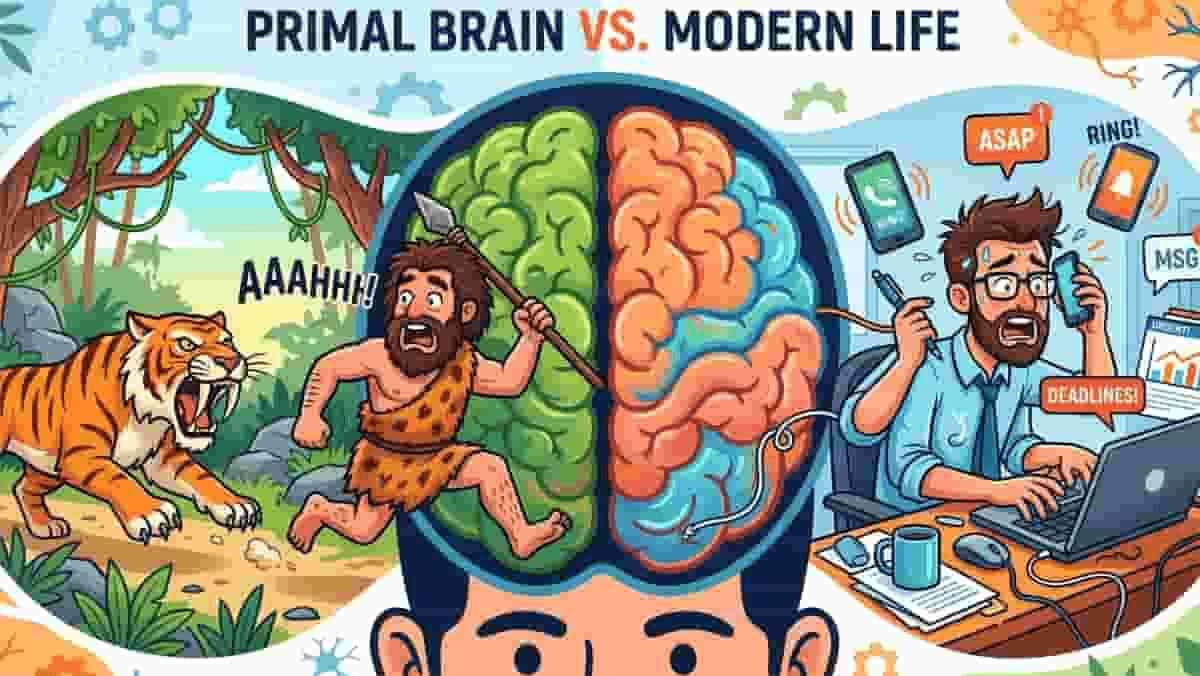
Living in a Modern World with a Primitive Brain
You’re sitting in a quiet room, safe from predators, with no immediate danger in sight. Yet, your heart is pounding, your palms are sweaty, and your mind is racing. The cause? An email from your boss, a notification on your phone, or the thought of standing up to speak in front of a group.
In these moments, you are experiencing a profound evolutionary paradox. You are a modern human living in the 21st century, but your brain is running software that was designed for a world that no longer exists. To understand why we often overreact to a stressful inbox or a tense conversation, we have to travel back in time to explore the origins of the human mind. This is the core of evolutionary psychology: ancient mind, modern life.
KEY TAKEAWAYS
- Our brains are optimized for ancestral survival on the savanna, not 21st-century psychological stress.
- The amygdala reacts instantly to perceived threats before the prefrontal cortex can rationalize them.
- Modern anxiety is often an ‘evolutionary mismatch’ rather than a personal failure or weakness.
- Neuroplasticity enables us to train our rational brain to better manage primitive stress responses.
The Evolutionary Roots of Human Survival Mechanisms
Our journey begins hundreds of thousands of years ago on the African savanna. For our ancestors, life was a high-stakes game of survival. The environment was filled with genuine, life-threatening dangers: large predators, hostile neighboring tribes, food scarcity, and treacherous terrain.
To navigate this dangerous world, evolution equipped us with a sophisticated set of mental and physical tools. The humans who were most sensitive to danger, who reacted fastest to a rustle in the grass, and who remembered vividly where a predator was last seen were the ones who lived long enough to pass on their genes. In essence, we are all descendants of the most vigilant, anxious, and reactive members of our species.
What Are “Ancient Threats”? Understanding Our Past Environment
When we speak of “ancient threats,” we are referring to the specific dangers that plagued our ancestors for millions of years. These were tangible, immediate, and physical:
- Predation: Being hunted by saber-toothed cats, lions, or snakes.
- Physical Conflict: Tribal warfare or attacks from rival groups.
- Exclusion: Being ostracized from the tribe, which in a survival context, was a death sentence. Without the group, an individual had no access to food, protection, or mates.
- Environmental Hazards: Facing starvation, dehydration, or injury from a fall.
These threats were simple but brutal. The brain’s response to them needed to be fast, automatic, and unconscious. Thinking too much about whether that shadow was a lion or just a bush was a quick way to become lunch. This highlights how the brain constructs reality based on survival priorities.
The Brain’s Alarm System: How the Amygdala Detects Danger
Deep within the center of your brain lies a small, almond-shaped cluster of nuclei called the amygdala. Think of the amygdala as your brain’s dedicated 24/7 smoke detector. Its primary job is not to reason, but to detect threats and sound the alarm.
The amygdala operates on a simple principle: speed over accuracy. It bypasses the rational, thinking parts of your brain to assess sensory information almost instantaneously. It asks a single question: “Is this a threat?” If the answer is even a potential “yes,” it initiates a full-body emergency response before your conscious mind has even registered what is happening. This is a key reason why the brain overthinks simple situations when it perceives even a minor threat.
Fight, Flight, or Freeze: The Automatic Survival Response
Once the amygdala sounds the alarm, it activates the autonomic nervous system, triggering the famous “fight, flight, or freeze” response. This is a cascade of physiological changes orchestrated by stress hormones like adrenaline and cortisol.
In a split second, your body prepares for physical action:
Heart rate and blood pressure skyrocket to pump oxygen to your muscles.
Breathing becomes rapid and shallow to increase oxygen intake.
Digestion shuts down (leading to that “butterflies in the stomach” feeling) to conserve energy.
Pupils dilate to take in more light and enhance vision.
Blood flow is redirected from the frontal lobes (the thinking center) to the limbs and brainstem.
This response is brilliant—if you need to outrun a predator. But what happens when the “predator” is a notification on your phone?
Why Our Brain Can’t Tell the Difference Between Real and Perceived Threats
This is the crux of the modern dilemma. The amygdala is an ancient structure; it doesn’t speak English, and it doesn’t understand the concept of a PowerPoint presentation, a stock market crash, or a passive-aggressive text message.
To the amygdala, a threat is a threat. It does not have the capacity to distinguish between a literal, physical danger (a lion) and a perceived, social, or psychological danger (a performance review). The neural pathways that fire when you are being chased by a wild animal are the exact same pathways that fire when you are criticized in a meeting. Understanding this perception vs. reality gap is vital for mental health.
PROS
- ✓ Physical threats (e.g., wild predators, falling rocks)
- ✓ Acute, short-lived activation of stress hormones
- ✓ Requires immediate physical effort (fight or flight)
- ✓ Ends with safety or resolution quickly
CONS AT A GLANCE
- ✕ Psychological threats (e.g., work emails, social media)
- ✕ Chronic, low-grade stress activation
- ✕ Physical action cannot resolve the situation
- ✕ Persists for days, weeks, or months
Modern Triggers, Ancient Reactions: Stress in Everyday Life
In our modern environment, the “tigers” we face are no longer four-legged; they are deadlines, traffic jams, financial pressures, and social media comparisons. These triggers are not life-threatening, but they are persistent.
Our ancestors would face a burst of stress to escape a predator, and then the stress would subside. Today, we face a constant, low-grade stream of stressors. Your alarm clock, the news, a stressful commute, a demanding boss, and the blue light from your screen all conspire to keep your stress response in a state of chronic, low-level activation. This is why anxiety can feel so intense for many people today.
The Role of Evolutionary Mismatch in Anxiety and Fear
Evolutionary mismatch occurs when an adaptation that was once beneficial becomes harmful in a new environment. Our sensitive threat-detection system was a life-saving adaptation on the savanna. Today, in our safe, complex, and high-stimulation world, that same system often misfires.
We are not anxious because we are weak. We are anxious because our brains are doing exactly what they evolved to do. The problem is the context. We are over-prepared for physical dangers that rarely materialize and under-equipped for the chronic, psychological stressors that define modern life. This mismatch explains why growing up feels harder today.
Why We Overreact: Negativity Bias and Survival Advantage
Have you ever noticed that a single piece of criticism sticks with you far longer than ten compliments? That is your negativity bias at work.
From a survival standpoint, it was far more important for our ancestors to remember the location of a predator (a negative event) than the location of a beautiful flower (a positive event). The brain is hardwired to give more weight to negative experiences because, for most of human history, overlooking a threat could be fatal. This negativity bias ensures that we are constantly scanning for what’s wrong, making us prone to overreact and assume the worst-case scenario.
Examples: Public Speaking, Social Rejection, and Fear Responses
These ancient mechanisms play out in our daily lives in ways that can feel confusing or embarrassing.
Consider public speaking, which is often cited as a greater fear than death. To your primitive brain, stepping in front of a silent, staring audience is not a business presentation; it feels like being judged by the tribe. In our ancestral past, being the center of attention and being judged could lead to exclusion, which meant death. This is often why adults struggle with confidence in social settings.
Social rejection is another powerful trigger. Being left out of a group chat or unfriended online can trigger genuine physical pain. This is because, evolutionarily, social bonds were essential for survival.
When Survival Instincts Become Maladaptive
While these instincts are natural, they can become maladaptive when they are triggered too easily or too intensely. A person might develop a panic attack in a crowded elevator (a perceived threat of entrapment) or suffer from debilitating social anxiety (a hypersensitive fear of exclusion).
When the brain’s alarm system becomes overactive, it can lead to chronic anxiety disorders, phobias, and post-traumatic stress. This is why mental health challenges can develop over time when survival instincts are constantly triggered.
How the Rational Brain (Prefrontal Cortex) Tries to Take Control
Fortunately, we are not entirely at the mercy of our amygdala. Located just behind your forehead is the prefrontal cortex (PFC)—the “rational brain.” This is the most recently evolved part of the brain, responsible for logic, planning, impulse control, and reasoning.
When the PFC is active, it can act as a calming force, sending inhibitory signals to the amygdala. It can say, “That’s not a lion; it’s a bush,” or “This public speaking event is not a life-or-death situation.” However, there’s a catch: during a high-stress response, the amygdala temporarily impairs the function of the prefrontal cortex. This is why we do things we regret later.
Can We Rewire Our Responses? Neuroplasticity and Behavior Change
The good news is that the brain is not fixed. Thanks to a concept called neuroplasticity, we can intentionally reshape our neural pathways. The more we practice a new response, the stronger the neural connections for that response become.
This means that while we cannot remove our ancient survival wiring, we can build stronger “on-ramps” to the rational brain. This is the foundation of behavior modification therapy for lasting change.
Practical Strategies to Manage Primitive Fear Responses
Understanding the evolutionary basis of your stress is the first step. The second step is applying practical strategies to manage it:
ACTIONABLE COPING STRATEG
- ✓ Labeling (Name It to Tame It): Acknowledge your emotional state aloud or mentally to activate the prefrontal cortex.
- ✓ Deep, Slow Breathing: Use box breathing or prolonged exhales to engage the parasympathetic nervous system.
- ✓ The 10-Second Rule: Pause before responding to stressors to allow the rational brain to process the trigger.
- ✓ Mindfulness Meditation: Train the prefrontal cortex to observe thoughts without initiating fear responses.
Balancing Ancient Instincts with Modern Awareness
We live in a world of technology and abstract responsibilities, but we do so with a mind shaped by the wild. The fear, anxiety, and stress you feel are not signs of weakness; they are echoes of a past that kept your ancestors alive.
The goal is not to eliminate these ancient instincts, but to cultivate awareness. By understanding your brain, you can choose a response aligned with your modern goals, proving that small positive habits lead to big life changes.
FAQs
What is evolutionary mismatch in psychology?
Evolutionary mismatch occurs when an evolved trait or behavior that benefited survival in an ancient environment becomes unhelpful or maladaptive in a modern environment.
Why does an email from my boss trigger my stress response?
The amygdala cannot distinguish between physical survival threats and social or financial threats. It interprets potential social or professional threats as threats to your safety and tribal acceptance.
Can you completely eliminate the fight-or-flight response?
No, and you wouldn’t want to. It is an essential life-saving mechanism. However, through neuroplasticity and mindfulness, you can change how easily it gets triggered and how quickly you recover.
Related Articles


Sponsored


You May Also Like

What Your Aesthetic Consistency Says About Your Mental Archi…

Emotional Contagion: How Your Reaction to Workplace Crisis C…

Social Loafing: Why Group Projects Feel Unfair (and How to F…

What the Speed and Rhythm of Your Walk Signals to the Sidewa…

Why Backrooms Feel Real Even Though They Aren’t