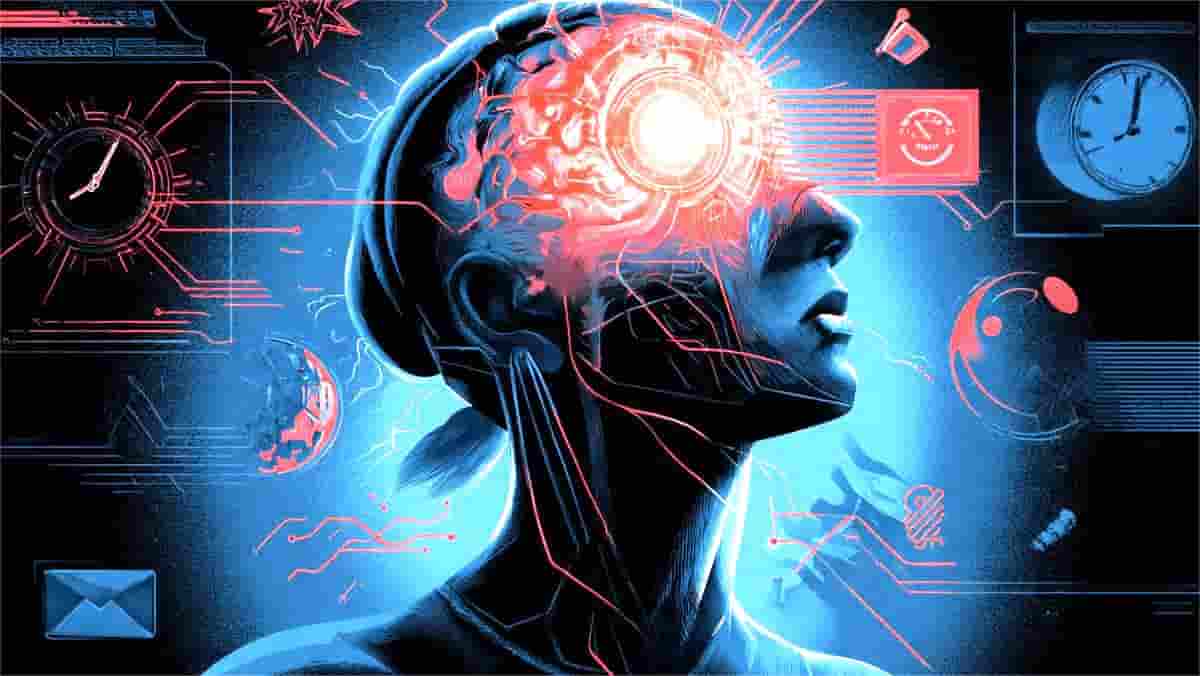
While observing how people describe anxiety, one pattern keeps repeating. They don’t just say they feel worried—they say it feels overpowering, consuming, and difficult to control. Even small uncertainties trigger intense physical and mental reactions.
This raises an essential psychological question: why does anxiety feel so much bigger than the situation itself? Understanding this begins with how the brain interprets threat and uncertainty.
When Worry Becomes Overwhelming
We all worry from time to time. A job interview, a health scare, or a difficult conversation can naturally trigger concern. But for many people, anxiety crosses a threshold where it no longer matches the situation. A text left on read sparks panic. A minor deadline feels life-threatening. The body responds as if survival is at stake—even when the mind knows it isn’t.
This gap between perceived threat and actual danger lies at the heart of why anxiety feels so overwhelming. It is not a character flaw or a lack of mental toughness; it is the brain doing exactly what it evolved to do—but in contexts where that wiring works against us.
How the Brain Interprets Uncertainty
The brain’s priority is survival, not happiness. To keep us alive, it maintains a constant threat-detection system. The amygdala, our emotional alarm center, scans for anything unfamiliar, unpredictable, or potentially dangerous. When it detects ambiguity, it errs on the side of caution—activating the fight-or-flight response even when the threat is only imagined.
Uncertainty feels dangerous because, evolutionarily, it often was. A rustle in the grass could mean a predator. Today, that same system activates when we face an unclear email, an uncertain future, or social ambiguity. The alarm rings just as loudly, even though the stakes are completely different.
The Body’s Role: The Anxiety Sensitivity Loop
Anxiety isn’t just in the head—it lives in the body. Racing heart, tight chest, shallow breathing, trembling hands. These physical symptoms are the body preparing for action: blood diverts to muscles, digestion slows, and senses sharpen.
What makes anxiety spiral is a phenomenon known as Anxiety Sensitivity. This is when the body’s symptoms become perceived as additional threats. A racing heart is misinterpreted as a heart attack; shortness of breath feels like suffocation. The mind notices these changes and concludes, “Something must be seriously wrong,” which triggers more adrenaline. This feedback loop traps the individual in physical discomfort that reinforces psychological fear.
Overthinking and Mental Loops
When the body is activated, the mind follows suit. Anxiety fuels catastrophic thinking—the tendency to imagine the worst possible outcome. A single worried thought multiplies: “What if I mess up? What if they judge me? What if I lose everything?“
These “what if” spirals are hard to interrupt because anxiety hijacks attention. Logic tries to intervene: “This probably won’t happen.” But the anxious brain responds, “But it could.” Because uncertainty feels unsafe, the mind keeps turning the problem over, searching for a level of certainty that simply doesn’t exist.
You May Also Like
Recovered vs False Memory in Amnesia
Emotional Memory and Neural Pathways
Anxiety doesn’t start from scratch each time. It builds on emotional memory and established neural pathways. If you have been embarrassed publicly before, your brain “hard-wires” similar situations as high-risk. If you have experienced rejection, your system stays alert for even the slightest sign of abandonment.
This is why certain triggers feel disproportionately strong. The brain isn’t just reacting to the present moment—it’s drawing on a database of past hurts, warning you not to get hurt again. The problem is that the brain generalizes. A slight shift in someone’s tone can feel like the beginning of a major rejection, even when the person is simply tired.
Trending
Emotional Devastation Psychology
The Illusion of Losing Control
One of the most distressing parts of anxiety is the feeling that it is happening to you, not by you. Thoughts race without permission. The body reacts without warning. It feels like being a passenger in a car with no steering wheel.
This illusion of losing control feeds the fear. When we believe we cannot manage our own minds, we feel helpless. However, the psychological truth is that anxiety is not a breakdown—it is a misfiring protection system. It is not that control is gone; it is that the alarm system has temporarily overpowered the control room.
Why Modern Life Intensifies the Alarm
Our brains did not evolve for the world we live in now. We carry threat-detection systems designed for small, stable tribes into a world of constant information and performance pressure. According to the World Health Organization, global anxiety prevalence increased by a staggering 25% in recent years, largely due to the unprecedented uncertainty of global events.
Modern Anxiety Triggers
- Constant Information Exposure: News cycles keep the threat system chronically activated.
- Social Comparison: Triggers fears of inadequacy—a perceived social threat to our status in the tribe.
- Digital Ambiguity: Text communications lack non-verbal context, forcing the amygdala to scan endlessly for hidden danger.
You May Also Like
Screen Authority Bias: Digital Trust
Immediate Strategy: Grounding the System
While understanding the “why” is vital, interrupting the “how” requires action. When the alarm system is screaming, logic often fails. Instead, use a Sensory Grounding Technique (5-4-3-2-1) to signal to your brain that you are safe in the present moment:
5-4-3-2-1 GROUNDING TECHNIQUE
- ✓ Acknowledge 5 things you can see around you.
- ✓ Acknowledge 4 things you can touch or feel.
- ✓ Acknowledge 3 things you can hear in your environment.
- ✓ Acknowledge 2 things you can smell.
- ✓ Acknowledge 1 thing you can taste.
This shifts the brain’s focus from the internal “threat loop” back to the external, safe environment.
Anxiety Has a Pattern
Anxiety feels overwhelming because it engages the entire system: brain, body, memory, and attention. It is not one thing going wrong—it is multiple layers activating at once.
But here is the hope: anxiety follows psychological rules. It has triggers, patterns, and pathways. What follows rules can be understood, and what is understood becomes less frightening. Clarity reduces intensity. You start to see: “This is the uncertainty response. This is the body loop.” In that recognition, you regain your role as the driver, and the anxiety becomes just a passenger.
FAQs
Why does anxiety cause physical symptoms like a racing heart?
Physical symptoms are driven by the brain’s threat-detection system (the amygdala) triggering a fight-or-flight response. Adrenaline is released, blood is diverted to muscles, and your heart accelerates to prepare your body to act against a perceived threat.
What is Anxiety Sensitivity?
Anxiety Sensitivity is a feedback loop where an individual misinterprets physical symptoms of anxiety (such as tightness in the chest or dizziness) as life-threatening emergencies, which causes further panic and worsens the symptoms.
How can I stop anxiety spirals when they start?
Sensory techniques like the 5-4-3-2-1 grounding exercise help interrupt anxiety loops. By focusing actively on external sensory inputs (things you see, touch, hear, smell, and taste), you redirect cognitive focus away from internal threats.
For a comprehensive overview of anxiety disorders and their treatment, visit: Anxiety Disorders: Types, Symptoms, Treatment
Related Articles


Sponsored


You May Also Like

The Thin-Slicing Effect: How the Brain Decides Romantic Viab…

Why Do I Overthink Everything? (And How to Finally Calm Your…

Psychology Quotes – Words That Understand the Mind

How Different Scent Profiles Secretly Signal Your Personalit…

The Hidden Spatial Negotiations of Passing Strangers