The psychology of liminal spaces, empty rooms, and the mind’s urge to fill the void
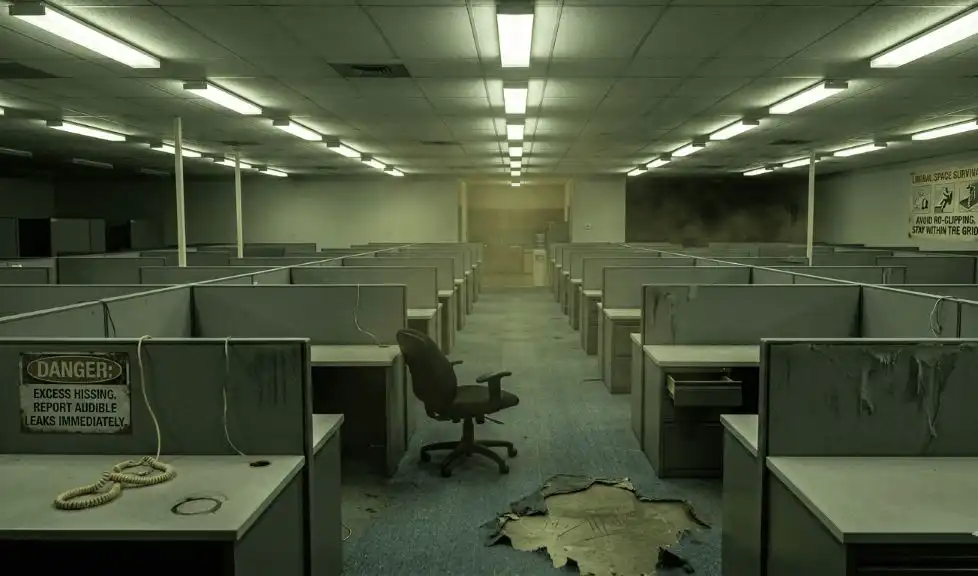
Backrooms images—endless yellow corridors, vacant office spaces, damp carpeted rooms with no exit—have carved out a unique corner of the internet. To some, they’re just oddly lit rooms; to many others, they provoke a deep, wordless creepiness. There’s no monster in the frame, no overt threat, yet the unease settles in immediately.
This feeling isn’t a glitch. It’s the brain doing its job, detecting a fundamental wrongness in the environment and sounding a quiet but persistent alarm.
What Makes Backrooms Images Feel So Strange
A backrooms image typically shows a place that is recognizable but off. The architecture is mundane—office partitions, fluorescent lights, beige walls—but everything is slightly worn, empty, and endless.
The brain’s scene-recognition system fires its “indoor space” template, but then hits a wall: where are the people, the exits, the signs of purpose? This mismatch between the “what” and the “how it should be” creates a prediction error. The mind expects a contextually complete space, but receives a hollow shell, and that gap is where the creepy feeling lives.
Why Empty Spaces Create Unease
Humans are profoundly social creatures, and the built environment is almost always designed with human presence in mind. An empty room is only ever temporarily empty—at least that’s what the brain expects. When a space suggests that no one has ever been there, or that everyone has suddenly vanished, the brain’s threat-detection systems activate. Emptiness can signal abandonment, neglect, or a hidden danger that drove others away. The unease isn’t about the space itself; it’s about the story the brain tries to complete.
You May Also Like
First Impression Psychology: How rapidly the mind forms emotional judgments based on even a single glance at an environment.
How Silence and Isolation Affect the Brain
Backrooms images are static, but the mind doesn’t process them as purely visual. The scene implies a complete sensory environment: a profound, unnatural silence and a sense of isolation. The brain simulates what it would be like to be there, and the simulation returns an eerie absence of sound, footstep echoes, and the muffled hum of distant activity.
This imagined sensory deprivation triggers a low-level alarm because isolation has historically been a risk factor for survival. The body may even respond physically—a slight tightening of the chest, a raised heartbeat—simply because the brain has unconsciously placed you inside the scene.
Why Familiar Places Can Still Feel Uncomfortable
The horror of the Backrooms is that they look nothing like a traditional dungeon. They look like a forgotten office, a cheap hotel, a 1990s shopping mall corridor. This familiarity makes the wrongness sharper. The brain walks through scenes of everyday life and builds strong predictive models of what those scenes should contain. When an image of a familiar space strips away the expected elements—people, exits, purposeful objects—the prediction error is far larger than it would be for a truly alien landscape.
The uncanny feeling is the brain’s signal that it cannot match the current visual stream to any safe, normal scenario.
Why Yellow Lighting Feels Unsettling to Some People
The distinctive yellow-green tint of many backrooms images isn’t an aesthetic accident; it’s a specific choice that taps into a shared cultural memory of institutional fatigue. Fluorescent lighting in windowless rooms is associated with places that are liminal in real life—hospital waiting areas, government offices, school hallways late at night. That light spectrum also differs from natural daylight, lacking the warm or cool cues that help the brain calibrate time of day.
The result is a sense of temporal dislocation: there’s no hint of morning or evening, only a perpetual, stale afternoon. The brain registers this as another violation of the normal rhythm, deepening the unease.
How Imagination Makes the Feeling Stronger
The Backrooms are compelling because they are incomplete. A photograph of an empty room becomes creepy precisely because it invites the viewer to imagine what might be around the next corner. The brain’s natural negativity bias means that, in the absence of information, it tends to default toward worst-case possibilities—not because there’s any evidence of danger, but because assuming safety could be costlier than assuming threat.
This is the same reason a dark doorway in an otherwise safe room makes the heart beat faster. The mind fills the silence and the emptiness with its own carefully rehearsed, survival-oriented fears.
Why Limbo-Like Spaces Feel Wrong
Psychologists and online communities often refer to backrooms-style images as “liminal spaces”—transitional zones like hallways, waiting rooms, and stairwells that are meant to be passed through, not lived in. The brain categorizes these spaces as temporary. When a liminal space is presented as vast, unending, and inescapable, it violates the core expectation that there is an exit.
This creates a sensation of being trapped in a place that doesn’t have the features of a destination. The wrongness is cellular: the architecture promises movement, but the scale denies it.
Why Online Images Trigger Strong Reactions
The internet has turned backrooms imagery into a shared language of unease. Viewing these images on a screen creates a strange double-layer: you are safe at home, yet your brain is partially immersed in an unsettling fictional environment.
This safe-but-not-safe paradox can intensify the creepiness because the amygdala can react to visual stimuli without the prefrontal cortex fully counter-tagging it as harmless. Additionally, the collective commentary around these images builds expectation; knowing that others find them creepy can prime your own brain to search harder for something wrong, amplifying the response.
Why Some People Enjoy the Feeling of Creepy Spaces
UPSIDES
- ✓ Controlled Dose of Fear: Provides a safe way to explore the brain’s internal alarm circuits without encountering actual risk.
- ✓ Benign Threat Satisfaction: The cognitive cocktail of psychological arousal followed immediately by baseline relief can feel highly pleasurable to certain personality types.
- ✓ Aesthetic & Curiosity: Feeds a deeper artistic fascination with isolation, structural decay, and the quiet passage of time.
DOWNSIDES
- ✕ Subconscious Physical Reaction: Can trigger instinctual physical anxiety, such as sudden chest tightness or a elevated heartbeat.
- ✕ Amplify Existential Dread: For some, the total subversion of safe everyday environments highlights feelings of abandonment and loneliness.
FINAL THOUGHTS
- Backrooms images feel creepy because they systematically exploit our brain’s core survival habits: environmental prediction, scanning for social presence, and filling sensory voids.
- An empty, yellow-lit space doesn’t need an explicit monster to terrify—it only needs to display enough contextual ‘wrongness’ to continuously trip the mind’s safety checkpoints.
- While dissecting the psychology behind the phenomenon won’t make liminal spaces feel less eerie, it beautifully illustrates how ancient survival machinery handles modern digital symbolism.
Related Articles


Sponsored


You May Also Like

How the Brain Misjudges Height and Distance

Generativity vs. Stagnation (Erikson’s Seventh Stage of Psyc…

Why Humans Are Naturally Afraid of Certain Things: The Psych…
Why Social and Cognitive Factors Influence Criminal Behavior

What Your Perfume Says About You (Psychology & Perceptio…