
The Silent Rules of Sidewalk Navigation
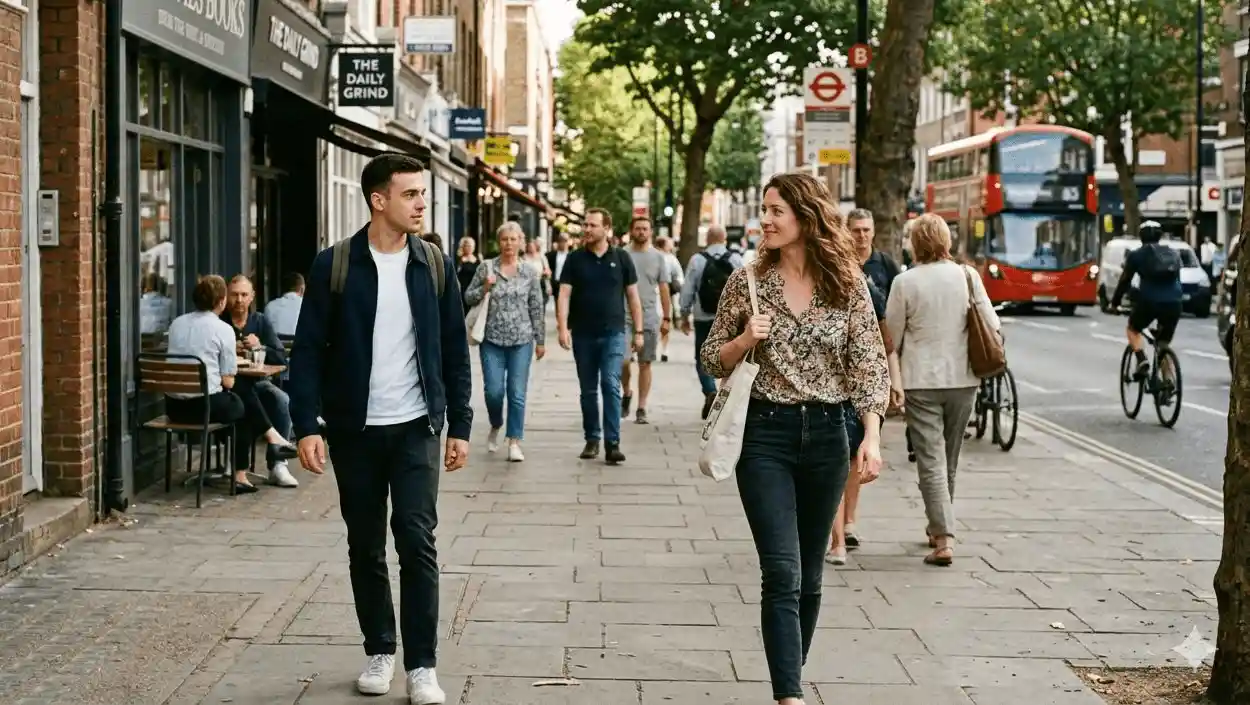
Every day, millions of pedestrians perform an invisible dance. On crowded sidewalks, strangers approach each other from opposite directions, and without a single word, they decide who moves left, who moves right, and who yields. This negotiation happens in milliseconds, guided by subtle body shifts, eye movements, and shoulder dips.
This is sidewalk proxemics — the study of how people use and perceive space during pedestrian movement. The rules are unwritten, but violations are immediately felt. A person who fails to signal their trajectory creates awkward collisions, annoyed glances, and the familiar “sidewalk shuffle.”
Understanding these hidden negotiations makes you a smoother, more respected pedestrian — and signals high social intelligence to everyone around you.
Why Humans Predict Walking Trajectories
The human brain is a prediction machine. When you see a person walking toward you, your visual system automatically extrapolates their path and your potential collision point. This happens unconsciously, guided by the direction of their gaze, the angle of their shoulders, and the speed of their approach.
Successful navigation depends on mutual predictability. If both walkers signal their intentions clearly, they pass without friction. If one or both are ambiguous, the dance begins — hesitation, mirroring, awkward correction.
The brain’s prediction system is so sensitive that a glance to the left is enough to signal “I am moving left.” A slight shoulder turn signals direction change before the feet follow.
| Cue | Meaning | Response |
|---|---|---|
| Direct eye contact + slight shoulder dip | “I am yielding to you” | Continue straight, they will adjust |
| No eye contact, fixed gaze ahead | “I am not yielding” | You will likely need to move |
| Glance to the left while walking | “I am moving left” | You move right |
| Sudden head turn (phone, shop window) | “My path is now unpredictable” | Increase alertness, prepare to dodge |
| Slowing pace | “I am letting you pass first” | Maintain speed or also slow |
The Psychology of Yielding Space
Yielding — giving the right‑of‑way to another pedestrian — is a subtle status negotiation. In most sidewalk encounters, the person who moves first or moves more is perceived as the yielder. The person who holds their line is perceived as the holder.
Neither is inherently superior. Holders may be confident or arrogant. Yielders may be polite or submissive. The social meaning depends entirely on context.
In crowded urban settings, mutual yielding is the norm: both parties shift slightly, sharing the responsibility. In less dense settings, the higher‑status person (by dress, demeanor, or group size) often holds their line, expecting others to move. Observers notice this and adjust their own behavior accordingly.
A socially intelligent pedestrian knows when to balance the dynamics of the street grid seamlessly:
UPSIDES
- ✓ You are walking with clear purpose and speed
- ✓ You are on the correct side of the sidewalk
- ✓ The other person is clearly distracted (phone, looking away)
DOWNSIDES
- ✕ You are walking slower than the crowd
- ✕ You are in a tourist or unfamiliar area
- ✕ The other person is elderly, carrying heavy items, or with children
Shoulder Dips and Direction Signaling
The most precise non‑verbal signal for sidewalk navigation is the shoulder dip — a slight rotation of the upper body indicating which direction you intend to move.
A shoulder dip toward the left signals: “I am going to pass you on my left (your right).” The other pedestrian, if aware, will dip their shoulder toward their right (your left), and you slip past without contact.
This signal is often unconscious in skilled navigators. Clumsy pedestrians do not dip their shoulders at all, relying on last‑second lunges that create friction.
PRO NAVIGATION TIPS
- Look ahead, not at your feet
- Identify potential collision points 10–15 feet away
- Slightly dip your shoulder toward your intended passing side
- Make brief eye contact to confirm mutual awareness
These small adjustments turn the sidewalk shuffle into a smooth, almost invisible negotiation.
You May Also Like
Discover why people behave differently in groups — pedestrian flow is a collective behavior
Social Friction During Crowded Movement
Social friction is the subtle irritation caused by minor spatial violations — someone brushing your shoulder, cutting too close, or stopping suddenly in front of you. In dense pedestrian environments, social friction accumulates, raising cortisol levels and lowering mood.
The sidewalk is a shared resource. Smooth movement requires every pedestrian to follow the same implicit rules:
IMPLICIT SIDEWALK LAWS
- ✓ Walk on the same side of the sidewalk (right in most countries)
- ✓ Do not stop suddenly without pulling to the side
- ✓ Do not walk three abreast in a single‑file space
- ✓ Look up from your phone every few seconds
People who violate these rules are not just annoying. They are perceived as selfish or oblivious. Their spatial violations are read as character signals.
Why Awkward Sidewalk Dances Happen
The “sidewalk dance” — two people stepping left, then right, then left again, unable to pass — happens when both pedestrians try to yield simultaneously. Each mirrors the other’s correction, creating a frustrating loop.
The dance is caused by:
ROOT CAUSES
- Delayed signaling — Neither person committed to a direction early enough
- Over‑politeness — Both trying to yield, creating mutual hesitation
- No eye contact — Without visual confirmation, each guesses wrong
The solution is simple: choose a side quickly and commit. Even if you guess wrong, committing breaks the loop. The other person will adjust. A brief smile acknowledges the awkwardness and restores goodwill.
Spatial Awareness and Public Smoothness
Spatial awareness — the ability to perceive your position relative to others and predict movement — is a form of public intelligence. People with high spatial awareness navigate crowds effortlessly. People with low awareness create friction everywhere they go.
Indicators of spatial awareness:
HIGH SPATIAL AWARENESS
- ✓ Looking ahead, not just at the immediate path
- ✓ Anticipating slow walkers, door blockers, and phone zombies
- ✓ Adjusting pace smoothly, not abruptly
- ✓ Never stopping in a choke point (doorways, narrow sections)
Observers notice spatial awareness. A person who moves fluidly through a crowd is perceived as competent, confident, and socially intelligent. The opposite is also true.
Final Thoughts
Sidewalk proxemics is a silent language spoken by every pedestrian, every day. You may not know the grammar, but others are judging your fluency.
Dip your shoulder. Look ahead. Choose a side and commit. Yield when appropriate, hold when purposeful.
Smooth movement is not just about avoiding collisions. It is about signaling to the world that you respect shared space — and that you are competent enough to navigate it without friction.
Related Articles


Sponsored


You May Also Like

Recovered vs False Memory in Amnesia: The Shocking Truth Abo…

Initiative vs. Guilt (Erikson’s Third Stage of Psychosocial …

The Trust Spectrum: How Blue and Earth Tones Lower Social De…

Signs Low Self-Confidence Is Holding You Back

Why Deep Water Photos Trigger Anxiety for Some People
