Why Humans Need Both Privacy and Connection
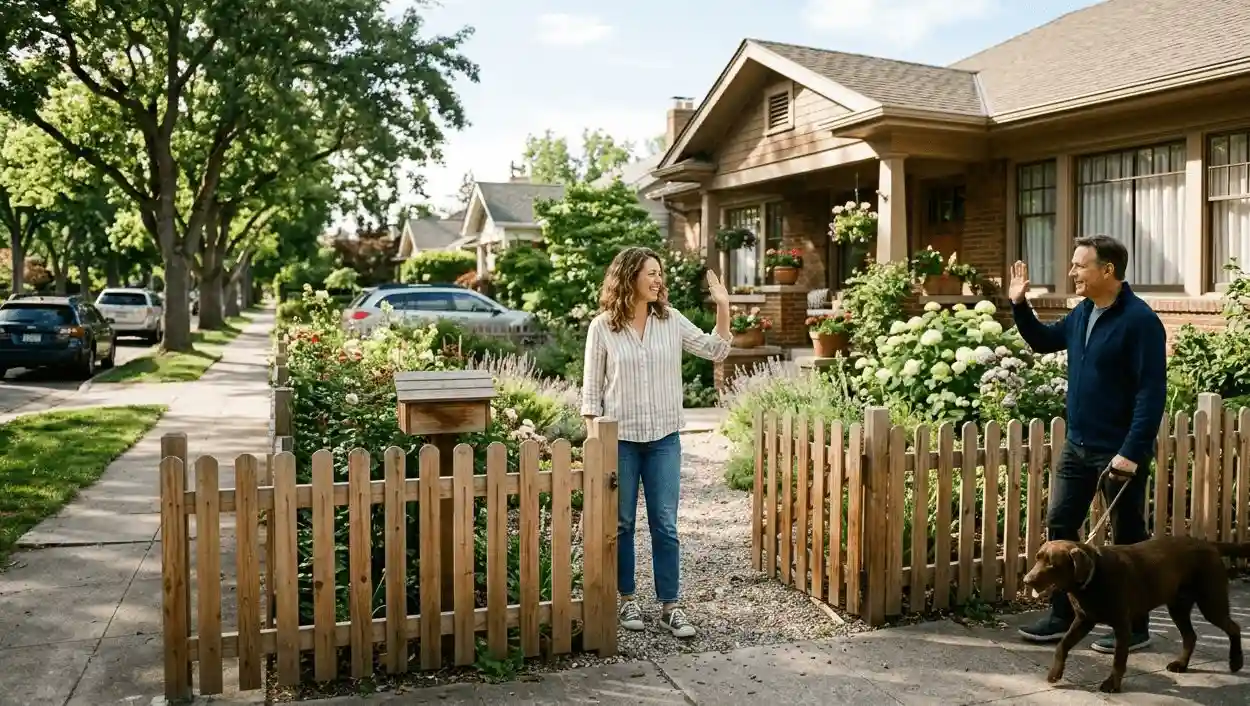
The fence at the edge of your property is not just wood or metal. It is a psychological statement — a negotiation between your need for sanctuary and the community’s need for connection. Too high, and you seem hostile. Too low, and you feel exposed. No fence at all signals openness — or vulnerability, depending on who is watching.
Fence psychology is the study of how physical and behavioral boundaries shape neighborly perception. Every interaction at the property line — a wave from the driveway, a conversation over the hedge, a quick retreat inside — answers the same question: “How available am I to this community?”
The most respected neighbors are not the most outgoing or the most reclusive. They are the ones who master warm boundaries — accessible enough to be trusted, private enough to be respected.
The Psychology of Boundary Management
Boundary management is the art of controlling access to your time, attention, and personal space without appearing cold or suspicious. In a neighborhood, boundaries are managed through:
CORE BARRIERS
- ✓ Physical barriers (fences, hedges, gates)
- ✓ Temporal barriers (when you are visible vs. when you are inside)
- ✓ Interactional barriers (how you respond to greetings or requests)
The brain reads these boundaries as signals of your social availability. A person who is never visible signals “I do not want to be part of this community.” A person who is always available signals “I have no boundaries” — which can be read as needy or unsafe.
UPSIDES
- ✓ High fence + visible and waving (Private but friendly)
- ✓ No fence + intermittent visibility (Trusting, cooperative)
DOWNSIDES
- ✕ High fence + never visible (Hostile, suspicious, secretive)
- ✕ Low fence + always available (Open but potentially needy)
- ✕ No fence + visible neglect (Unpredictable, low self-respect)
Introversion vs. Suspicion in Communities
One of the most common neighborhood misunderstandings is confusing introversion with hostility. The quiet neighbor who keeps to themselves is often labeled “stuck up” or “suspicious” — when in reality, they are simply drained by social interaction.
The brain’s default assumption is that unfamiliar people are potentially dangerous. To override that assumption, the brain needs positive exposure. Introverts provide less exposure, so the brain takes longer to categorize them as safe.
To prevent being misread as hostile, introverts can use low‑effort signaling:
LOW-EFFORT SIGNALS
- A brief wave from the driveway (2 seconds)
- A nod while checking the mail (1 second)
- A “morning” spoken while walking to the car (3 seconds)
These acts cost almost no social energy. But they provide enough positive exposure to shift perception from “suspicious” to “private but fine.”
You May Also Like
Discover why we care so much about others’ opinions — introverts are often judged unfairly
How Avoidance Changes Social Perception
Avoidance behavior — crossing the street to avoid a neighbor, pretending not to hear a greeting, rushing inside when someone approaches — is read as rejection. The avoided neighbor feels personally snubbed, even when the avoidance is about social anxiety, not dislike.
Repeated avoidance creates a feedback loop:
- You avoid because you are anxious or tired.
- Neighbor feels rejected and becomes cooler toward you.
- You perceive their coolness as confirmation that they dislike you.
- You avoid more.
To break the loop, you need one small positive interaction — a wave, a held door, a brief “how are you.” It resets the narrative.
Warm Authority Without Forced Small Talk
Warm authority is the ability to be kind and respected without being overly familiar. In neighborhood contexts, warm authority looks like:
WARM AUTHORITY FRAMEWORK
- ✓ Acknowledging without engaging — “Morning!” then continuing to walk
- ✓ Helping without hovering — Retrieving a blown‑over trash bin, then leaving
- ✓ Offering without insisting — “Let me know if you need anything” (once)
- ✓ Setting limits kindly — “I’d love to chat, but I’m late for dinner”
People who master warm authority are trusted because they are predictable — warm when appropriate, firm when needed. They are not pushovers. They are not walls. They are safe.
Must Read
Learn how real confidence is calm, steady, and not loud — warm authority is the neighborhood version
The Social Meaning of Openness
Openness — visible presence, maintained property, occasional greetings — signals that you have nothing to hide. It is the opposite of the boarded‑up house that everyone avoids.
Signals of healthy openness:
HEALTHY OPENNESS
- Spending time in your front yard (not just the back)
- Keeping blinds or curtains partially open (not always closed)
- Responding to greetings with a brief acknowledgment
- Not rushing inside the moment a neighbor appears
These signals are not about being an extrovert. They are about being present. A present neighbor is a predictable neighbor. A predictable neighbor is a safe neighbor.
Balancing Accessibility and Personal Space
The optimal neighborhood boundary is permeable but selective — you are accessible when it matters, private when you need it.
Practical strategies:
PRACTICAL STRATEGIES
- Set “porch hours” — Be visible at predictable times (morning coffee, evening mail). At other times, it is fine to be invisible.
- Use transitional objects — Earbuds in (even without music) signal “not available for conversation.” A gardening tool in hand signals “busy but visible.”
- Have an exit line — “Great to see you — I’ve got to run” ends interactions cleanly.
- Protect your front door — Do not feel obligated to answer every knock. A doorbell camera allows screening without avoidance.
These strategies allow you to be a good neighbor without being an exhausted one.
Trending
Explore why humans fear being watched — but in neighborhoods, moderate visibility reduces that fear
Final Thoughts
Fence psychology is not about the height of your fence. It is about the clarity of your boundaries.
Be visible enough to be known. Be warm enough to be trusted. Be private enough to be respected. And let every small interaction — a wave, a nod, a held gate — say the same thing: “I am here. I am safe. I am not available all the time — and that is okay.”
The best neighbors are not the loudest or the most available. They are the most consistent. Build your fence where you need it. Leave a gate where you can. And let the community see the difference.
Related Articles



Sponsored


You May Also Like

The Tribal Gatekeeper Effect: How Your Interaction with Staf…

Intimacy vs. Isolation (Erikson’s Sixth Stage of Psychosocia…

Anxiety Disorders Uncovered: Understanding Different Types a…

Behavioral Psychology: Understanding Why We Act the Way We D…

Why Humans Fear Being Watched