The unsettling psychology of long, silent corridors
A hallway is meant to be a passage—somewhere to walk through, not to stay. Yet an empty corridor, especially one that stretches on without a visible end, can produce a quiet, creeping unease. There’s no obvious threat, no danger in sight, but the body tightens and the mind grows alert. This feeling isn’t strange. It’s the brain’s deeply rooted response to environments that break our expectations of safety, purpose, and human presence.
You May Also Like
Perception vs Reality: Why some places feel far more threatening than they actually are.
Why Long Empty Spaces Feel Unusual
The brain learns very early that corridors connect destinations. They are transitional zones—built for movement, not stillness.
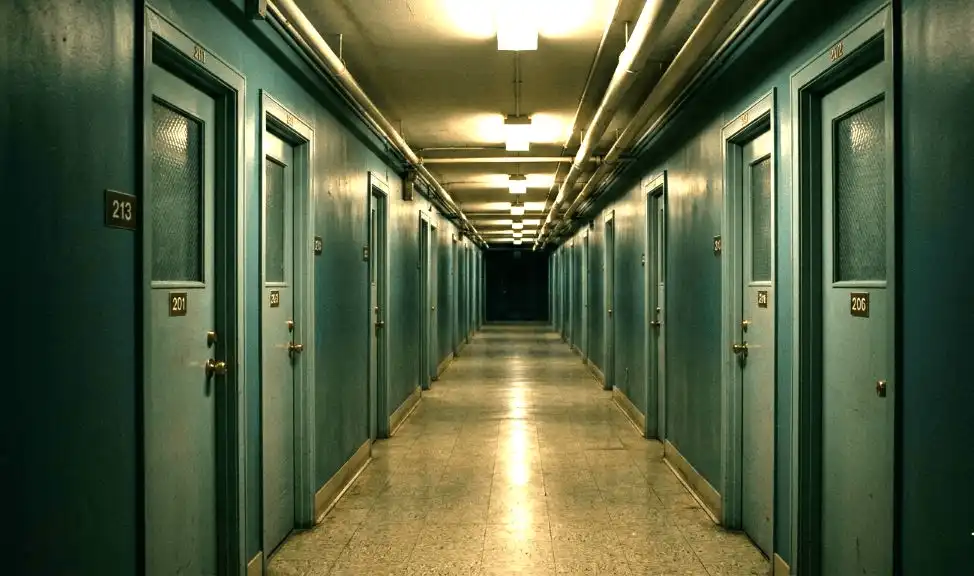
When a hallway stretches on without a visible door or exit, that learned expectation breaks. The visual system tries to process the depth but finds no clear end point. The brain can interpret this indefinite space as a sign that movement would not lead to safety or resolution. This produces a subtle tension, a feeling of being stuck in transit.
Ancestral experience also plays a part. In natural environments, long, narrow passages without escape routes raise the alert level. The modern mind may know the hallway is safe, but older brain structures still pulse with caution.
How Silence Changes the Mood of a Place
Silence is rarely total in everyday life. Most spaces hum with background noise—conversation, ventilation, distant traffic. A truly silent hallway feels stripped of life and context.
The brain uses ambient sound to confirm that the environment is active and inhabited. When sound is absent, the limbic system can interpret the quiet as a sign of danger. In evolutionary terms, silence often preceded a predator’s presence or indicated that others had fled.
The mind also tends to fill silence with its own imagined sounds. A tiny echo, a distant hum—the brain magnifies these, searching for meaning. This self-generated auditory alertness adds to the sense that something is off.
Why Poor Lighting Increases Unease
Light quality directly affects the brain’s spatial confidence. In a dimly lit hallway, the visual field loses sharp edges and clear depth markers. Shadows pool in corners, and the far end becomes ambiguous.
The brain relies on clear visual data to map an exit path. Poor lighting introduces uncertainty. The amygdala, always watching for the unpredictable, nudges the body into higher alert. A hallway that would feel unremarkable under bright lights can feel oppressive when the bulbs flicker or the corners stay dark.
Fluorescent lighting with a hint of yellow or green can be particularly unsettling. It mimics the color palette of institutional fatigue—hospitals late at night, empty school buildings, forgotten office spaces.
Why Schools, Hotels, and Hospitals Feel Different at Night
Certain hallways are designed to be busy. When they are empty—especially after dark—their entire atmosphere transforms.
A school corridor normally rings with voices and footsteps. At night, the stillness is a direct contradiction of expectation. The same holds for hotel corridors late at night and hospital hallways during quiet hours. These are spaces built for human flow, and without it, the brain marks them as uncanny.
Our memory of these places is tied to their usual activity. When the visual scene is stripped of life, the brain senses an absence, a violation of the learned pattern. The space becomes a stage, and the mind becomes a reluctant performer.
How the Brain Reacts to Isolation
Human beings are fundamentally social, and the built environment reflects that. An empty hallway signals isolation—the removal of all company.
The brain’s threat-detection system treats isolation as a risk factor. Throughout human history, being separated from the group meant increased vulnerability. Even in a modern, safe building, being alone in a long corridor can trigger a subtle defensive response.
The feeling is not always conscious. It shows up as a quickened heartbeat, a tighter grip on a bag strap, or an unconscious increase in walking speed. The brain is simply preparing for an outcome it hopes will never arrive.
Why Uncertainty Makes People Alert
A hallway with a clear end point is a promise. A hallway that turns a blind corner or fades into shadow becomes a source of uncertainty.
The brain is a prediction engine. When the environment denies it a clear prediction—what lies around the corner, how far the corridor goes—alertness spikes. This is the same mechanism that makes a half-open door feel more unnerving than a fully closed one.
Uncertainty forces the brain to fill gaps with its own cautious guesses. In the absence of information, the mind leans toward the protective side. The default setting is not optimism; it is watchfulness.
Why Some Hallways Feel More Intense Than Others
Not all corridors are equally disturbing. Several design features can crank up the unease.
UNSETTLING DESIGN FEATURES
- ✓ Narrow width — reduces the sense of personal space and potential exit routes.
- ✓ Repetitive doors or panels — create visual monotony that can feel disorienting.
- ✓ No windows or natural light — removes the connection to the outside world and anchors of time.
- ✓ Long, straight design without visual breaks — makes the distance feel infinite and the walk hopeless.
- ✓ Worn or outdated finishes — suggest neglect and a lack of human care.
These elements collectively signal that the space is abandoned, unmaintained, or not built for comfort.
Common Physical Reactions People Notice
The body reacts to an empty hallway in subtle but measurable ways. It’s not always obvious, but many people experience:
PHYSICAL SYMPTOMS OF INSTINCTUAL ALERT
- A slight increase in heart rate
- Tensing of the shoulders or neck
- A heightened awareness of one’s own footsteps
- Cooling of the hands or a faint shiver
- The urge to walk faster or look behind
- A feeling of being watched, even when alone
These responses are the body’s low-level survival mode. They are not signs of an anxiety disorder; they’re the nervous system doing exactly what it evolved to do.
Why Movies Use Empty Hallways So Often
Filmmakers understand the power of liminal spaces better than anyone. An empty hallway in a psychological thriller or horror film is rarely just background. It’s a signal.
The long corridor creates anticipation. The audience’s brain, wired to detect pattern breaks, searches the static frame for any small movement. This state of hyper-vigilance is emotionally potent.
Movies also tap into our memory of real-world spaces that feel different when empty—the hospital hallway late at night, the school after hours. The familiarity makes the creepiness sharper.
Final Thoughts
An empty hallway is rarely just a hallway. To the brain, it is a space full of prediction errors, silent signals, and old instincts. The unease it provokes has nothing to do with weakness and everything to do with the mind’s ability to detect when an environment does not feel right.
Understanding that this reaction is a natural, ancient part of being human can make the feeling easier to manage. The brain is not broken. It’s simply reading the room—and finding it far too quiet.
Related Articles


Sponsored


You May Also Like

Why Emotional Regulation Develops Slowly

How Different Scent Profiles Secretly Signal Your Personalit…

Generativity vs. Stagnation (Erikson’s Seventh Stage of Psyc…

Enclothed Cognition: The Brain Chemistry Behind Why “D…

Personality Types — Why People Think, Feel, and Act So Diffe…