

Why do some people thrive in a crowd while others recharge in quiet corners? Why do deadlines energize some and overwhelm others? From ancient astrologers charting the stars to modern apps predicting our online habits, humans have always sought to understand these patterns.
Personality psychology turns curiosity into insight. It gives structure to the age-old question: “Why am I the way I am — and why are others so different?” It’s more than quizzes and labels — it’s a lens to understand ourselves, our relationships, and the choices we make every day. Whether it’s navigating work, building friendships, or discovering hidden strengths, personality provides a roadmap to make sense of the patterns that shape our lives.
KEY TAKEAWAYS
- Personality Types vs. Traits: Types categorize people into distinct boxes (e.g., MBTI), whereas traits measure behavior on a continuous spectrum (e.g., Big Five).
- Major Frameworks: The most recognized systems include the 16 MBTI types, Type A/B/C/D stress models, the Big Five (OCEAN), and HEXACO.
- Practical Application: Understanding your personality aids in career choices, relationship dynamic management, and overall self-awareness.
What Is a Personality Type?
A personality type is a category describing consistent behavioral and emotional patterns — your typical “default setting.” It’s different from a mood or a single action.
The biggest debate in psychology is Types vs. Traits:
TYPES
- ✓ Categorizes people into distinct groups (e.g., Introvert vs. Extravert)
- ✓ Simple, memorable, and easily relatable for general users
TRAITS
- ✕ Measures personality on a continuous sliding scale
- ✕ Highly nuanced and supported by extensive scientific research
Major Personality Type Theories
1. Myers–Briggs Type Indicator (MBTI)

Sorts people into 16 types based on four preference pairs: Introversion–Extraversion, Sensing–Intuition, Thinking–Feeling, and Judging–Perceiving.
The Myers–Briggs Type Indicator (MBTI) remains one of the most recognized personality models worldwide. It divides people into 16 distinct types, built from four key preference pairs: Introversion–Extraversion, Sensing–Intuition, Thinking–Feeling, and Judging–Perceiving.
Each combination reveals how individuals gain energy, process information, make decisions, and structure their lives. An INTJ might approach the world with quiet strategy, while an ENFP thrives on creativity and connection.
Though the MBTI faces criticism for its limited scientific reliability, it continues to hold power in career counseling, leadership training, and self-discovery. Its true value lies less in labeling and more in sparking awareness — helping people recognize how they interact, communicate, and grow.
2. Type A, B, C, and D Personalities
Focuses on stress and health patterns:
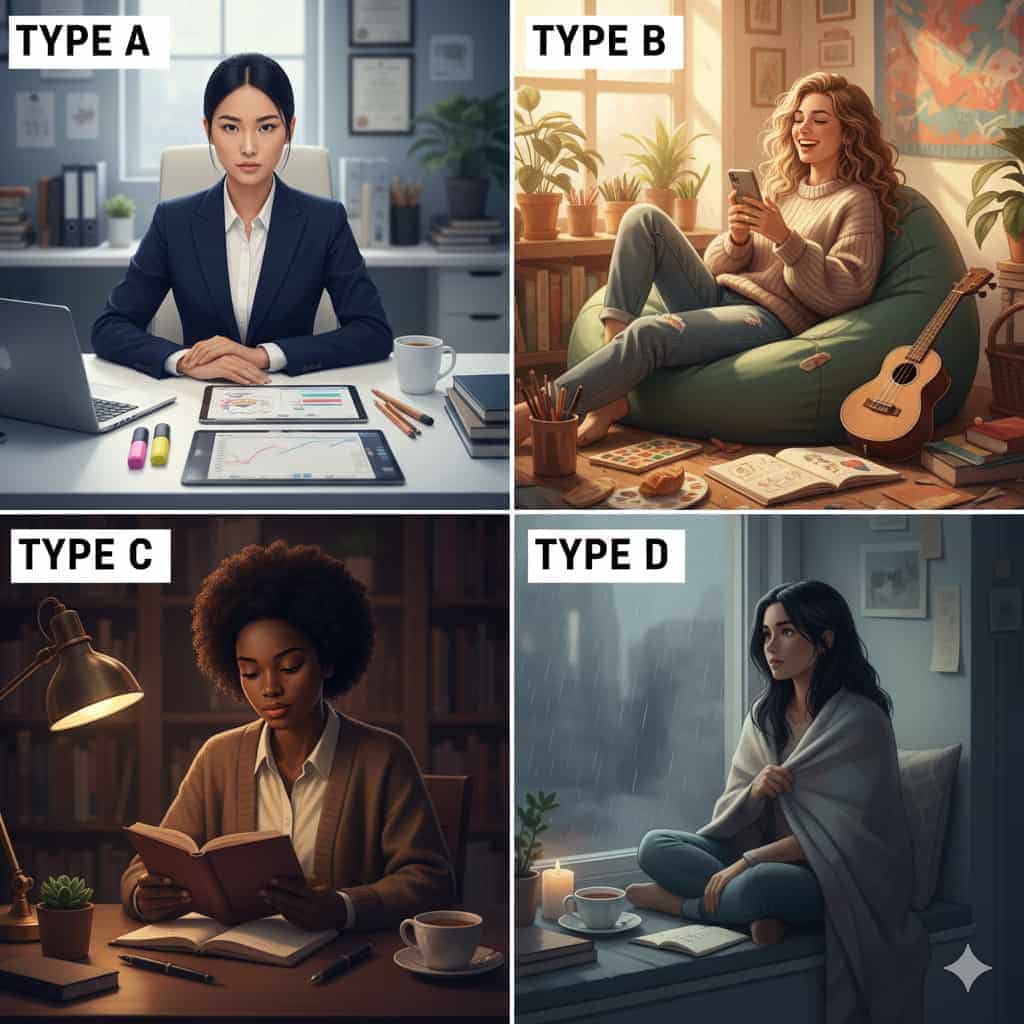
Personality Types Overview
- ✓ Type A: Competitive, time-urgent, prone to stress.
- ✓ Type B: Calm, patient, easy-going.
- ✓ Type C: Conscientious, detail-focused, emotionally restrained.
- ✓ Type D: Distressed, anxious, socially inhibited.
3. The Big Five (OCEAN) Model
Measures personality across five spectrums:
- Openness (imaginative ↔ practical)
- Conscientiousness (organized ↔ spontaneous)
- Extraversion (outgoing ↔ reserved)
- Agreeableness (compassionate ↔ competitive)
- Neuroticism (sensitive ↔ stable)
4. The HEXACO Model
An evolution of the Big Five, HEXACO adds a sixth trait: Honesty–Humility — sincerity, fairness, and modesty.
5. Ancient Temperament Models
Centuries before psychology, Hippocrates proposed the Four Humors:
Sanguine (cheerful), Choleric (ambitious), Melancholic (analytical), Phlegmatic (calm).
How Psychologists Study Personality
Modern researchers go beyond quizzes:
Factor Analysis: Identifies clusters of related behaviors.
Longitudinal Studies: Track people for decades to see if traits endure.
Twin Studies: Separate genetic from environmental influence.
Real-Life Applications of Personality Typing
a. Career and Education
Understanding your type can guide career choice and learning style.
b. Relationships and Compatibility
Personality influences how we connect, argue, and care.
c. Mental Health and Self-Awareness
Therapists use personality profiles to tailor treatment plans.
d. Marketing and Social Media
Marketers apply personality insights to understand audiences.
Common Misconceptions & Criticisms
Personality typing is powerful — and often misused:
MBTI Reliability: Results can shift over time; categories oversimplify.
Labeling Risks: Over-identifying with a type can box people in.
Ethical Issues: Using personality data in hiring can enable bias.
How to Discover Your Personality Type
If you’re curious:
- Big Five: Try the free IPIP-NEO inventory.
- HEXACO: The HEXACO-PI-R offers detailed feedback.
Use results as mirrors, not verdicts. Good tests describe — they don’t define.
Future Trends in Personality Research
- AI-Based Prediction: Algorithms can infer personality from text, music, and social media activity.
- Neuroscience Links: Brain imaging now connects neural patterns with traits like extraversion and neuroticism.
Case Studies: Personality in Action
Priya (INFJ teacher): Loves mentoring students but feels drained by staff meetings — illustrating social energy awareness through MBTI.
Ravi (Type A entrepreneur): Thrives on deadlines but faces high blood pressure — reflecting health risks associated with Type A behavior.
Anita & Mehul (Coworkers): Contrasting Conscientiousness scores create tension; pairing their strengths improves team performance.
CEO Ethics & HEXACO: High Honesty–Humility scores predict lower risk of corporate fraud.
Melancholic Temperament: Maps closely to introversion and neuroticism traits.
Minnesota Twin Study: Identical twins raised apart share traits, highlighting genetic influence.
Student Career Shift: High Openness student switches to design, boosting success and satisfaction.
Relationship Meta-Analysis: High Agreeableness + low Neuroticism couples report better satisfaction.
Mental Health Application: High Neuroticism client learns CBT to regulate emotions.
Marketing Application: Targeting high-Openness consumers increases engagement by 30%.
Hiring Misuse: Personality testing led to discrimination claims in recruitment.
AI Personality Prediction: Algorithms predict Big Five traits from LinkedIn posts with 80% accuracy, raising privacy concerns.
FAQs
What’s the most accurate personality test?
Big Five–based assessments (e.g., NEO-PI-R) are the scientific gold standard, measuring traits on a spectrum rather than placing people in rigid boxes.
Is the Myers-Briggs scientifically valid?
While widely used in self-discovery and career coaching, it is debated by psychologists due to low test-retest reliability and oversimplified either/or categories.
Can your personality change?
Core traits remain fairly stable throughout adulthood, but major life events, targeted therapy, or conscious effort can shift specific habits and behavioral tendencies.
What’s the difference between Type A and OCD?
Type A is a personality style marked by competitiveness and time urgency. OCD is a clinical anxiety disorder involving intrusive thoughts and repetitive compulsions.
Are personality types like zodiac signs?
No. Psychological personality theories rely on observed behavioral patterns and statistical factor analysis, whereas zodiac signs have no empirical basis.
What is a “Type C” personality?
Type C personalities tend to be detail-oriented, conscientious, and conflict-avoidant, often suppressing emotions under stress.
Beyond Labels
Personality types are maps, not cages. They reveal patterns that help us understand ourselves and others — but only if we use them wisely.
The goal isn’t to find your box. It’s to recognize your shape, stretch your edges, and grow beyond them.
Note: This article is for educational purposes only and does not constitute professional clinical advice.
Related Articles



Sponsored


You May Also Like

Cultural Lenses: How Modern vs. Traditional Style Alters Soc…

Behavioral Synchronization: The Psychology of Mirroring and …

The Hidden Spatial Negotiations of Passing Strangers

Conversational Velocity: The Psychology of Speech Rate and P…

Bipolar Disorder in the Digital Age: How Social Media and Da…
