When we think about personality, we often picture something innate and fixed—a core self that defines who we are. But what if much of what we call “personality” is actually a collection of survival strategies forged in the fires of our past?
The very traits we believe to be fundamental to our identity—people-pleasing, emotional detachment, defensive anger, avoidance—often began as intelligent, necessary responses to earlier, challenging environments. The problem arises when these coping styles become so ingrained that they feel like unchangeable traits, long after the original threat has passed.
KEY TAKEAWAYS
- Personality traits often originate as childhood survival mechanisms.
- Rigid behavior patterns can signal an underlying personality disorder rather than fixed identity.
- Neuroplasticity allows us to rewire old coping mechanisms and adopt healthier relational patterns.
This exploration is not about dismissing personality as an illusion; it’s about understanding its origins. Healing is not about erasing who you are, but about expanding beyond the limits of who you had to become.
We all have our own ways of thinking, feeling, and behaving—the little patterns that make us who we are.
Some people thrive on social energy, others prefer solitude. Some are emotionally open, others steady and measured. These differences are part of being human. But sometimes, these patterns grow so rigid that they start to create distress or conflict. Relationships feel chaotic, emotions swing sharply, or trust becomes almost impossible.
When these patterns consistently interfere with life, they may point toward something deeper: a personality disorder.
What Is a Personality Disorder?
A personality disorder isn’t about being “difficult” or “dramatic.”
It’s a mental health condition marked by long-standing patterns of thinking and behaving that differ from social norms and cause problems in relationships, work, or self-image. These patterns usually begin in adolescence or early adulthood and tend to remain stable over time.
They can affect how a person sees themselves, interprets others’ actions, and responds to the world. Importantly, having a personality disorder doesn’t mean someone is “bad” or beyond help. It simply means their coping patterns have become too fixed to adapt easily—and therapy can help reshape them.
🧩 The Three Clusters of Personality Disorders
Experts group personality disorders into three main clusters based on shared traits. Understanding these helps make sense of how symptoms show up.
🌀 Cluster A: Odd or Eccentric

Paranoid Personality Disorder: Distrustful and suspicious of others’ motives.
Schizoid Personality Disorder: Prefers solitude, limited emotional expression.
Schizotypal Personality Disorder: Unusual thoughts or behaviors, social discomfort. People in this cluster often feel safest at a distance, where misunderstanding can’t hurt them.
🔥 Cluster B: Dramatic or Emotional
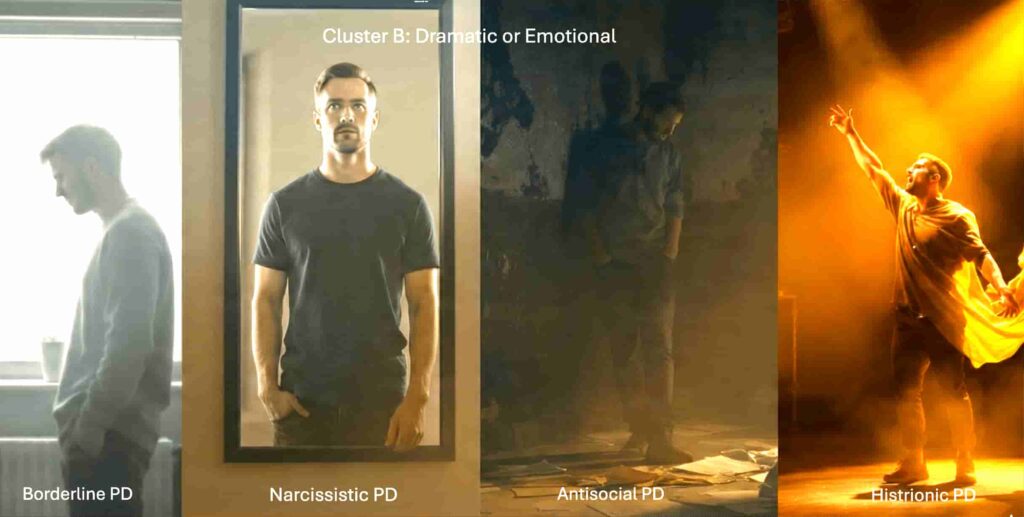
Borderline Personality Disorder: Intense emotions, fear of abandonment, unstable relationships.
Narcissistic Personality Disorder: Need for admiration, fragile self-esteem.
Antisocial Personality Disorder: Disregard for others’ rights, impulsive actions.
Histrionic Personality Disorder: Constant need for attention, highly expressive emotions. This cluster feels everything louder—connection, rejection, and desire all burn bright, often leading to unstable relationships and impulsive actions.
🌧️ Cluster C: Anxious or Fearful
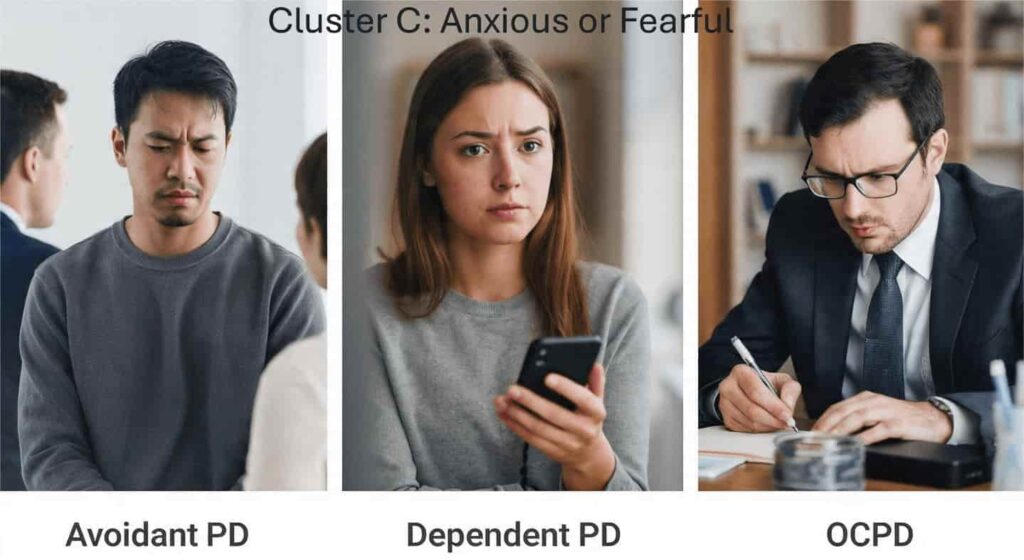
Avoidant Personality Disorder: Fear of rejection, social withdrawal.
Dependent Personality Disorder: Difficulty making decisions without reassurance.
Obsessive-Compulsive Personality Disorder (OCPD): Perfectionism and control that interfere with flexibility. Here, fear of disapproval or loss quietly drives most choices. Each cluster reflects a different way the mind tries—often unsuccessfully—to protect itself.
Childhood Coping Strategies Become “Personality Patterns”
- During childhood, our brains are incredibly plastic and impressionable. We develop ways of navigating the world based on what feels safest or most rewarded. A child who is validated only when compliant may become an adult who struggles with assertiveness. Another who learns that emotional displays lead to punishment might master the art of detachment.
- Over time, these repeated strategies wire the brain. Neural pathways strengthen with each use, and the behavior becomes automatic. When the external world continues to respond to these patterns, the brain receives a powerful, unconscious message: This is who I am. This is how I survive.
The Identity Trap: When Coping Turns Into a Personality Style
Behaviors that once served a clear protective function slowly morph into what we perceive as fixed personality traits. This is the identity trap: we confuse a survival strategy with our intrinsic nature.
Avoidance used to stay safe from conflict or criticism becomes labeled as “I’m just an introvert” or “I’m not a people person.”
Emotional shutdown meant to reduce overwhelm or chaos becomes “I’m just logical and cold.”
Hyper-vigilance developed in an unpredictable environment becomes “I’m just a worrier—it’s my personality.”
The strategy hardens into a story we tell ourselves, limiting how we see our own capacity for change.
Trauma Shapes Personality Architecture
Long-term stress, inconsistent caregiving, emotional invalidation, or traumatic experiences don’t just create memories—they shape the very architecture of personality. The brain, in an effort to predict and manage future threat, forms rigid schemas: core beliefs about the self, others, and the world.
These schemas dictate everything: your attachment style, how you handle conflict, your tolerance for intimacy, and your tendency toward withdrawal or eruption. Your personality becomes organized around preventing past pain from recurring, often at the cost of present peace.
You May Also Like
Understanding PTSD: Symptoms & Treatment
When Survival Patterns Hijack Relationships
Our earliest survival strategies often play out most intensely in our closest relationships. The very connections we crave become the trigger for our oldest fears.
Fear of abandonment may lead to clinginess or emotional explosions to gauge commitment.
Fear of betrayal can manifest as hypervigilance for disloyalty or pre-emptive withdrawal.
Fear of rejection might result in ghosting, pushing people away, or avoiding vulnerability entirely.
These patterns create painful loops: the very behaviors meant to prevent hurt often drive others away, confirming the deepest fear and reinforcing the cycle.
Emotional Dysregulation Isn’t Drama — It’s a Nervous System Overreaction
For many with personality patterns, intense emotional reactions aren’t “dramatic” by choice. They are the result of a nervous system stuck in a heightened state of threat detection. The body reacts as if danger is present—even during a casual disagreement or a moment of perceived slight.
This explains intense mood swings, panic attacks, “splitting” (seeing people as all-good or all-bad), and black-and-white thinking. It’s not a character flaw; it’s a physiological overreaction rooted in a history where the threat was real and consistent.
How Personality Disorders Develop
There’s no single reason why someone develops a personality disorder.
Research points to a blend of genetic, environmental, and psychological factors. Childhood experiences play a powerful role. Emotional neglect, trauma, or inconsistent caregiving can disrupt a person’s ability to form a stable sense of self. Over time, coping strategies that once kept them safe become deeply ingrained patterns. It’s not about blame—it’s about understanding. Personality disorders are learned ways of surviving in environments that didn’t always feel safe or predictable.
The Line Between a Trait and a Disorder
It’s important to distinguish between personality traits and personality disorders. Traits are flexible, context-aware, and adaptable. They show up in certain situations but do not dominate your entire functioning.
A disorder, in contrast, is defined by rigidity, repetition, and significant impairment. The coping style no longer serves you—it sabotages you. It persists across time and situations, causing distress and disrupting relationships, work, and self-image. The core differentiator is this combination of inflexibility and functional impairment.
ADVANTAGES
- ✓ Flexible and context-dependent
- ✓ Adaptable across situations
- ✓ Enhances or maintains functioning
- ✓ Allows varied emotional responses
LIMITATIONS
- ✕ Rigid and pervasive across contexts
- ✕ Sabotages goals and relationships
- ✕ Causes distress and dysfunction
- ✕ Triggers automatic, threat-based reactions
Signs and Symptoms
While symptoms differ across disorders, some patterns appear often:
COMMON SYMPTOMS & SIGNALS
- ✓ Intense, rapidly changing emotions
- ✓ Ongoing struggles in close relationships
- ✓ Fear of abandonment or rejection
- ✓ A shifting or fragile sense of identity
- ✓ Impulsive or self-destructive behavior
- ✓ Difficulty trusting others
- ✓ Chronic feelings of emptiness or anger
Having some of these traits doesn’t automatically mean a personality disorder. The key difference is how long these patterns last and how much distress or dysfunction they cause.
Healing Is Possible: Personality ≠ Destiny
powered by neuroplasticity—the brain’s ability to rewire itself—meaning you’re never stuck with old survival patterns (Neuropsychology: How the Brain Shapes Thoughts & Behavior).
The journey begins with a proper clinical assessment where a mental health professional studies your history, behaviours, and emotional patterns to form an accurate diagnosis (Personality Disorders: Clusters & Treatment).
Evidence-based therapies like DBT for emotional regulation, Schema Therapy for core beliefs, and EMDR for trauma processing form the core treatment (Types of Therapy Explained).
Medication, when necessary, helps stabilize co-occurring symptoms such as anxiety or depression (Major Depressive Disorder Guide).
Group therapy and supportive relationships rebuild connection, trust, and healthier relational experiences (Mind–Body Connection & Stress).
And ultimately, these combined approaches help you identify rigid survival patterns, heal the pain beneath them, and create flexible, healthier ways of thinking, feeling, and relating—allowing you to outgrow what no longer serves you and build a more grounded, fulfilling life.
Breaking the Stigma
Personality disorders are among the most misunderstood mental health conditions.
Labels like “toxic” or “manipulative” often overshadow the reality of deep emotional pain and unmet needs. When we replace judgment with understanding, we create room for empathy.
No one chooses to live in constant inner chaos; most just haven’t learned safer ways to connect or cope yet. Awareness is the first step to compassion—for others, and for ourselves.
Change Is Slow—but Real
Recovery from a personality disorder rarely follows a straight line.
Progress can feel uneven—two steps forward, one step back—but each small shift matters. Personality disorders don’t define someone’s worth or potential. With the right support, therapy, and self-awareness, the same emotional intensity that once fueled chaos can become a source of strength and creativity. Healing doesn’t erase the past; it changes how the past shapes the present. Over time, those once-rigid patterns start to bend toward balance.
Remember: Flexibility, not perfection, is the true mark of recovery.
FAQs
Can a personality disorder be cured completely?
While ‘cured’ isn’t typical clinical terminology, individuals with personality disorders can achieve complete remission. Through therapies like DBT and Schema Therapy, people can unlearn rigid survival patterns and develop healthy coping mechanisms.
What is the main difference between a personality trait and a disorder?
Personality traits are flexible and adapt to different circumstances. A personality disorder is marked by rigid, pervasive patterns that persist regardless of the situation and cause significant distress or functional impairment in daily life.
Are personality disorders caused by trauma or genetics?
They are generally caused by a combination of both. Genetic predispositions (such as high emotional sensitivity) combined with environmental factors (such as early childhood trauma, emotional neglect, or invalidation) interact to form these rigid coping styles.
Note: This article is for educational purposes only and does not constitute professional clinical advice.