

The Science of Growth
Have you ever wondered why a toddler’s world is filled with tantrums, or how a teenager navigates the complex quest for identity? What about the profound shifts in perspective that come with retirement? These questions are at the heart of developmental psychology—the scientific study of how we grow, change, and adapt throughout our entire lives.
More than just a field focused on childhood, developmental psychology explores the physical, cognitive, social, and emotional changes that shape us from the moment of conception to the final stages of life. At its core, this field seeks to answer a simple, yet profound question: What makes us who we are?
The Big Questions: Core Debates in Development

Developmental psychologists often frame their research around three fundamental debates that help us understand the forces shaping us.
- Nature vs. Nurture: Are our traits and behaviours primarily determined by our genes (nature) or our environment and experiences (nurture)? Most experts now agree it’s a dynamic interplay between both.
- Continuity vs. Discontinuity: Does human growth happen in a smooth, gradual way (continuity), like a plant slowly growing taller, or does it unfold in a series of distinct, measurable stages (discontinuity), much like a caterpillar’s metamorphosis into a butterfly?
- Stability vs. Change: Do our early personality traits and dispositions remain stable throughout our lives, or do we have the capacity to evolve and transform into different people over time?
Influential Theories and Key Concepts
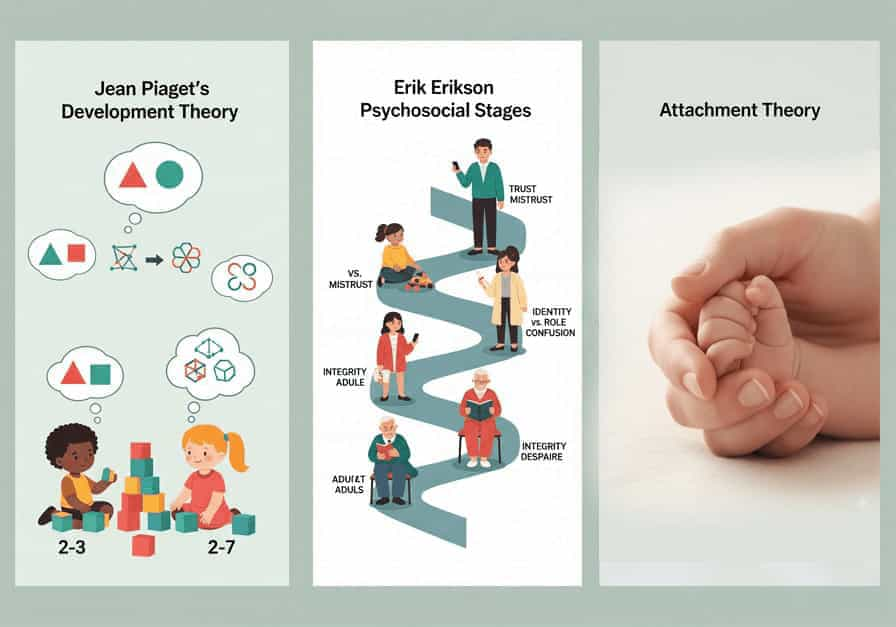
This field is built on the foundational work of influential thinkers who have helped us understand the predictable patterns of human growth.
- Jean Piaget (1896–1980): A pioneer in cognitive development, Piaget’s theory was revolutionary because it demonstrated that children don’t just think less than adults—they think in fundamentally different ways. His work introduced concepts like schemas, the mental frameworks we use to organize and interpret information.
- Erik Erikson (1902–1994): Erikson’s psychosocial theory expanded the scope of development beyond childhood. He proposed a series of eight stages across the lifespan, each defined by a unique conflict to be resolved, such as “Identity vs. Role Confusion” during the teenage years.
- Attachment Theory: Pioneered by John Bowlby and Mary Ainsworth, this theory highlights the critical importance of the early emotional bond between an infant and their primary caregiver. This initial attachment profoundly influences a person’s future relationships and sense of security.
Development in Action: Everyday Examples
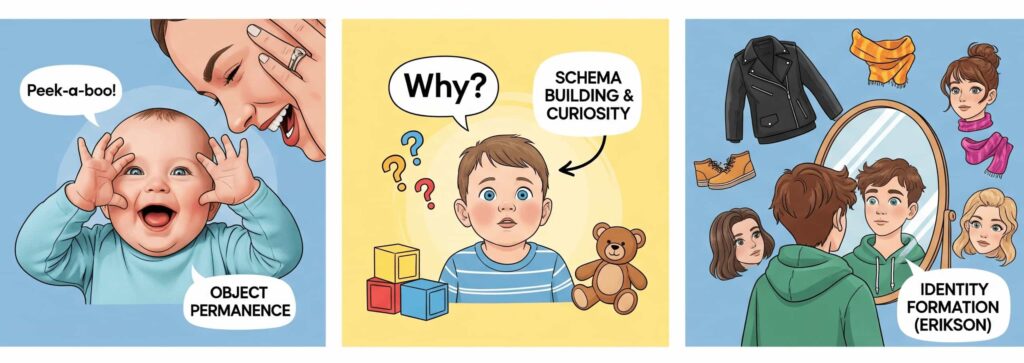
Psychological concepts aren’t just for textbooks; they’re visible in our daily lives.
- The Power of Peek-a-boo: A baby’s delight in this simple game demonstrates a key milestone: the gradual development of object permanence, the understanding that things continue to exist even when they are out of sight.
- The “Why” Phase: A toddler’s constant questioning isn’t just curiosity—it’s a powerful sign that they are actively building and refining their schemas, trying to make sense of how the world operates.
- The Teen Identity Search: The experimentation with different styles, social groups, and beliefs during adolescence is a normal and healthy part of Erikson’s stage of identity formation.
The Practical Applications of Developmental Psychology
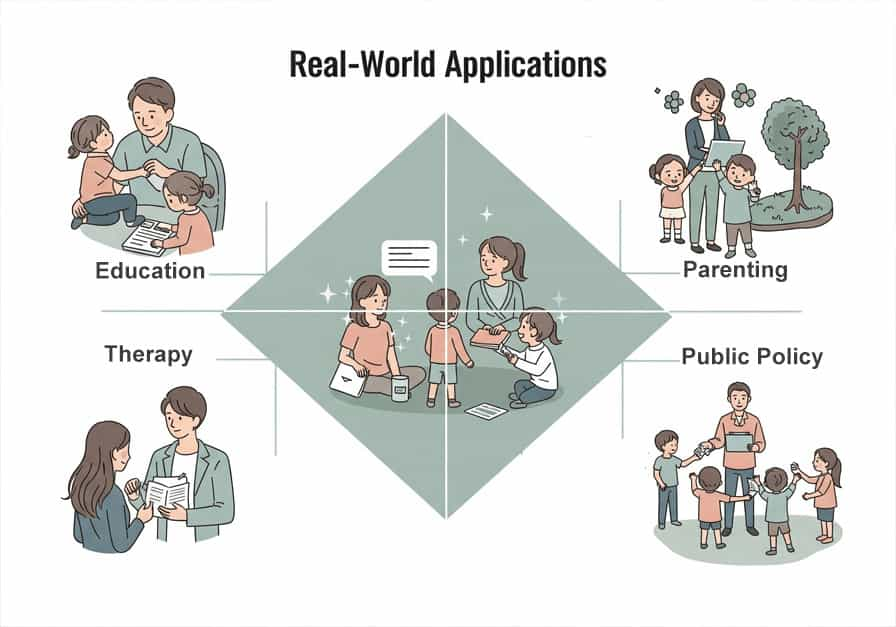
This field is far from just an academic exercise. Its principles are applied in numerous real-world settings to improve lives.
- Education: Educators use developmental principles to design age-appropriate curricula and teaching methods that align with how children’s brains are wired to learn.
- Parenting: Understanding developmental milestones helps parents provide the right support at the right time, fostering a healthy environment for growth.
- Therapy: Therapists and counsellors use developmental frameworks to identify and treat emotional or behavioural challenges that may be linked to specific life stages.
- Public Policy: Insights from developmental psychology inform policy decisions on topics ranging from parental leave and early childhood education to elderly care and support systems.
Frequently Asked Questions
What is the difference between developmental psychology and child psychology?
Child psychology focuses on the developmental period from infancy through adolescence, whereas developmental psychology is a broader field that covers the entire lifespan from conception to death.
What are the four main types of development?
Development is a multi-faceted process typically categorized into four main domains: physical, cognitive, social, and emotional development. These areas are interconnected and influence one another.
Why is Piaget’s theory still so important?
Piaget’s work was groundbreaking because it was among the first to systematically show that children are not simply “miniature adults.” His stage theory provided a roadmap for understanding the unique, evolving nature of a child’s mind.
Authoritative Resources
- APA Division 7: Developmental Psychology
- CDC: Developmental Milestones
- Society for Research in Child Development
Note: This article is for educational purposes only and does not constitute professional clinical advice.
Related Articles



Sponsored


You May Also Like

The Power Matrix: Why Black and Navy Command Authority (And …

Why Our Closest Relations Misread Our Micro-Behaviors

Personality Disorders DSM-5: The 10 Types, Symptoms & Ke…

Why Introverts and Extroverts Think Differently: The Science…

The Illusion of Self-Control: Why Willpower Fails and System…
