
As digital interfaces become our primary windows to the world, a strange psychological pattern has emerged. We often find ourselves questioning advice from real humans while instantly trusting a notification, a search result, or a chatbot.
This isn’t just about convenience; it’s a fundamental shift in how the human brain evaluates truth. In the field of Cyberpsychology, this is driven by specific cognitive biases that make “the screen” appear more authoritative than “the person.”
KEY TAKEAWAYS
- The ‘Machine Heuristic’ makes us view algorithms as objective and free from emotional bias.
- Polished UIs and rapid repetition trigger the Illusory Truth Effect, bypassing critical evaluation.
- Over-reliance on search engines leads to Cognitive Offloading, replacing personal judgment with algorithm rankings.
- Balancing digital trust requires active awareness of our screen authority biases.
The Machine Heuristic: The Illusion of Objectivity
Psychologists have identified a phenomenon called the “Machine Heuristic.“ Humans tend to believe that because machines (and algorithms) are not “emotional,” they must be more objective and accurate than humans.
We unconsciously ignore the fact that algorithms are programmed by biased humans. Instead, we see a clean, sleek interface and assume the information is a “pure” fact, free from the messy opinions of a live speaker.
2. Screen Authority Bias & The Truth Effect
There is a perceived permanence to text on a screen. Unlike spoken words, which feel fluid and debatable, digital text feels “published” and “verified.”
Furthermore, the Illusory Truth Effect—a core concept in Social Psychology—suggests that the more we see a piece of information repeated on various feeds, the more we believe it to be true. Screens allow for rapid repetition, which shortcuts our critical thinking.
The Google Effect: Outsourcing Our Judgment
We no longer just use search engines to find data; we use them to replace our own judgment. This is known as Cognitive Offloading.
When we “Google it,” we aren’t looking for a perspective; we are looking for a definitive answer. This habit reduces our reliance on human expertise, placing trust in a platform’s ranking system rather than a professional’s experience. This shift heavily impacts how our brains construct reality.
Confidence Illusion: Style Over Substance
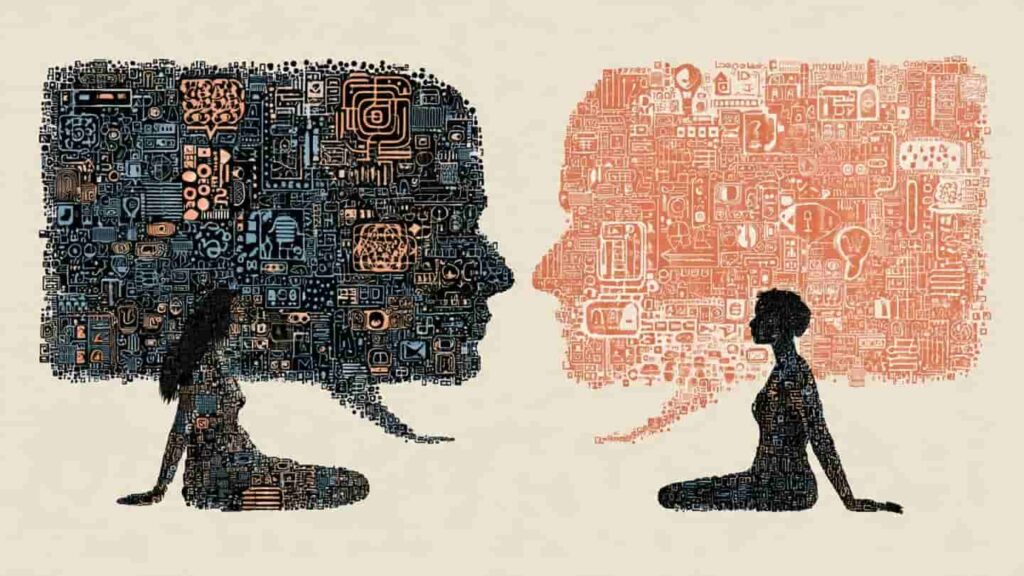
A human expert might stutter, show doubt, or use “hedging” language (like “perhaps” or “usually”). A screen, however, delivers information with 100% confidence.
- The Polished Interface: We equate a fast-loading, beautiful UI with accuracy.
- The Paradox of Choice: Algorithms filter out the “noise,” giving us a single, confident answer that feels safer than the nuanced, complex advice of a person.
Our instant judgments are often swayed more by the design of the website than the actual quality of the evidence.
UPSIDES
- ✓ Delivers authoritative, absolute answers quickly
- ✓ Removes emotional vulnerability and social anxiety
- ✓ Processes massive volumes of data instantly
DOWNSIDES
- ✕ Lacks human empathy, nuance, and contextual wisdom
- ✕ Masks algorithmic bias behind clean UI designs
- ✕ Encourages cognitive offloading and atrophy of critical thought
Emotional Distance and the Shield of the Screen
Interacting with a screen removes “social friction.” There is no fear of judgment or the need to be polite. This emotional buffer lowers our natural skepticism. We are more likely to argue with a person’s motives than we are to question a platform’s data-gathering methods.
As we explore the AI mental health revolution, we see that some people actually feel safer sharing secrets with a screen than with a human therapist because the screen “doesn’t judge.”
6. The Risk: When Critical Thinking Atrophies
Blind digital trust makes us vulnerable to:
- Algorithmic Echo Chambers: We only see what we already believe.
- The “Expertise Gap”: We value a viral post over a peer-reviewed study.
- Attention Decay: Our ability to focus and scrutinize deep content is replaced by a preference for quick, digital “bites” of truth.
Reclaiming Human Judgment
Screens are powerful tools, but they lack wisdom. Recognizing our screen authority bias is the first step toward a healthier digital life. By consciously valuing human insight and questioning the “Machine Heuristic,” we can ensure that our tools serve us, rather than dictate our reality.
STEPS TO OVERCOME SCREEN AUTHORITY BIAS
- ✓ Verify Primary Sources: Always check who created or funded the algorithm delivering the answer.
- ✓ Embrace Hesitation: Recognize that human hesitation and nuance often signify deeper wisdom than automated certainty.
- ✓ Practice Active Critical Thinking: Pause before accepting a clean notification or top search result as absolute truth.
FAQs
What is the Machine Heuristic?
The Machine Heuristic is a cognitive shortcut where people automatically assume that machine-generated output is objective, unbiased, and accurate simply because algorithms lack human emotions.
How does screen authority bias affect decision-making?
It causes individuals to trust digital notifications, AI answers, and search engine rankings over expert human advice, often leading to cognitive offloading and reduced critical analysis.
Why do people prefer sharing secrets with AI or screens?
Screens provide a non-judgmental environment free from social friction, allowing individuals to speak without fear of embarrassment or interpersonal evaluation.
Note: This article is for educational purposes only and does not constitute professional clinical advice.
Related Articles


Sponsored


You May Also Like

The X-Factor: Why Confidence Can Change the Outcome of Compe…

The Synchronization Principle: How Mirroring and Body Langua…

How to Manage Anxiety Naturally (Psychology-Based Methods)

Why Anxiety Feels So Overwhelming

Why Giant Objects Feel Terrifying to Some People