
Perception psychology is the scientific study of how our brain organizes, interprets, and makes sense of sensory information. It goes beyond simply registering stimuli—it explores how the brain actively transforms raw sensory input into a coherent, meaningful experience of the world. Your brain functions as a highly opinionated editor, constantly filtering, shaping, and guessing to turn the data from your eyes and ears into a usable story. This constructive process is why your personal reality is unique and, sometimes, prone to error. For a deeper look at specific instances, you can explore these perception psychology examples.
KEY TAKEAWAYS
- Perception is active: The brain acts as a creative director rather than a passive camera.
- Interplay of Processing: We rely on both data-driven (bottom-up) and concept-driven (top-down) processing simultaneously.
- Constancy & Organization: Mechanisms like Gestalt principles and perceptual constancy keep our world stable and predictable.
Core Idea: Perception is an Active Construction

The central tenet of this field is that perception is an active, constructive process, not a passive recording. The brain isn’t a camera; it’s a creative director, constantly making rapid, unconscious inferences based on context, expectation, and past experience to quickly make sense of the world (Gregory, 1997). This leads to a fascinating question about perception vs. reality and how our internal construction of the world differs from the objective truth.
Key Concepts and Mechanisms
Perception psychology relies on several core mechanisms to explain how we bridge the gap between sensation and meaningful experience:
Bottom-Up vs. Top-Down Processing

Note: Most everyday perception involves a seamless and rapid interplay between both bottom-up and top-down processing.
Gestalt Principles
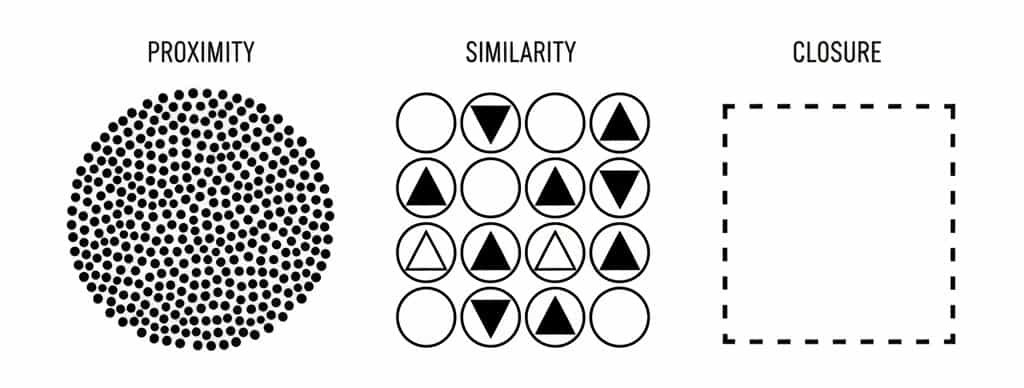
Originating from early 20th-century German psychology, the Gestalt school emphasized that “the whole is greater than the sum of its parts”[cite: 1]. These principles describe the innate rules our brains use to group visual elements into organized wholes (Koffka, 1935)[cite: 1]:
CORE GESTALT RULES
- ✓ Proximity: Objects near each other tend to be grouped together[cite: 1].
- ✓ Similarity: Objects that look similar are perceived as belonging together[cite: 1].
- ✓ Closure: We tend to visually complete incomplete figures to perceive a whole object[cite: 1].
Perceptual Constancy
The brain achieves perceptual constancy by perceiving objects as unchanging and stable, despite constantly changing sensory input. This allows for a predictable environment. For instance, a white sheet of paper appears white in bright sunlight and under dim indoor lighting, even though the light waves hitting the retina are dramatically different (a case of Brightness Constancy).
Foundational Studies and Examples
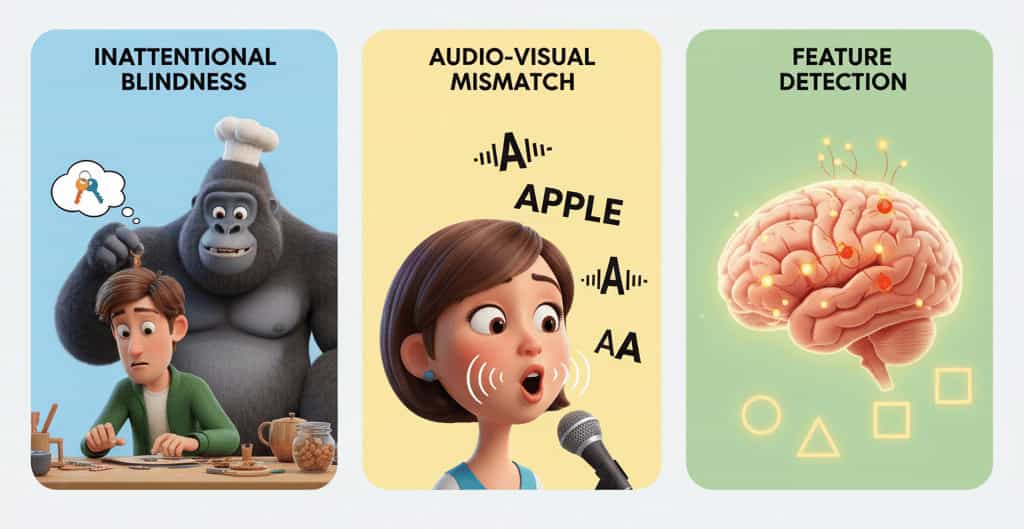
Understanding how perception works requires examining when it fails or when different sensory inputs clash[cite: 1].
| Phenomenon | Description | Study/Theorist |
|---|---|---|
| Inattentional Blindness | The failure to notice a fully visible, but unexpected, object or event when attention is directed elsewhere. | The “Invisible Gorilla” experiment (Simons & Chabris, 1999) |
| The McGurk Effect | A perceptual phenomenon demonstrating an interaction between hearing and vision in speech perception. When the auditory information for one sound is paired with the visual information for another sound, the brain often perceives a third, different sound. | McGurk & MacDonald (1976) |
| Feature Detectors | Specialized neurons in the visual cortex that respond only to specific types of visual stimuli, such as lines, angles, or movements. | Hubel and Wiesel’s Nobel Prize-winning work on the visual system (1962) |
| Ecological Approach | An alternative theory emphasizing that all the necessary information for perception is available directly in the environment (the stimulus array), eliminating the need for complex, top-down internal processing. Affordances—the perceived function of an object—are key to this approach. | James J. Gibson (1979) |
You May Also Like
How Attention Shapes Perception: A Beginner’s Guide
Real-World Applications
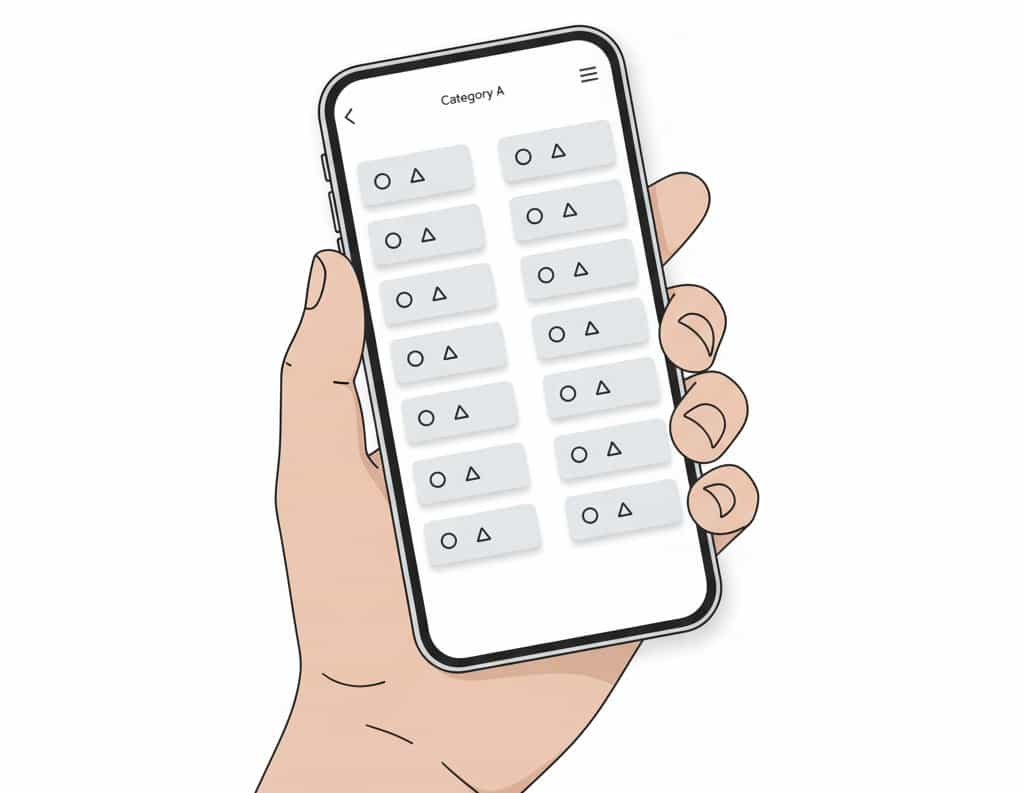
Understanding the mechanisms of perception is critical for fields that rely on how humans interact with the physical and digital world[cite: 1]:
UX/UI Design: Designers use Gestalt principles and constancy to create intuitive and easy-to-navigate applications and websites.
Forensic Psychology: Research on attention and memory, like the impact of weapon focus (Loftus, 1979), is used to analyze the reliability and limitations of eyewitness testimony. This is a key area of study in criminal profiling and perception psychology.
Safety Engineering: Designing cockpit displays, automobile dashboards, and warning signs to reduce the likelihood of perceptual error (e.g., misreading a dial or failing to notice a hazard). The study of attention in psychology is fundamental to this work.
FAQs
What is the difference between sensation and perception?
Sensation is the passive process of sensory receptors detecting raw physical stimuli (light, sound, heat)[cite: 1]. Perception is the active cognitive process where the brain organizes and interprets those sensory signals into meaningful experiences[cite: 1].
Why does perceptual error occur?
Perceptual errors occur because the brain relies heavily on shortcuts, expectations, and context (top-down processing) to process information quickly[cite: 1]. When sensory input is ambiguous or attention is focused elsewhere, these shortcuts can lead to illusions or blind spots[cite: 1].
How are Gestalt principles used in everyday life?
Gestalt principles are widely applied in user interface (UX/UI) design, graphic design, and marketing to group elements naturally, guide user attention, and make information easier to visually digest[cite: 1].
References
Gregory, R. L. (1997). Knowledge in perception and illusion. Philosophical Transactions of the Royal Society of London. Series B: Biological Sciences, 352(1358), 1121–1128[cite: 1].
Gibson, J. J. (1979). The ecological approach to visual perception. Houghton Mifflin[cite: 1].
Hubel, D. H., & Wiesel, T. N. (1962). Receptive fields, binocular interaction and functional architecture in the cat’s visual cortex. The Journal of Physiology, 160(1), 106–154[cite: 1].
Koffka, K. (1935). Principles of Gestalt Psychology. Harcourt, Brace and Company[cite: 1].
Loftus, E. F. (1979). Eyewitness testimony. Harvard University Press[cite: 1].
McGurk, H., & MacDonald, J. (1976). Hearing lips and seeing voices. Nature, 264(5588), 746–748[cite: 1].
Simons, D. J., & Chabris, C. F. (1999). Gorillas in our midst: Sustained inattentional blindness for dynamic events. Perception, 28(9), 1059–1074[cite: 1].
Note: This article is for educational purposes only and does not constitute professional clinical advice.[cite: 1]
Related Articles

Sponsored


You May Also Like

The Silent Power Move: Why High-Status Professionals Priorit…

Why Mental Health Challenges Can Develop Over Time

Why Do Some People Seek Therapy Even When Life Seems Fine?

When Anxiety Becomes a Problem? Signs to Watch

Initiative vs. Guilt (Erikson’s Third Stage of Psychosocial …