
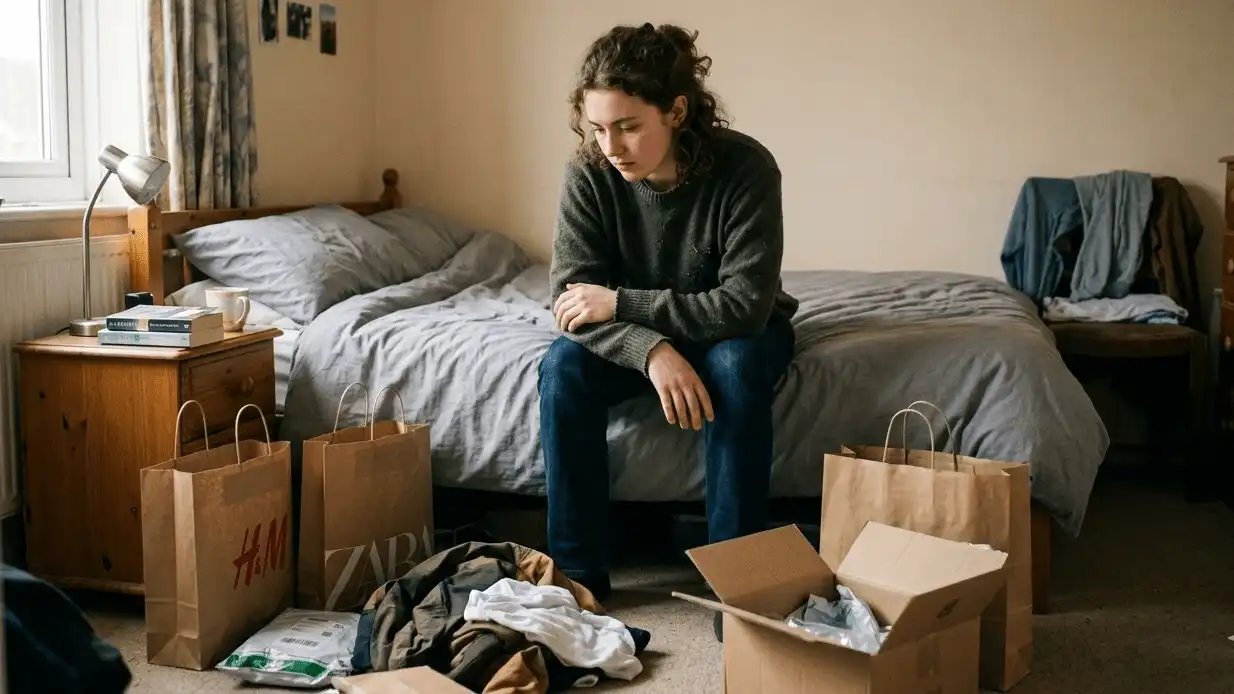
Why People Emotionally Shop
Shopping is never just about acquiring things. It is about regulating feelings.
When you feel anxious, bored, lonely, or angry, the brain seeks relief. Fast fashion offers the cheapest, fastest relief available. A $15 shirt delivers a dopamine spike within seconds — no therapy, no meditation, no difficult conversation required.
The problem is not occasional emotional shopping. The problem is when shopping becomes the primary emotional regulation strategy. The shirt arrives. The dopamine fades. The original emotion returns, often with added guilt. So you shop again. The loop tightens.
This is not weakness. This is the brain doing exactly what it evolved to do: seek pleasure, avoid pain. Fast fashion companies know this. They design for it.
The Psychology of Revenge Shopping
Revenge shopping is the sudden, often excessive purchase of items following a period of deprivation, stress, or perceived injustice.
The term exploded during post-lockdown periods, but the psychology is older. Revenge shopping is driven by three mechanisms:
Core Driving Mechanisms
- Compensation — “I was denied pleasure. Now I will reclaim it.”
- Control restoration — “I could not control that situation. I can control buying this.”
- Identity reassertion — “That experience made me feel small. This purchase makes me feel powerful again.”
Revenge shopping feels like freedom. But it often creates the opposite: debt, clutter, and the realization that no handbag can undo what hurt you.
| Emotional Driver | Shopping Behavior | Long-Term Outcome |
|---|---|---|
| Boredom | Browsing → small impulse buys | Clutter, mild guilt |
| Loneliness | Buying “aspirational” outfits for imagined social events | Unworn clothes, deeper loneliness |
| Anger | Expensive purchases, visible logos | Short-term relief, financial stress |
| Injustice (revenge) | Multiple items, often from same brand | Buyer’s remorse, avoidance of returns |
| Stress | High volume of cheap items | Overwhelmed space, decision fatigue |
Fast Fashion and Dopamine Addiction
Fast fashion is engineered for addiction.
The business model is not clothing. It is novelty. New styles every week. Limited drops. “Buy now or lose it.” Your brain responds to novelty with dopamine — the same neurotransmitter involved in gambling and social media scrolling.
Each step of the fast fashion cycle is optimized for reward:
The Fast Fashion Cycle
- 1. Anticipation — scrolling, adding to cart (dopamine begins)
- 2. Purchase — click, confirmation email (dopamine peaks)
- 3. Arrival — package opening (smaller spike)
- 4. Post-purchase — guilt, boredom (dopamine drops below baseline)
- 5. Repeat — need new hit
The only way to break the cycle is to recognize that the feeling you are chasing is not in the package. It is in the anticipation. And anticipation can be generated without spending money.
Why Clothes Become Emotional Comfort
Clothing offers unique emotional comfort because it is physical and symbolic simultaneously.
Physically: soft fabrics, familiar weights, warm layers — these trigger tactile soothing responses similar to a childhood blanket.
Symbolically: clothing represents identity. A new dress is not fabric. It is “the person I want to become.” Buying it feels like becoming that person.
This is why people hold onto unworn clothes for years. The clothes are not clutter. They are talismans — objects carrying the hope of a future self.
The dark side: talismans do not create change. Only action does. But action is hard. Shopping is easy.
You May Also Like
Learn why smart people make bad decisions under pressure — emotional shopping is often a pressure-driven mistake.
Identity, Trends, and Social Pressure
Fast fashion does not just sell clothes. It sells belonging.
When a trend emerges, wearing it signals: “I am part of this moment. I understand the code. Accept me.”
Not wearing a trend signals risk: irrelevance, exclusion, being left behind. This fear is real. Social rejection activates the same brain regions as physical pain.
But trends move faster than ever. What signals belonging this week signals desperation next week. The only way to keep up is to keep buying. The only way to stop is to tolerate the discomfort of not belonging — and discover that the discomfort passes.
Can Shopping Improve Mood?
Yes — temporarily.
A 2013 study found that 62% of shoppers had made an impulse purchase to improve their mood. And it worked. For about 30 minutes.
The problem is not the temporary lift. The problem is the crash. Mood improves, then drops below original levels. The second purchase requires more novelty to achieve the same lift. Tolerance builds.
The healthier alternative is not “never shop.” It is separate emotional shopping from identity shopping.
Shopping Mindsets
- Emotional shopping (I feel bad → I buy) → reduce frequency
- Identity shopping (I need an outfit for a specific purpose) → keep
If you cannot remember why you bought an item three months later, it was emotional shopping.
Final Thoughts
Fast fashion is not evil. It is designed for your brain’s weaknesses.
Understanding the design does not make you immune. But it gives you a choice. The next time you feel the urge to revenge-shop, pause and ask: “Am I buying a shirt or am I buying relief from a feeling I am unwilling to feel?”
The shirt will not answer. But you might.
Related Articles


Sponsored


You May Also Like

7 Signs Low Self-Confidence Is Holding You Back (Without Say…

Why Do We Care So Much About Others’ Opinions?

The Collaborative Threat: How to Disagree Productively Witho…

The Psychology of “Cockroach Army”: How Reels Turn Crowds In…
The All-Nighter Myth: How Sleep Deprivation Blocks Memory Co…
