
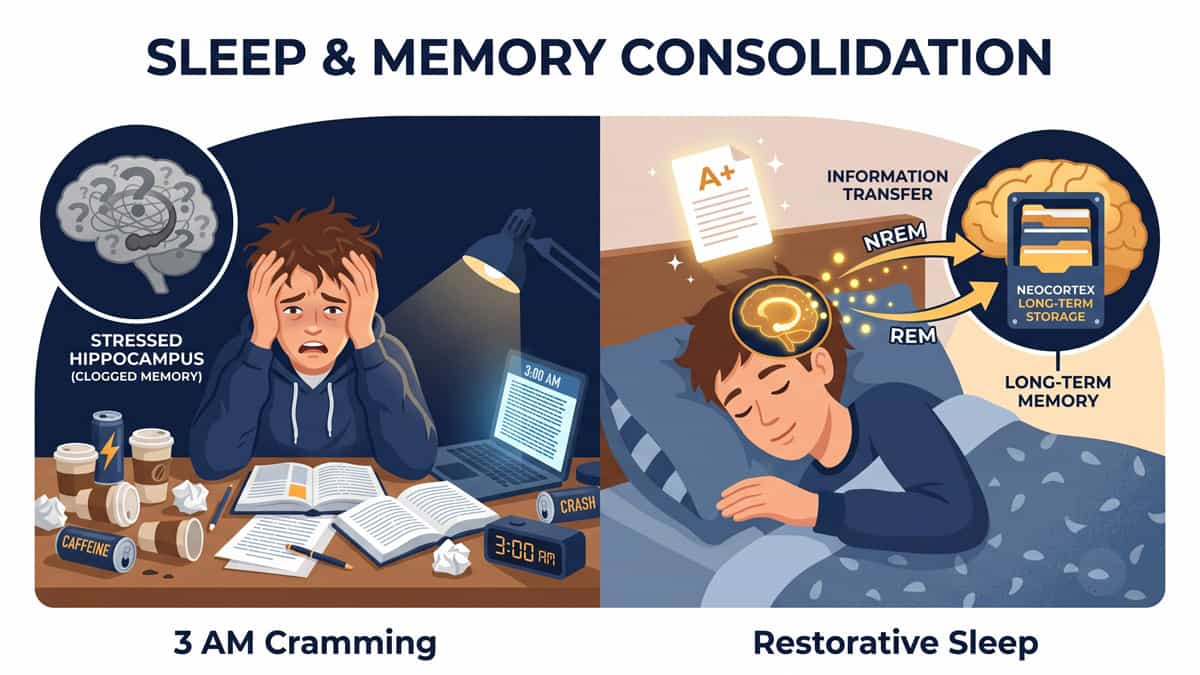
It’s 3:00 AM. Your third coffee is cold. The textbook is blurry. But you tell yourself: “I just need to get through this one night. I’ll cram it all in, and it’ll stick.”
Every semester, millions of students make the same bet—that trading sleep for study time will pay off on exam day. It’s the most common academic gamble there is. And it is the worst bet you can make.
Here’s the brutal truth: pulling an all-nighter doesn’t just fail to help—it actively sabotages everything you just studied. The science of sleep and memory is unforgiving: without sleep, the brain cannot save what you’ve learned. You’re not cramming. You’re flushing.
The Brain’s Night Shift: Why Sleep Is Not “Shutting Down”
For decades, scientists thought sleep was a passive state—the brain simply resting after a long day. That view is dead wrong.
Sleep is an active, highly orchestrated neurological process during which the brain performs its most critical maintenance tasks. Among them: memory consolidation—the process of transforming fragile, short-term memories into durable, long-term storage.
This consolidation happens almost exclusively during sleep, specifically during the interplay of two distinct sleep stages:
GOOD
- ✓ NREM Sleep (Declarative Memory): Replays and strengthens facts, dates, formulas, and vocabulary in an unconscious rehearsal session.
- ✓ Rebuilds physical synaptic connections needed for long-term retention.
BAD
- ✕ REM Sleep (Procedural & Creative): Integrates new information with existing knowledge.
- ✕ Fosters creative problem-solving and solidifies how to execute complex tasks.
Together, these stages create a neural filing system that organizes and archives what you learned that day. When you skip sleep, you shut down the entire archive department.
The Hippocampus: Your Memory’s Gatekeeper
The hippocampus—a seahorse-shaped structure deep in your brain—is the temporary holding tank for new memories. Think of it as your brain’s short-term warehouse. During waking hours, it accumulates everything you encounter.
But the hippocampus has limited storage. If it fills up, new information starts to overwrite old information. The solution? During sleep, the hippocampus offloads these memories to the neocortex (the brain’s long-term hard drive). This transfer is what we call memory consolidation.
Sleep deprivation stops this transfer cold.
When you pull an all-nighter, the hippocampus remains clogged. New information taken in during those late-night hours never gets filed. Worse, the information you studied earlier that day doesn’t get consolidated either—because you never gave your brain the chance to run the transfer.
“Sleep is not the enemy of studying; it is the ally. Without it, the hippocampus literally cannot process what you’ve learned.“
The Synaptic Plasticity Problem
At the microscopic level, memory is built through synaptic plasticity—the strengthening of connections between neurons. When you learn something new, synapses fire together, and those pathways become more efficient.
Here’s the critical catch: synaptic strengthening requires specific molecular processes that are largely restricted to sleep. During NREM sleep, the brain produces proteins that physically alter synaptic connections. These proteins are the literal building blocks of memory.
Without sleep, those proteins are not produced. The synapses don’t strengthen. The learning doesn’t stick.
What the Research Actually Says
The evidence for sleep-dependent memory consolidation is overwhelming:
WHAT NEUROSCIENCE PROVES
- Nature Neuroscience Study: Sleep deprivation immediately after learning completely blocks hippocampal activation, preventing the brain from encoding memories.
- Medical Resident Research: A single night of sleep deprivation reduced the ability to remember newly learned material by nearly 40%.
- Cramming vs. Sleeping: Experiments consistently show students who prioritize sleep outperform those who pull all-nighters—even when sleeping students studied fewer total hours.
- REM & SWS Stages: Dual-stage sleep enhances long-term retention, creative problem-solving, and integration with existing knowledge frameworks.
The Double Hit: Lost Consolidation + Impaired Retrieval
Pulling an all-nighter inflicts two distinct cognitive wounds:
THE TWO COGNITIVE WOUNDS
- Wound #1: Blocked Consolidation
Memories never get transferred to long-term storage. You might recognize the material during the exam, but you will not be able to retrieve it on demand. - Wound #2: Impaired Retrieval
Sleep deprivation impairs frontal lobe function—the area governing attention, logical reasoning, and memory access under stress. A sleep-deprived brain literally cannot access what it stored.
The 24-Hour Window: Why a Full Night Matters Most
Research on memory consolidation reveals a critical 24-hour consolidation window. The most fragile period for a new memory is the first night after learning. If you disrupt sleep during that window, the memory is permanently weakened—no amount of later catching up can fully repair the damage.
So if you studied hard on Tuesday, pulling an all-nighter Tuesday night is the single most destructive choice you can make for a Wednesday exam. You’re not just tired. You’re actively deleting the effort you put in.
How to Sleep Your Way to Better Grades
The evidence-based strategy is simple, counterintuitive, and radically effective:
SCIENCE-BACKED SLEEP PROTOCOL
- ✓ Study early, sleep regularly: Distribute your studying over several days and sleep a full night each night so your brain consolidates incrementally.
- ✓ Prioritize sleep over extra cramming: Six hours of sleep plus six hours of studying beats ten hours of studying plus zero sleep every time.
- ✓ Aim for 7–9 hours: Ensure you complete full cycles of both NREM and REM sleep before a major test.
- ✓ Naps help, but do not replace night sleep: A 90-minute nap provides brief consolidation benefits but cannot replace overnight processing.
- ✓ Cut caffeine and blue light early: Both disrupt NREM sleep onset, severely delaying memory consolidation.
The Bottom Line
The all-nighter is a myth—a seductive, dangerous lie that has ruined more exam scores than any single topic ever has. Sleep deprivation doesn’t just make you tired; it blocks the biological processes that turn study time into knowledge.
Your brain needs sleep to file memories. Without it, your hippocampus stays clogged, synaptic connections stay weak, and everything you crammed disappears into the void. The students who sleep before a test aren’t lazy—they’re strategic. They’re letting their brains do the one job that studying alone cannot.
So the next time you’re tempted to trade sleep for a few more pages of notes, remember: pulling an all-nighter doesn’t prove you’re dedicated. It proves you’re working against your own biology. And biology always wins.
10 KEY TAKEAWAYS FROM THIS ARTICLE
- 1. Sleep is part of studying: Your brain uses sleep to process and consolidate what you studied; it is not simply “time away” from learning.
- 2. The hippocampus needs sleep: New memories depend on neurological processes that help move information toward durable long-term storage.
- 3. All-nighters create a double problem: Skipping sleep interferes with memory consolidation while also impairing attention and retrieval the next day.
- 4. More study hours ≠ more learning: Hours spent awake are useless if fatigue prevents your brain from effectively encoding and retrieving information.
- 5. The first night matters most: Sleep within the 24-hour window after studying gives the brain its most important opportunity to consolidate newly learned material.
- 6. Sleep helps more than recall: Different sleep stages (NREM and REM) support memory, creative problem-solving, and information integration.
- 7. Cramming and sleep are not equal: Giving up sleep for a few additional hours of revision actively undermines the learning those hours were meant to build.
- 8. Naps cannot replace night sleep: Short naps provide minor benefits, but they cannot reproduce everything a full 7–9 hour night of sleep provides.
- 9. Study timing matters: Spreading study across multiple days and sleeping between sessions gives your brain repeated opportunities to consolidate learning.
- 10. Exhaustion is not productivity: Working until 3 AM may feel like dedication, but effective studying depends on what your brain retains—not how long you stayed awake.
Stop sabotaging your memory consolidation. Download our free printable protocol to optimize your study-to-sleep ratio before your next major exam.
Related Articles

Sponsored


You May Also Like

Cognitive Dissonance 101: Why We Justify Bad Habits When We …

Why Our Brains Still React to Ancient Survival Threats

Educational Psychology: What It Is, Key Theories, Examples &…

Conversational Velocity: The Psychology of Speech Rate and P…

7 Signs Overthinking Is Silently Ruining Your Day (And How t…
