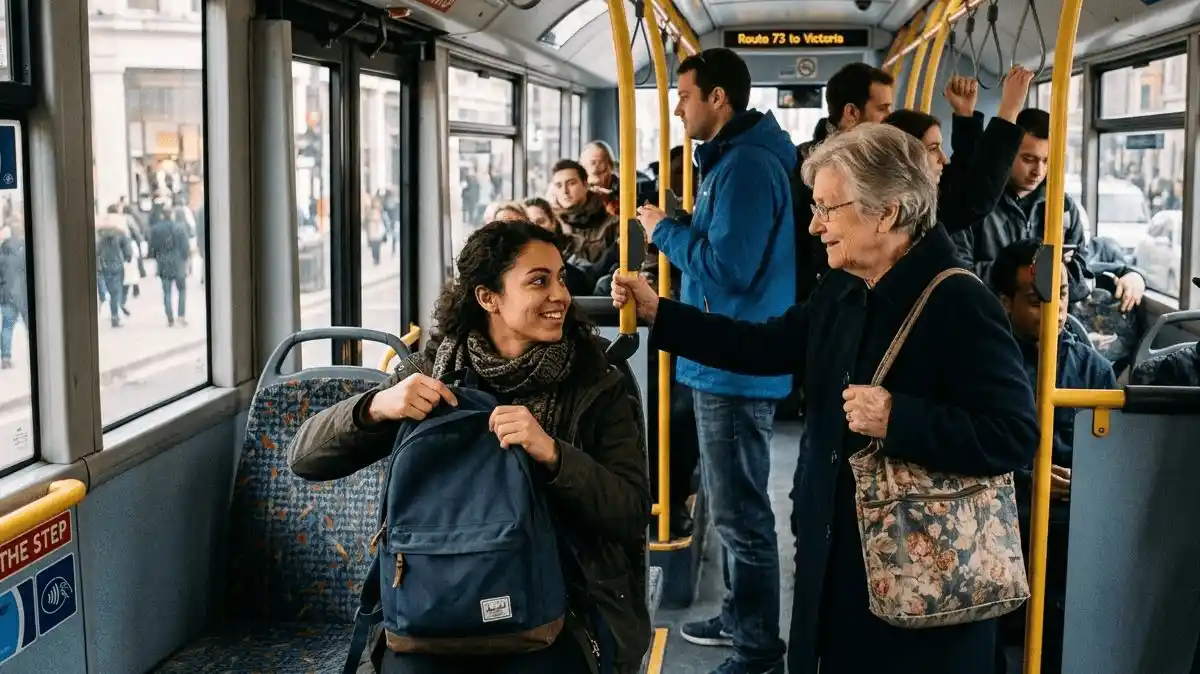
The Consideration Matrix: How Commute Etiquette Shapes Invisible Trust Networks

Busy metro station, passengers letting others exit the train first before boarding, calm and orderly flow, no pushing.

Why Commute Etiquette Matters More Than People Think Every day, millions of tiny decisions shape the public transit experience. Letting someone exit before boarding. Keeping the escalator left lane clear. Offering a seat to someone who needs it. These acts seem trivial — but they are the threads of an invisible trust network that holds … Read more

The Propinquity Effect: How Repeated Glimpses Build (or Break) Neighborhood Trust

A suburban street, a person walking a dog at the same time each day, a neighbor watching from a porch, calm and familiar scene. Image Title: Propinquity Effect – How Repeated Glimpses Build (or Break) Neighborhood Trust Caption: Every wave, every walk, every routine is a vote in your neighborhood reputation. Propinquity builds trust without words.

What the Propinquity Effect Really Means Propinquity — physical or psychological proximity — is one of the most powerful forces in social psychology. The mere exposure effect, first documented by Robert Zajonc, shows that repeated, passive exposure to a stimulus increases liking for it. In neighborhoods, this means that every time a neighbor sees you … Read more

Interdependent Friction: Managing Social Status and Autonomy in a Joint Family Matrix

A multi‑generational family sitting together in a living room, one younger adult speaking calmly while elders listen, warm and respectful atmosphere.

The Psychology of Multi‑Generational Living A joint family is not a collection of individuals. It is a living system — an interdependent matrix where every action triggers a reaction, every mood influences the group, and every member occupies a specific rung on an invisible ladder. In this system, social status is not earned through career … Read more

The Psychology of Where You Live: How Neighbourhoods Affect Your Mind

Person standing by window looking at busy city street, showing how neighbourhood environment influences stress and well-being

While comparing stress levels across different living environments, I noticed that people’s mental states often mirrored their surroundings. Some felt constantly alert and tense, while others appeared emotionally grounded and calm. Community psychology explains how neighbourhood design, safety, and interaction quietly shape emotional health—often without people realizing it. Environment Shapes Psychology Where we live is … Read more

Social Media vs. Real Communities: Why Interaction Isn’t Always Belonging

A split-screen illustration showing a person surrounded by glowing social media icons on one side and a warm, inclusive group of people talking in a circle on the other.

Two Types of Communities At first glance, social media communities and real-life communities appear similar. Both offer shared interests, identity, and interaction. However, they function very differently. Social belonging online is often driven by visibility, while offline belonging relies on presence and mutual accountability. This distinction shapes whether we feel truly supported or “digitally surrounded … Read more

Loneliness Isn’t a Personal Failure — It’s a Community Gap

A realistic illustration of diverse adults sitting apart on individual stone blocks, focused on their glowing phones with thin light trails connecting them, symbolizing digital connection despite physical isolation.

Redefining Loneliness Loneliness is commonly misunderstood as a personal shortcoming—something that happens when people “fail” socially. In reality, loneliness is a social signal, much like hunger or pain, alerting us that our need for connection isn’t being met. Humans evolved as deeply social beings, wired for belonging and shared meaning. This is a core concept … Read more