
Why Tiny Courtesies Feel Huge in Public Transit
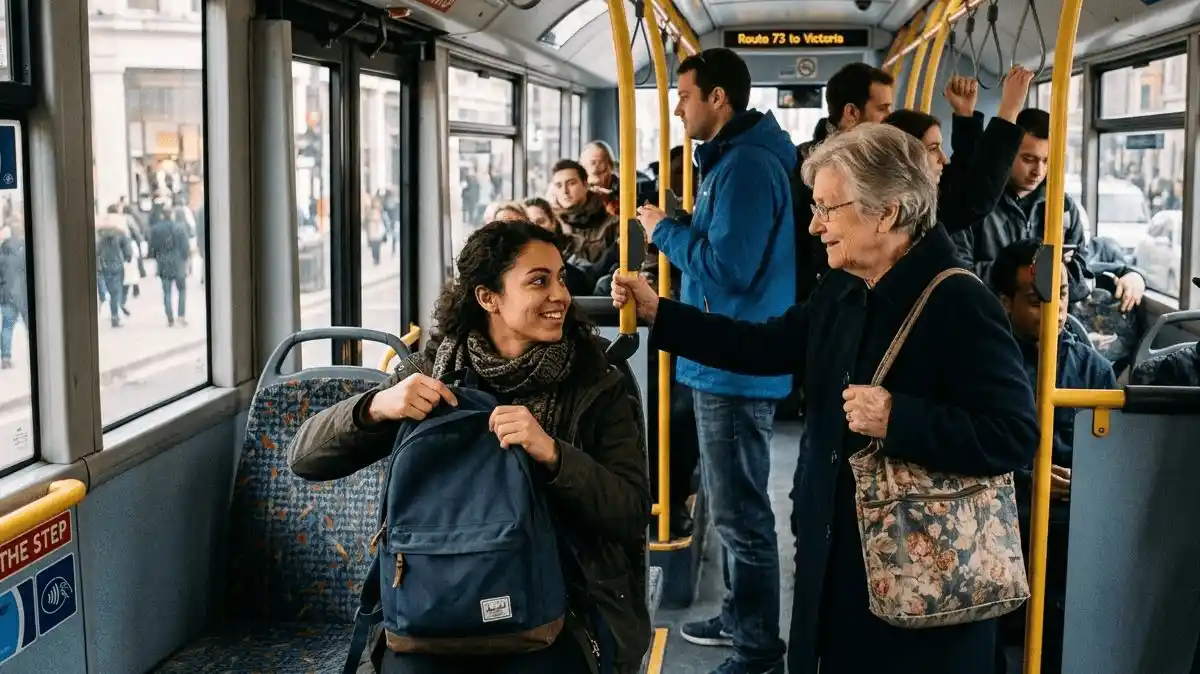
On a crowded bus, small physical adjustments carry enormous social weight. A person shifts their bag from the seat to their lap, making room for a standing passenger. Another angles their knees away from the neighbor’s space. A third steps back to let someone exit first.
These are acts of kinesthetic courtesy — small, voluntary physical accommodations that reduce interpersonal friction in shared spaces. They cost almost nothing. Yet they generate disproportionate social goodwill.
The brain is exquisitely sensitive to kinesthetic courtesy. When someone makes a small physical adjustment for your comfort, you register it as a prosocial signal — evidence that the person is kind, aware, and trustworthy. Conversely, when someone fails to make an obvious accommodation (bag on seat while people stand, knees spread wide), the omission signals selfishness or obliviousness.
In high‑density environments like buses, micro‑friction mastery is the difference between being perceived as a considerate human and being silently resented by everyone around you.
The Psychology of Physical Accommodation
Physical accommodation is any voluntary reduction of your spatial footprint to benefit others. On public transit, this includes:
COMMON PHYSICAL ACCOMMODATIONS
- ✓ Moving a bag from the seat to your lap when the bus fills
- ✓ Tucking your knees inward to give the next seat more room
- ✓ Shifting your shoulder slightly when someone needs to pass
- ✓ Stepping off the bus to let others exit, then reboarding
- ✓ Holding a pole in a way that leaves space for others’ hands
These acts are not required. No law mandates bag removal. No sign demands knee tucking. That is precisely why they are powerful. They are chosen kindness — visible evidence of character.
When you accommodate, observers (including strangers) note it. They may not consciously thank you, but their brain files the data: “This person is cooperative. Safe. Good to be near.”
| Kinesthetic Act | Observer Perception | Social Premium |
|---|---|---|
| Moving bag to lap when bus fills | Aware, considerate, high social intelligence | High |
| Knees together, not manspreading | Respectful, low entitlement | High |
| Stepping aside to let others pass | Patient, cooperative | Medium‑High |
| Holding pole near the top (leaving lower space) | Thoughtful of shorter passengers | Medium |
| No accommodation (bag on seat, knees wide, blocking) | Selfish, oblivious, low status | Negative |
Bags, Knees, and Shared-Space Respect
The most common micro‑friction violations on buses involve bags and knees.
Bag violations:
- Leaving a bag on the empty seat next to you while people stand nearby
- Placing a backpack on the floor in a way that blocks the aisle
- Swinging a bag onto a seat without checking for someone already reaching for it
Knee violations (often gendered):
- Sitting with knees spread wide (“manspreading”), occupying 1.5 seats of space
- Extending legs into the aisle, forcing standing passengers to step over
- Crossing legs in a way that pokes the neighbor
Each of these violations is small. Each takes less than a second to correct. Yet each signals that the violator prioritizes their own comfort over the collective good. Observers notice. Resentment builds.
The socially intelligent passenger anticipates these violations and corrects them before anyone has to ask. Bag on the lap before the bus gets crowded. Knees together as soon as a neighbor sits down. This is not submission. It is leadership by accommodation.
How Courtesy Lowers Environmental Stress
Public transit is inherently stressful. The brain is in high‑alert mode — monitoring strangers, tracking exits, managing proximity. Kinesthetic courtesy acts as a stress buffer.
When someone accommodates you, your cortisol levels drop slightly. The environment feels safer. You relax. When someone fails to accommodate, your cortisol rises. The environment feels more hostile.
Over a full commute, these micro‑frictions accumulate. A bus ride with courteous passengers leaves you feeling neutral or even slightly restored. A ride with multiple violations leaves you irritable — and you may not know why.
The courteous passenger is not just being nice. They are reducing the ambient stress of the entire vehicle. That is a public service.
Prosocial Signals and Public Trust
Kinesthetic courtesy is a prosocial signal — a non‑verbal announcement that you value the group over your individual convenience. Prosocial signals build trust networks, even among strangers.
When you accommodate, you are not just helping one person. You are demonstrating a behavioral pattern. Observers infer that you are likely to be helpful in other ways — following rules, paying fares, assisting in emergencies.
In sociology, this is called generalized reciprocity. Your small act of courtesy increases the likelihood that others will act courteously toward strangers later. The effect ripples through the social system.
This is why courteous public behavior is not optional for a functioning society. It is the glue.
Why Rude Movement Feels Personal
When someone fails to accommodate — a bag left on a seat while you stand, a knee pressing into your leg — it feels personal. But it rarely is. The violator is usually not targeting you. They are simply unaware.
However, the brain does not care about intent. It only registers impact. A violation feels like disrespect because the brain processes spatial intrusion as a status challenge. The message received is: “You do not matter enough for me to move.”
Knowing this, the courteous passenger does not wait to be asked. They anticipate. They move their bag before anyone has to stand. They shift their knees before contact occurs. This is not anxiety — it is anticipatory empathy.
Kinesthetic Awareness and Social Intelligence
Kinesthetic awareness — the ability to sense your body’s position relative to others — is a marker of social intelligence.
SIGNALS OF HIGH KINESTHETIC AWARENESS
- Notice when they are blocking an aisle
- Feel when their bag is touching someone
- Adjust posture automatically when space becomes tight
- Never need to be asked to move
People with low kinesthetic awareness are not malicious. They are simply not sensing the friction they create. But the outcome is the same: they are perceived as rude, oblivious, or entitled.
Kinesthetic awareness can be trained. Start by noticing your physical footprint. Look at your bag. Feel your knees. Check the space behind you. Small adjustments become habit.
Final Thoughts
Micro‑friction mastery is not about being a doormat. It is about recognizing that tiny physical accommodations generate massive social returns.
Move your bag. Tuck your knees. Step aside. Hold the pole at the top. These acts take less than a second. They cost nothing. But they tell everyone around you: “I see you. I respect you. We are in this together.”
On a crowded bus, that signal is priceless.
Related Articles


Sponsored


You May Also Like

Attention Psychology: Your Beginner’s Guide to Masteri…

Taare Zameen Par & Psychology: Dyslexia, Empathy, and Le…

Why Smart People Make Bad Career Decisions Under Pressure

Why Competitive Education Makes Even Good Students Feel Like…

Why Procrastination Is Not Just Laziness
