

While comparing stress levels across different living environments, I noticed that people’s mental states often mirrored their surroundings. Some felt constantly alert and tense, while others appeared emotionally grounded and calm. Community psychology explains how neighbourhood design, safety, and interaction quietly shape emotional health—often without people realizing it.
Key Takeaways
- Neighbourhoods act as psychological ecosystems that directly impact your stress and cortisol levels.
- Perceived safety and low noise levels are fundamental for long-term emotional security.
- Micro-interactions with familiar faces foster community resilience and lower rates of anxiety.
Environment Shapes Psychology
Where we live is not just a physical location; it is a psychological ecosystem. Neighbourhood environment, including safety, noise, green spaces, and social connection, directly affects stress levels, emotional regulation, and long-term mental well-being. Health psychology shows that chronic environmental stressors activate the body’s stress response, gradually impacting sleep, mood, and physical health .
As urbanization increases, understanding the psychological impact of neighbourhoods becomes essential—not just for policymakers, but for individuals seeking healthier lives.
Safety, Trust, and Stress Levels
Perceived safety is one of the strongest predictors of psychological comfort. Living in areas with frequent crime, poor lighting, or unpredictable surroundings keeps the brain in a constant state of vigilance. This activates the stress response system, increasing cortisol and emotional exhaustion over time.
A large-scale UK study found that residents of high-crime neighbourhoods reported significantly higher anxiety and depressive symptoms—even when personal victimization had not occurred. The perception of danger alone was enough to raise stress levels.
As psychologist Abraham Maslow noted, “A person who feels unsafe cannot grow psychologically.” Safety is not a luxury—it is a mental health foundation.
The Role of Familiar Faces
Human brains are wired for recognition and predictability. Seeing familiar neighbours, shopkeepers, or morning walkers creates micro-moments of reassurance. These repeated, low-intensity social interactions strengthen emotional security and reduce loneliness.
Community psychology research shows that neighbourhoods with stronger social ties experience lower rates of depression and anxiety. Social connection acts as a buffer against stress, similar to other protective factors in health psychology .
Noise, Crowding, and Mental Load
Constant noise—traffic, construction, overcrowding—adds invisible cognitive strain. The brain is forced to filter stimuli continuously, increasing mental load and irritability. Studies from the United States have linked long-term exposure to urban noise with higher stress hormones, sleep disturbances, and reduced attention capacity.
Crowding also reduces perceived control, a key factor in psychological stress. When people feel they cannot regulate their environment, emotional fatigue builds faster.
Why Supportive Neighbourhoods Feel Calmer
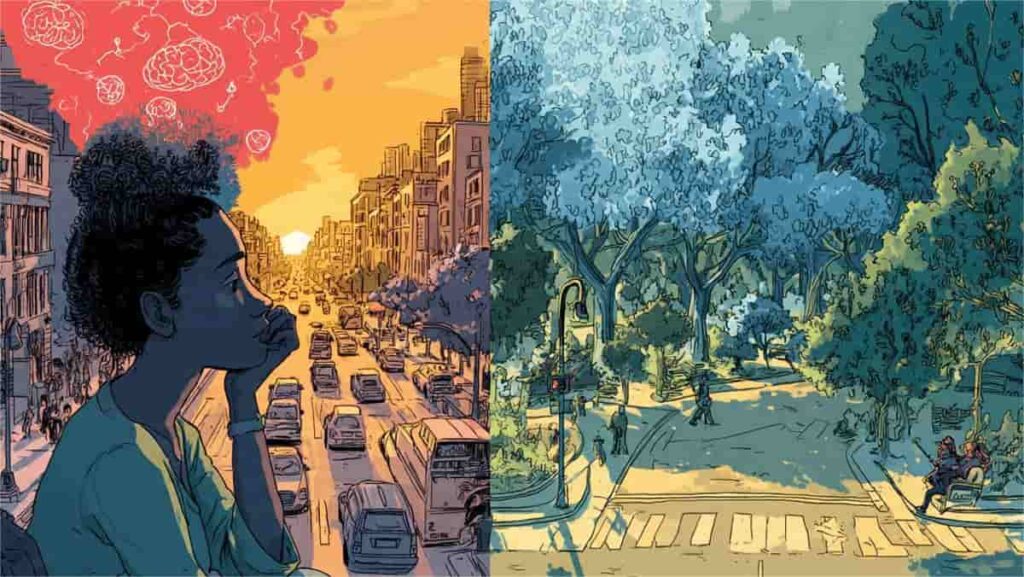
BENEFITS
- ✓ Abundant green spaces & walkability
- ✓ Predictable, soothing daily routines
- ✓ Mutual respect & social norms
- ✓ Activates ‘rest and digest’ nervous system
DRAWBACKS
- ✕ Constant urban traffic & construction noise
- ✕ High density causing crowd fatigue
- ✕ Unpredictable surrounding environments
- ✕ Sustained high cortisol & stress levels
Supportive neighbourhoods share common traits: green spaces, walkability, predictable routines, and social norms of mutual respect. These environments promote parasympathetic nervous system activation—the “rest and digest” state.
A well-known case study from Copenhagen showed that neighbourhoods redesigned to prioritize pedestrians and shared spaces led to improved mood, reduced stress complaints, and higher life satisfaction among residents.
This reflects the mind-body connection, where external calm supports internal balance .
You May Also Like
Understanding the Mind-Body Connection and Stress Response
Community Interaction and Emotional Security
Communities that encourage interaction—festivals, shared parks, local groups—foster collective resilience. During stressful life events, people in connected neighbourhoods report feeling “held” rather than isolated.
In Japan, community-oriented housing for older adults significantly reduced loneliness-related depression and anxiety. Emotional security increased not because of therapy, but because daily life felt socially supported.
This aligns with findings in positive psychology, where belonging and meaning are essential for well-being .
Designing Healthier Living Spaces
Urban planners and policymakers now recognize that mental health must be considered in design. Simple changes—better lighting, green areas, noise regulation, and shared community spaces—can lower population-level stress.
Even individuals can make micro-adjustments: engaging with neighbours, choosing quieter routes, or spending time in local green spaces. Small environmental shifts can lead to meaningful psychological relief.
Where You Live Shapes How You Feel
Mental health is not shaped by the mind alone. Neighbourhood design, safety, and social connection quietly influence how relaxed, alert, or overwhelmed we feel every day. Understanding this relationship empowers individuals and societies to create environments that support—not strain—psychological health.
As community psychology reminds us, healing does not always begin within the person; sometimes, it begins around them.
Note: This article is for educational purposes only and does not constitute professional clinical advice.
FAQs
Can changing neighbourhoods improve mental health?
Yes. Moving to safer, quieter, and more socially connected areas is often associated with reduced stress and better emotional stability.
How does neighbourhood stress affect physical health?
Chronic environmental stress increases cortisol, which can impact sleep, immunity, and cardiovascular health.
Are green spaces really that important?
Absolutely. Access to nature is linked to lower anxiety, improved mood, and better cognitive functioning.
Related Articles



Sponsored


You May Also Like

The Imposter Phenomenon in Academics: Why High Achievers Fee…

Signs Low Self-Confidence Is Holding You Back

Beyond the Game: Why Visualization Is the Secret Weapon of E…
Why Do Some People Seek Therapy Even When Life Seems Fine?

The Comfort Conundrum: Does Dressing Casual Casualize Your W…
