Two Minds, Two Decision Styles
When faced with danger, animals rarely hesitate. A deer bolts at the faintest rustle. A bird abandons a nest if conditions turn risky. Humans, however, often freeze—mentally. We analyze, compare, doubt, and overthink. This contrast reveals two fundamentally different decision-making styles: instinctive efficiency versus cognitive complexity.
Understanding how animals decide under pressure can teach us why humans struggle—and how simplifying our choices can actually lead to better outcomes.
How Animals Decide Under Pressure
Animals operate under constant survival pressure. Their brains are optimized for speed, not deliberation. Rather than evaluating dozens of variables, animals rely on evolved heuristics—simple mental shortcuts shaped by natural selection.
From an evolutionary psychology perspective, these fast decisions work because environments tend to reward “good enough” answers over perfect ones1. In the wild, hesitation is costly. An animal’s survival often depends on perception and how the brain constructs reality to react to immediate threats2.
Speed vs Accuracy in Decision-Making
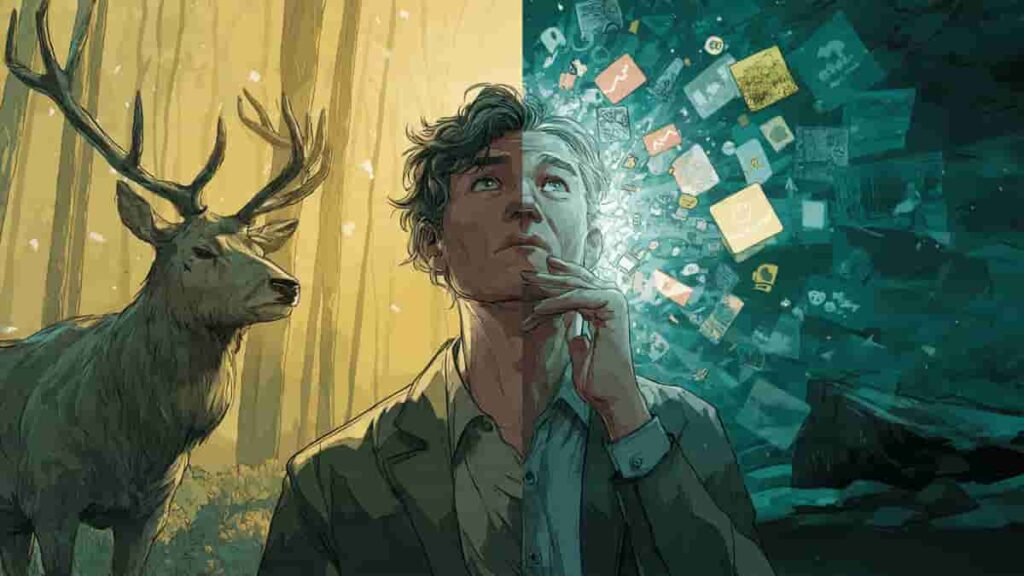
Psychologists describe this trade-off as the speed–accuracy dilemma. Animals lean heavily toward speed. Humans, by contrast, often prioritize accuracy—even when speed matters more.
A well-documented case comes from emergency medicine. Studies of ER triage show that experienced nurses often rely on gut judgments rather than lengthy analysis. This mirrors animal strategies: fast, experience-based pattern recognition often outperforms slow, detail-heavy reasoning. This concept is closely linked to first impression psychology, where our brains make instant judgments to navigate social and physical environments quickly3.
Why Humans Over-Evaluate Choices
Humans possess advanced cognitive flexibility, allowing us to imagine future outcomes, regrets, and alternatives. While powerful, this ability has a downside—overthinking. Barry Schwartz famously called this the “paradox of choice.” More options don’t make us happier; they make us anxious. We fear choosing wrong, missing out, or being judged.
Social comparison and constant access to information intensify this effect. Unlike animals, humans don’t just decide—we evaluate ourselves for deciding.
The Cost of Too Much Information
Information overload taxes attention, increases decision fatigue, and reduces satisfaction. The neuropsychology of how thoughts influence behavior explains why: the prefrontal cortex—responsible for complex reasoning—tires quickly4. Animals avoid this bottleneck by delegating decisions to automatic systems.
Excessive conscious control often interferes with optimal performance, a principle also explored in mind-body psychology and stress regulation5.
Situations Where Animal Strategies Work Better
Animal-like decision rules outperform human deliberation in specific situations:
- High-pressure environments (emergency response, sports, combat)
- Time-limited decisions (driving, first impressions)
- Repeated familiar choices (daily routines, habits)
Applying Simpler Decision Rules in Human Life
Humans don’t need to abandon thinking—but we can simplify it. Practical ways to adopt animal-inspired strategies include:
- Limit options before deciding (set boundaries early).
- Trust trained intuition in familiar domains.
- Use “if-then” rules (If X happens, I do Y).
- Decide once for recurring choices (clothing, meals, routines).
Smarter Choices Don’t Always Mean Complex Ones
Animals remind us that effective decisions aren’t always deeply analytical. Often, simplicity, speed, and trust in experience lead to better outcomes. In a world flooded with choices, learning when not to think too much may be the most intelligent move of all.
Note: This article is for educational purposes only and does not constitute professional clinical advice.
Related Articles



Sponsored


You May Also Like

The Psychological Fallout of Read Receipts and “Left on Seen…
Why Do We Make Irrational Decisions So Often? The Science of…

Why Fog Feels Unsettling to Some People

Vulnerability vs. Status: The Delicate Balance of Projecting…

The Explorer Archetype – The Drive for Freedom, Adventure &a…