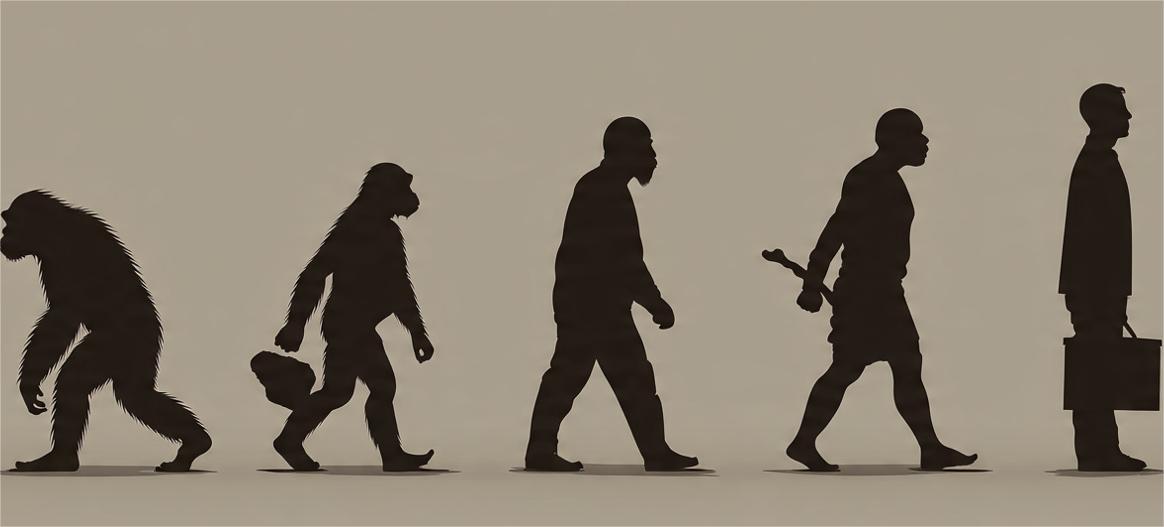
You check your phone for the 50th time today. Your heart races when you see a spider. You feel a pang of jealousy, an urge to gossip, or a deep sense of satisfaction when you finish a tough task. Why do we do the things we do? The answer, according to a fascinating field of science, lies not in our personal histories alone, but in our deep, collective past. Welcome to the world of evolutionary psychology—the study of how our Stone Age brains navigate the Space Age world.
KEY TAKEAWAYS
- Mind as a Tool: Your brain evolved through natural selection to solve ancestral survival and mating problems.
- Evolutionary Mismatch: Many modern psychological struggles stem from a Stone Age brain navigating a modern environment.
- Modular Design: The human mind is equipped with specialized ‘software’ modules for tasks like cheater detection and mate selection.
What Exactly Is Evolutionary Psychology?

In a nutshell, evolutionary psychology is founded on the simple yet powerful idea that evolution by natural selection didn’t just sculpt our bodies; it also sculpted our minds. Just as the human eye is a universal physical adaptation for seeing, our brain is a universal mental organ packed with “software” – psychological adaptations. These are mental modules that evolved to solve specific problems of survival and reproduction faced by our ancestors over millions of years. This means your fear of snakes, your craving for fatty foods, and your desire for social status aren’t random occurrences; they were once crucial tools for survival and reproductive success in an ancestral environment.
The Roots: Darwin’s Big Idea
The seed for this field was planted by none other than Charles Darwin. His theories of natural selection, where traits that enhance survival become more common, and sexual selection, where traits that enhance mating success become more common, were the starting point. Darwin observed that not just physical forms, but also emotions, instincts, and even moral sensibilities, could be products of evolution. He wondered why we feel shame, love, or disgust, and suggested these feelings must have served an adaptive purpose that improved an ancestor’s ability to survive and pass on their genes.
Building Blocks: The Core Principles
Evolutionary psychology rests on a few key premises that define its approach to the mind. First, it posits that the brain is essentially an information-processing machine that was designed by natural selection. Second, it holds that this neural circuitry was fundamentally shaped to solve the recurring and vital adaptive problems faced by our hunter-gatherer ancestors, such as finding a mate, securing food, or avoiding predators. Finally, the mind is likely modular, meaning it has many specialized, domain-specific programs for different tasks, rather than operating as a single, general-purpose system. This includes, for example, a program for “cheater-detection” in social exchanges and a distinct program for “mate-selection” when choosing a partner.
CORE EVOLUTIONARY PRINCIPLES
- ✓ Information-Processing Engine: Neural circuits process environmental inputs into adaptive behavior.
- ✓ Domain-Specific Modules: Specialized cognitive programs handle distinct tasks (e.g., predator avoidance, child-rearing).
- ✓ Functional Design: Every mental mechanism serves (or once served) an evolutionary function.
The Brain’s Design: Adaptations, By-products & Mismatches
Not every trait is a direct product of natural selection; evolutionary psychologists draw important distinctions between different aspects of human design. Adaptations are the primary “tools” shaped by selection, such as the fight-or-flight fear response. By-products, however, are side effects of adaptations that have no function themselves, like the belly button being a non-functional remnant of the umbilical cord. A crucial concept for understanding modern life is the mismatch. Our brains are adapted for an environment that no longer exists. For instance, our powerful craving for sugar and fat was essential for survival when high-calorie food was scarce on the savannah, but it becomes a major health liability in today’s world of easily accessible soda and donuts. Similarly, our deep-seated need for social validation, once limited to securing status within a small tribe, is now stretched to the breaking point by the overwhelming scale of social media.
From Hunter-Gatherers to Hashtags: The Environment of Evolutionary Adaptedness (EEA)

The EEA is not a specific time or geographic location, but a statistical composite of the environments in which human adaptations were forged. This was a world of small, close-knit, highly interdependent bands of generally 50 to 150 people. Ancestors faced immediate dangers like predators and rival tribes, experienced scarce, high-calorie food sources, and relied on face-to-face social interaction. Our fundamental instincts were built for this world. This explains why people across cultures instinctively fear snakes and spiders more readily than modern, statistically greater threats like driving a car, and why humans find it exceptionally difficult to save for retirement—our ancient wiring prioritizes immediate rewards in an uncertain present over distant, future payoffs.
Must Read
What Does Acrophobia Feel Like?
The Science Behind the Mind
Evolutionary psychology is grounded in more than just philosophical speculation; scientists rigorously test evolutionary hypotheses through various methods. Cross-cultural studies are used to find universal human patterns, such as identifying traits people across the globe consistently find attractive in a mate. Behavioral experiments observe how individuals act in game-theory scenarios that mimic ancestral problems, like cooperation or resource distribution. Neuroscience is employed to identify specific brain regions that activate in response to evolutionarily significant stimuli, such as ancestral threats or rewards. Finally, genetic studies help to understand the heritability and underlying biological basis of certain behavioral traits.
The Big Themes: Survival, Sex, Family & Society
This is where the field offers a coherent framework for understanding our most fundamental drives. When it comes to Mate Selection, it helps explain the perennial differences in preferences: men often show an evolved tendency to be drawn to youth and physical signs of health, which were reliable cues for fertility, while women often prioritize a potential partner’s status and resources, which signaled a greater ability to invest in offspring. The powerful, universal bond between parent and child is a testament to the crucial role of Parenting as the foundation of our species’ survival. The emergence of Cooperation & Altruism is explained by concepts like kin selection (where helping genetic relatives increases the odds of shared genes surviving) and reciprocal altruism (the “you scratch my back, I’ll scratch yours” system of non-kin cooperation). Lastly, Tribalism & Gossip served vital social functions: forming cohesive “in-groups” and being wary of “out-groups” was essential for safety, and gossip was effectively the ancient internet—a way to monitor social standing and determine who in the group could be trusted or exploited.
Emotions, Motivation & Personality
Emotions are not incidental feelings; they are an ancient, evolved guidance system designed to motivate adaptive behavior. Fear is a specialized program that efficiently triggers a “RUN!” response in the face of imminent danger. Disgust functions as a program that shouts, “Don’t eat that rotten meat!” to prevent illness. Guilt acts as a crucial social glue that motivates an individual to repair important relationships after they have transgressed. Even the variability in human Personality (e.g., extraversion versus introversion) can be viewed as evolutionarily stable strategies—different personality “types” were successful in different ways, allowing for flexible responses to the ever-changing challenges faced by the tribe.
Culture & the Human Mind
The relationship between nature and nurture is not a competition but an interaction: it is nature via nurture. Our evolved psychology provides the foundational cognitive rules that universally shape all human culture. All languages, moral systems, and religions are built upon the same cognitive modules that evolved for social living. Culture then becomes a powerful feedback loop, constantly shaping and being shaped by our ancient, universal instincts.
The Critics & the Controversy
Evolutionary psychology is a dynamic field but is not without its detractors. A common criticism is the charge of “just-so storytelling,” where critics argue it is too easy to invent a plausible but untestable evolutionary narrative for any given trait. The field is also often, and inaccurately, accused of promoting Genetic Determinism, the idea that our behavior is immutably fixed by our genes. In reality, the discipline heavily emphasizes that evolved predispositions merely interact with an individual’s unique environment. Furthermore, some suggest Oversimplification, arguing that reducing the complexity of human behavior to a set of evolutionary algorithms can miss important nuance. The balanced view is that evolutionary psychology is a powerful, evidence-based lens, but it is one of several important perspectives needed to fully understand human behavior.
Why It Matters Today
This knowledge is a powerful tool for self-awareness and understanding the modern world. Understanding “mismatch” can help us combat widespread modern anxiety and depression, which are often rooted in our sedentary, high-stress, and socially fragmented modern lives. The insights the field offers into different mating and investment strategies can illuminate the enduring tensions and desires in Relationships. In Business & Marketing, understanding ancient desires for status, sex, or community helps explain why certain advertisements and products achieve viral success. Furthermore, recognizing our deep-seated tribal instincts provides context for the intense political polarization and in-group/out-group conflicts prevalent in modern discourse. Understanding that we possess a Stone Age brain navigating a modern world does not excuse our behaviors, but it fundamentally explains them. It allows us to view our quirks, our flaws, and our greatness not as random accidents, but as profound legacies of a deep past. By truly knowing our ancient wiring, we can make more conscious choices to build a modern world that works with our nature, not constantly against it.
Frequently Asked Questions About Evolutionary Psychology
Does evolutionary psychology claim that all human behavior is controlled by genes?
No. Evolutionary psychology emphasizes that behavior is a product of evolved cognitive mechanisms interacting with environment and culture, not strict genetic determinism.
What is an evolutionary mismatch?
An evolutionary mismatch occurs when a trait that evolved to aid survival in an ancestral environment becomes harmful or inefficient in a modern setting, such as sugar cravings leading to obesity.
How do scientists test evolutionary hypotheses?
Researchers use cross-cultural comparisons, behavioral game theory experiments, neuroscience imaging, and genetic research to test whether traits are universal human adaptations.
Note: This article is for educational purposes only and does not constitute professional clinical advice.
Related Articles


Sponsored


You May Also Like

Why Families Struggle to See the Grown-Up Version of You

Why Deep Water Photos Trigger Anxiety for Some People

Why Roller Coasters Cause Anxiety

Industrial-Organizational Psychology: The Science of Making …

Cyberpunk World vs Real World – A Psychological Comparison