Why Discipline Fails Even With Strong Motivation

A conceptual illustration of a man standing at a crossroads. The left path is bright and sunny with a sign that says "MOTIVATION," while the right path is cluttered with a desk, books, a clock, and floating social media icons, representing the obstacles that cause discipline to fail.

While observing people set ambitious goals—fitness plans, study routines, and productivity systems—a frustrating pattern emerges. Motivation is high in the beginning. Intentions are clear. Yet, discipline slowly collapses. This isn’t a character flaw. Behavioral psychology shows that discipline fails not because motivation disappears, but because behavior depends more on environment, reinforcement, and habit structure than … Read more

Why Are Habits So Hard to Break?

Young adult hesitating while reaching toward a distraction, representing the psychological struggle of breaking habits

You know the feeling. You promised yourself you’d scroll less, eat better, or stop biting your nails. You lasted three days. Maybe four. Then, without warning, you found yourself reaching for the phone, the cookie, or your mouth again. And then came the shame. “Why can’t I just stop? What’s wrong with me?” Nothing is … Read more

Why Emotional Regulation Develops Slowly

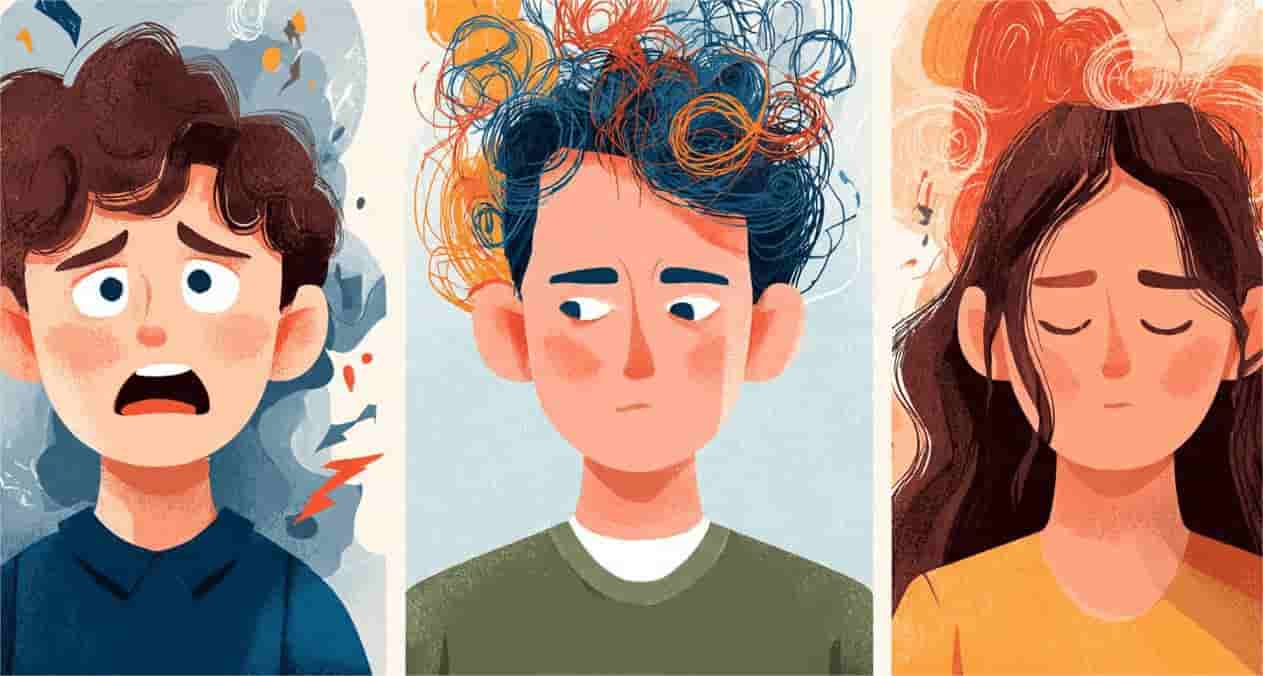
A three-panel psychological illustration showing a child with chaotic jagged lines of emotion, a teenager with tangled colorful scribbles, and an adult with soft, contained clouds and closed eyes, representing the development of emotional maturity.

While observing emotional reactions across ages, it became clear that self-control doesn’t appear suddenly. Children react openly, adolescents struggle with intensity, and adults continue refining emotional balance. Developmental psychology shows why regulation takes time. Emotion Precedes Control Emotional regulation—the ability to manage feelings in adaptive ways—is often mistaken as a basic life skill that should … Read more

How Social Media Algorithms Shape Human Behavior (Without Us Realizing)

A woman sitting on a sofa at night, focused on her glowing smartphone screen in a dark room.

While studying online behavior patterns, I noticed that people often blamed a “lack of self-control” for their screen habits. However, the more I researched, the clearer it became—most decisions on social media aren’t fully ours. Algorithms quietly guide what we see, feel, and engage with, shaping our behavior through complex psychological mechanisms. To regain control, … Read more

Social Hierarchies in Animals vs Humans: Same Patterns, Different Rules

A split-screen illustration comparing a wolf's profile with a human face, representing the shared evolutionary roots of social hierarchy in environmental psychology.

The Environment of Power In environmental psychology, we study how physical and social settings influence our mental state. While studying group behavior across species, familiar patterns kept appearing. Status, leadership, and conflict weren’t unique to humans. What changed was the environment in which these hierarchies were maintained. Comparative psychology makes one thing clear: the structure … Read more

Two Minds, Two Decision Styles: What Humans Can Learn from Animals

A split-screen illustration: a deer reacting instinctively in a forest (animal) vs. a person analyzing complex data at a desk (human).

Two Minds, Two Decision Styles When faced with danger, animals rarely hesitate. A deer bolts at the faintest rustle. A bird abandons a nest if conditions turn risky. Humans, however, often freeze—mentally. We analyze, compare, doubt, and overthink. This contrast reveals two fundamentally different decision-making styles: instinctive efficiency versus cognitive complexity. Understanding how animals decide … Read more

The Illusion of Self-Control: Why Willpower Fails and Systems Win

A man standing on a split-screen background, one side dark representing effort and the other bright representing ease, symbolizing the choice between willpower and systems.

We’ve been sold a powerful myth: that success and discipline are the results of sheer willpower. We are told that to eat healthier, work smarter, or break bad habits, we simply need to “try harder.” Yet the evidence—and our lived experience—tells a different story. The answer to lasting change isn’t a lack of character, but … Read more

Behavioral Psychology: Understanding Why We Act the Way We Do

Learning from Outcomes: Reward, Action, and Consequence Flowchart

Ever wondered why you reach for your phone the moment you wake up, or crave dessert even when you’re full? Most of the time, our actions aren’t random — they’re learned. Behavioral psychology explores this simple but powerful idea: that much of what we do is shaped by experience, not just intention. This branch of … Read more