
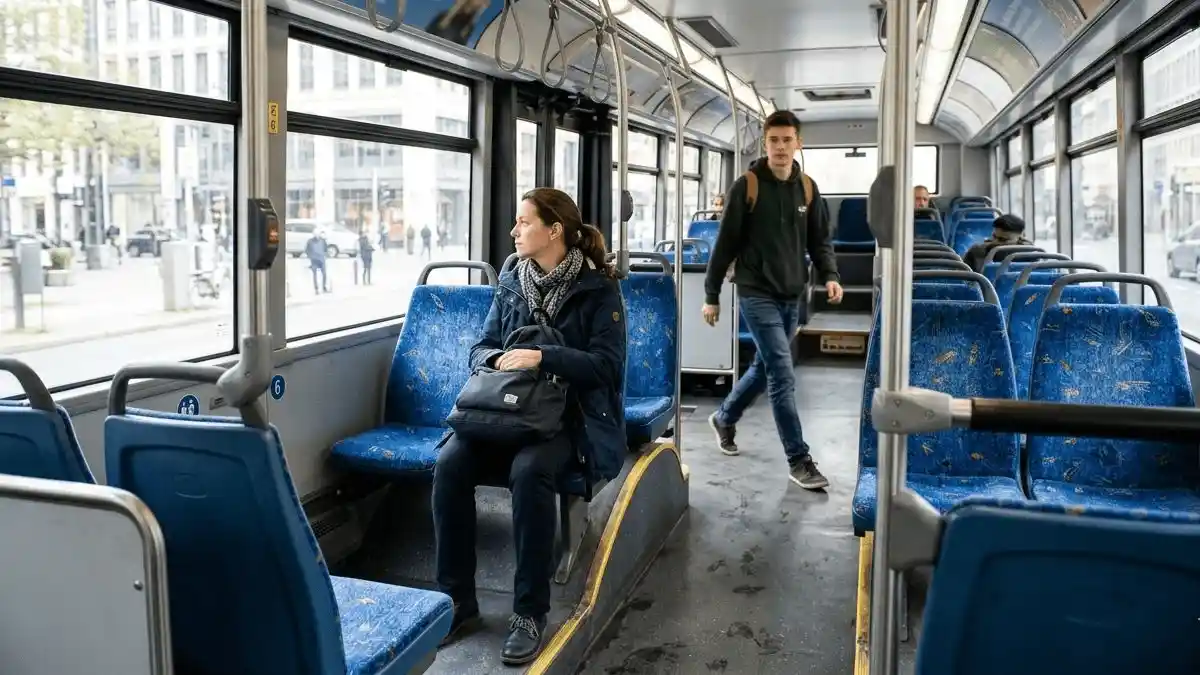
Why Humans Prefer Certain Seats
You step onto a nearly empty bus. Where do you sit? Not next to someone. Not in the front row. You scan for an isolation node — a window seat with no neighbor, a back row, a seat facing away from the crowd. Your brain runs this calculation in seconds, weighing safety, visibility, escape routes, and social friction.
This is the seat selection algorithm: the unconscious decision process that governs where people sit in shared public enclosures. The rules are consistent across cultures: choose seats that maximize personal space, minimize unwanted interaction, and provide visual command of the environment.
Violations of this algorithm — someone sitting directly next to you when empty seats are available — trigger immediate discomfort, sometimes described as “seat rage.” The violator has broken an unwritten but deeply felt social contract.
The Psychology of Isolation Nodes
Isolation nodes are seats that offer psychological distance from strangers. On a bus, these include:
COMMON ISOLATION NODES
- ✓ Window seats — Physical barrier on one side, only one potential neighbor
- ✓ Back rows — Fewer people behind you, better visual sweep
- ✓ Aisle seats facing forward — One open side for escape
- ✓ Seats near exits — Perceived safety (quick egress)
- ✓ Seats facing backward (on some trains) — Less eye contact with strangers
The brain prioritizes these nodes because they reduce ambient social monitoring. When you sit in an isolation node, you need to track fewer strangers. Your cognitive load drops. You can relax.
| Seat Type | Isolation Level | Preferred By |
|---|---|---|
| Window, no neighbor | Very high | Almost everyone |
| Window, one neighbor (if unavoidable) | Medium | Introverts, commuters |
| Aisle, no neighbor | High | Those who value quick exit |
| Aisle, one neighbor | Low | Extraverts, less socially anxious |
| Middle seat between two strangers | Very low | No one (last resort only) |
Window Seats vs. Aisle Seats
The window–aisle preference is one of the most studied phenomena in environmental psychology.
WINDOW SEAT ADVANTAGES
- ✓ Wall as a physical and psychological barrier
- ✓ Control over light (curtains, shades)
- ✓ View provides cognitive distraction
- ✓ Only one adjacent stranger
AISLE SEAT ADVANTAGES
- ✓ Freedom to stand and exit without disturbing others
- ✓ More legroom on one side
- ✓ Easier access to bags or phone charging
- ✓ Less feeling of being “trapped”
When both are available, window seats are chosen approximately 70% of the time on longer journeys. Aisle seats are preferred for short trips where quick exit matters. Middle seats are universally avoided unless the bus is full.
Spatial Buffering and Comfort Zones
Spatial buffering is the practice of maintaining empty seats between yourself and strangers. Even on a crowded bus, people will leave a buffer seat when possible.
The preferred buffer distance is one empty seat — close enough to monitor, far enough to avoid intrusion. When buffers are violated (someone sits in the immediately adjacent seat when others are available), the original occupant experiences:
PHYSIOLOGICAL EFFECTS OF BUFFER VIOLATIONS
- Increased heart rate
- Muscle tension
- Irritation or anxiety
- A desire to move or reposition
This response is not personal. It is neurological. The brain’s personal space boundaries are being crossed unnecessarily, triggering a mild threat response.
Why Empty Adjacent Seats Feel Valuable
An empty adjacent seat is not just empty. It is a resource. It provides:
THE VALUE OF AN EMPTY ADJACENT SEAT
- ✓ Space for a bag
- ✓ Room to spread out
- ✓ A barrier against strangers
- ✓ Psychological breathing room
When a stranger sits in that empty seat unnecessarily, they are not just sitting. They are taking a resource. The brain reacts as if something of value has been stolen — even though the seat was never “owned.”
This explains why seat violations feel aggressive. The violator is often unaware of the perceived theft, but the original occupant feels it keenly. The result: silent resentment, sometimes visible in posture shifts, sighs, or pointed looks.
The Anxiety of Personal Space Violations
When a stranger sits too close — especially when other seats are available — the brain activates its threat network.
Physiological responses include:
THREAT NETWORK RESPONSES
- Cortisol elevation (stress hormone)
- Sympathetic nervous system activation (fight or flight)
- Reduced cognitive performance (harder to read or work)
- Increased environmental scanning (watching the intruder)
This is why people change seats on buses even when it seems irrational to an observer. The body knows it is under low‑grade stress. The move is self‑protection.
Silent Rules of Public Seating
The unwritten rules of bus seating, observed across cultures:
THE UNWRITTEN RULES
- 1. Fill from the back — Rear seats fill first, then middle, then front
- 2. Window before aisle — Take the window seat; aisle seat remains open for latecomers
- 3. Buffer when possible — Leave one empty seat between you and the next person
- 4. Bags on lap if crowded — Do not use the adjacent seat as a bag holder when people are standing
- 5. No sitting next to someone unless no buffer remains — Last resort only
- 6. Eye contact avoidance — Once seated, do not look at immediate neighbors
Violations of these rules are not illegal. But they are noted. The violator is judged as socially unaware, entitled, or aggressive.
You May Also Like
Discover why people behave differently in groups — seat selection is a form of group spatial negotiation
Final Thoughts
The seat selection algorithm is not random. It is a sophisticated, unconscious calculation of safety, comfort, and social friction. Your brain runs it every time you enter a shared enclosure.
When you sit, honor the algorithm. Choose isolation nodes. Leave buffers. Do not sit directly next to a stranger unless the bus is full. And if someone violates your buffer without necessity, you are not wrong to feel irritated — your brain is just doing its job.
The empty seat is not just furniture. It is psychological space. Respect it.
Related Articles


Sponsored


You May Also Like

The Power Matrix: Why Black and Navy Command Authority (And …
Adaptive vs. Maladaptive Perfectionism: When High Standards …

The X-Factor: Why Confidence Can Change the Outcome of Compe…

Why Balconies Feel Unsafe to Some People
Social Media vs. Real Communities: Why Interaction Isn’t Alw…
