
We update our phones, apps, and even our wardrobes — yet the one thing we rely on the most, our behavior, often runs on outdated programming. Think about it: many of our habits were shaped years ago, under circumstances that no longer exist, but we still carry them like old software that’s never been patched. Just like a device slows down when it runs on an old version, our lives do too when our behaviors don’t evolve.
That’s why behaviour needs an update system — a way to review what’s no longer serving us, rewrite the patterns that hold us back, and install healthier responses that match who we are today. Behaviour change isn’t just psychology… it’s maintenance, it’s growth, and it’s our personal upgrade process.
KEY TAKEAWAYS
- Behavior is learned through reinforcement, associations, and observation — which means it can also be unlearned.
- The ABC Model (Antecedent → Behavior → Consequence) is the core diagnostic framework used to analyze and alter actions.
- Sustainable change relies on smart environmental design and reinforcement, not sheer willpower alone.
The Science Behind Behavior Change
Behaviour modification isn’t guesswork; it’s built on well-established learning theories:
Operant Conditioning (B.F. Skinner):
Behaviour is shaped by its consequences. We repeat behaviours that are rewarded (reinforced) and avoid those that lead to unpleasant outcomes.

Classical Conditioning (Ivan Pavlov):
We learn to associate a neutral stimulus (like a sound) with a meaningful one (like food), creating a new automatic response (salivating at the sound).

Social Learning Theory (Albert Bandura):
We learn by observing others. Seeing a behaviour modelled and witnessing its consequences can powerfully influence our own actions.

Together, these theories form the backbone of all behaviour-focused therapy. (To explore the fundamentals of how conditioning shapes our actions, read our guide on Behavioral Psychology & Conditioning.)
What Is Behavior Modification Therapy?
Definition: A therapeutic approach that uses learning principles to systematically increase adaptive (helpful) behaviours and decrease maladaptive (unhelpful) ones.
Core Principle: Behavior is learned and, therefore, can be unlearned or reshaped. It focuses on observable, measurable actions rather than deep-seated unconscious conflicts.
Relatable Example: If you check your phone (behavior) and get a satisfying notification (pleasant consequence), you’re more likely to check it again frequently. Behavior modification would help you change that pattern by altering the triggers or consequences.
The ABC Model: The Heart of Behaviour Analysis
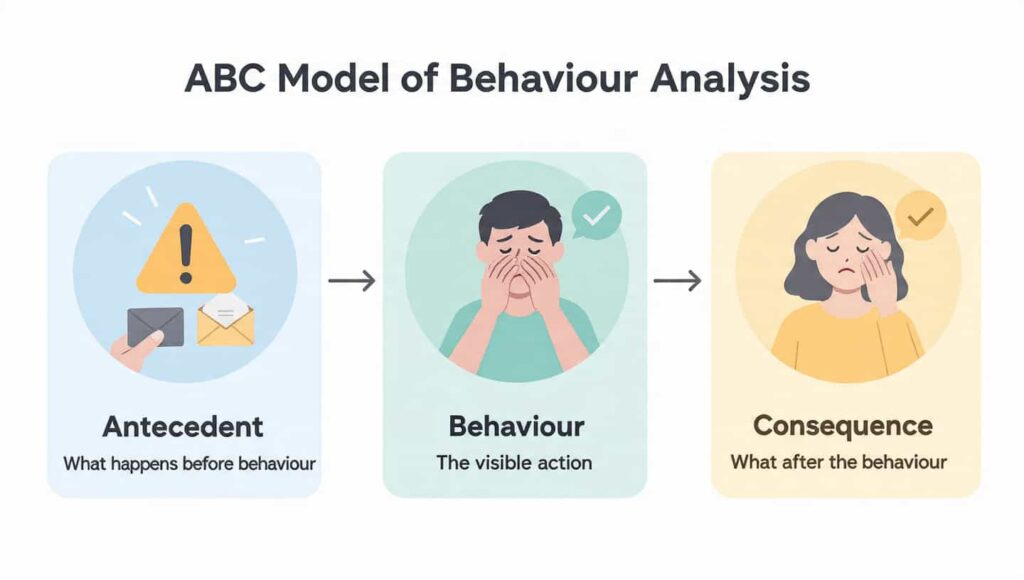
When it comes to understanding why we behave the way we do, the ABC Model is one of the most powerful tools in behavioural psychology. It breaks down even the most complicated behaviours into a simple, easy-to-understand sequence. Whether someone is struggling with anxiety habits, emotional reactions, or daily routines, this model helps us trace the behaviour back to its roots and identify what truly needs to change.
🔹 Antecedent: What Happens Before the Behaviour
Every behaviour begins with a trigger — something that happens right before the action. This could be an external event, an internal feeling, or even a subtle cue from the environment. Think of a stressful email landing in your inbox, someone calling your name sharply, or even feeling bored. These moments act as starting points that lead the behaviour to unfold.
🔹 Behaviour: The Action Itself
The behaviour is the visible, measurable action that follows the trigger. This is what we can observe and describe without interpreting emotions or intentions. It might be biting your nails, snapping at someone, scrolling mindlessly through your phone, or withdrawing from a task. The key is to focus on the action itself — what the person actually does.
🔹 Consequence: What Happens After the Behaviour
Right after the behaviour comes the consequence — and this part is crucial. Consequences determine whether the behaviour will happen again in the future. If the consequence brings comfort, relief, escape, or attention, the behaviour is likely to repeat. For example, biting your nails may momentarily reduce stress, making it more likely to happen again the next time stress appears.
The Flow of Behaviour:
Antecedent (Trigger) → Behaviour (Action) → Consequence (Outcome)
By analyzing the ABC chain, therapists can pinpoint where to intervene—by changing the antecedent, teaching a new behaviour, or altering the consequence.
Core Techniques Used in Behaviour Modification
1️⃣ Positive Reinforcement
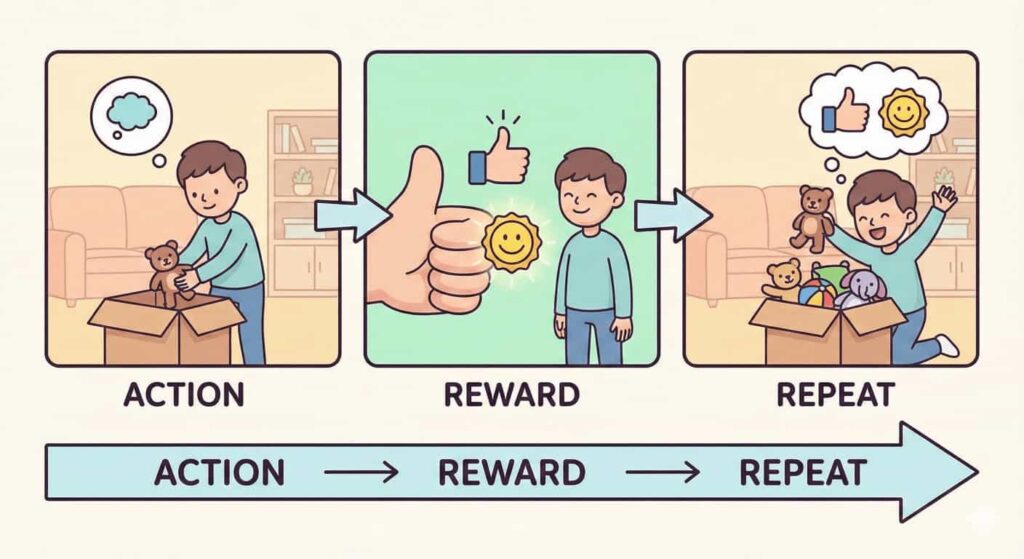
Positive reinforcement involves adding something desirable to increase a behaviour. This may include praise, rewards, tokens, or privileges. The behaviour strengthens because the individual experiences a pleasant outcome immediately after performing it.
2️⃣ Negative Reinforcement
Negative reinforcement focuses on removing something unpleasant to increase a desired behaviour. For example, waking up stops the alarm sound. The aim is not punishment — it is to encourage the behaviour by eliminating discomfort.
3️⃣ Punishment
Punishment is used to decrease or weaken an undesirable behaviour by applying an aversive consequence. This may include scolding or loss of privileges. Ethically, it should be used sparingly and never as the primary method of behaviour change.
4️⃣ Token Economy
A token economy system allows individuals to earn tokens, points, or chips for performing desired behaviours. These tokens can later be exchanged for rewards or privileges. This technique is widely used in schools, clinical settings, and behaviour therapy programs.
5️⃣ Shaping
Shaping involves reinforcing small, successive steps that gradually lead to a target behaviour. Each small improvement is rewarded until the final behaviour is learned. It is especially helpful for teaching complex or new skills.
6️⃣ Modeling
Modeling means demonstrating the desired behaviour so the individual can observe and imitate it. People — especially children and clients in therapy — learn more effectively when they see the behaviour performed correctly.
7️⃣ Contingency Contracts
A contingency contract is a formal written agreement that clearly outlines the expected behaviour and the consequences (rewards or penalties) linked to that behaviour. This increases clarity, responsibility, and motivation.
8️⃣ Time-Out
Time-out involves removing the individual from a reinforcing environment for a brief period after an undesired behaviour. The purpose is not punishment, but to reduce negative behaviour by temporarily limiting access to reinforcement.
9️⃣ Self-Monitoring
Self-monitoring requires individuals to track or record their own behaviour. This increases self-awareness, helps identify patterns, and improves self-control. It is often one of the first steps in behaviour therapy.
The Step-by-Step Process in Therapy
Identify Target Behaviour: Define the specific behaviour to change (e.g., “yelling” vs. “being angry”).
Baseline Recording: Measure how often the behaviour occurs before intervention.
Functional Behavioural Assessment (FBA): Analyze the ABCs to understand the behaviour’s function (What need does it serve?).
Select Interventions: Choose techniques based on the FBA.
Implement & Monitor: Apply the plan and track data consistently.
Use Reinforcement Schedules: Decide how frequently to provide reinforcement (continuous at first, then intermittent).
Evaluate & Follow-Up: Assess progress and adjust the plan as needed.
Where It Is Most Effective
ADHD Management: Improving focus, task completion, and impulse control.
Autism Interventions (Applied Behaviour Analysis – ABA): Building communication, social, and life skills.
Addiction Recovery: Replacing substance-use behaviours with healthier alternatives.
Classroom Behaviour: Promoting a positive learning environment.
Anger & Impulse Control: Learning pause-and-response techniques. (For related insights into emotional and personality-based challenges, our Guide to Abnormal Psychology provides useful context.)
Habit Disorders: (e.g., nail-biting, hair-pulling).
Parenting & Family Therapy: Creating consistent, positive home dynamics.
Real-Life Mini Case Examples
Child with Aggression: ABC: Antecedent = toy taken away. Behaviour = hitting. Consequence = peer cries, child gets toy back. Intervention: Teach “use your words,” and ensure the child does not get the toy back after hitting (remove reinforcement).
Adult with Smoking: ABC: Antecedent = work break. Behaviour = smoking. Consequence = nicotine rush, social time. Intervention: Replace smoking with a walk during the break (change behaviour), and use nicotine gum (alter consequence).
Teen with Anxiety Avoidance: ABC: Antecedent = thought of school presentation. Behaviour = skipping school. Consequence = immediate anxiety relief. Intervention: Use shaping—reinforce small steps like preparing slides, then practicing at home, then presenting to one friend.
Ethical Considerations
Consent and transparency are paramount. Good practitioners:
Obtain informed consent, especially for children or dependent adults.
Prioritize reinforcement over punishment.
Consider cultural values and individual dignity.
Aim to foster autonomy, not blind compliance.
Behaviour Modification vs. Other Therapies
While Cognitive Behavioural Therapy (CBT) works with thoughts and behaviours, pure behaviour modification focuses primarily on changing the behaviour itself, which can then alter thoughts and feelings indirectly. The key strength of behaviour modification is its speed and clarity in changing specific, observable actions. A potential limitation is that it may not directly address deeper emotional roots or complex cognitive patterns unless integrated with other approaches. (For a comparison of different therapeutic methods, see our comprehensive Types of Therapy Guide.)
ADVANTAGES
- ✓ Produces measurable, observable results rapidly.
- ✓ Highly structured and systematic approach.
- ✓ Techniques are widely applicable across ages and settings.
LIMITATIONS
- ✕ Requires high consistency from therapists, parents, and teachers.
- ✕ Can be perceived as ignoring inner experiences if used in isolation.
- ✕ Risk of relapse if reinforcement is removed too quickly.
You May Also Like
Understanding the Big Five Personality Traits (OCEAN Model)
Sustainable Change Comes from Reinforcement, Not Willpower Alone
Lasting behaviour change is less about brute-force willpower and more about smart, consistent reinforcement. It’s the science of building better habits through structured support. By understanding the ABCs of our actions and thoughtfully applying the principles of learning, we can effectively “update” our behavioural software for a healthier, more functional, and fulfilling life. (Understanding your inherent tendencies can also support this journey; learn how in our article on Big Five Personality Traits.)
Your journey starts not with a grand resolution, but with observing one pattern, understanding its function, and taking one small, reinforced step toward change. (For a broader perspective on the field of psychology, explore the Different Types of Psychology.)
Frequently Asked Questions About Behavior Modification
What is the main difference between CBT and Behavior Modification?
Cognitive Behavioral Therapy (CBT) focuses on identifying and restructuring cognitive distortions and thought patterns, while behavior modification focuses directly on modifying observable actions using environmental triggers and consequences.
How long does behavior modification take to work?
Noticeable improvements can occur in a few weeks depending on consistency, target behaviors, and the reinforcement schedule used.
Is behavior modification effective for adults?
Yes! While frequently used in child development and classrooms, adults routinely benefit from behavior modification techniques in habit change, addiction recovery, and stress management.
Disclaimer: This blog post is for informational purposes only and is not a substitute for professional medical or psychological advice, diagnosis, or treatment.
Related Articles


Sponsored


You May Also Like
The Smartphone “Brain Drain”: Why Having Your Ph…

You’re Not Lost — You’re Developing: How Erikson Explains Yo…

Beyond the Game: Why Visualization Is the Secret Weapon of E…

Trust vs. Mistrust (Erikson’s First Stage of Psychosocial De…

You Are Not a Robot: A Deep Dive into Humanistic Psychology