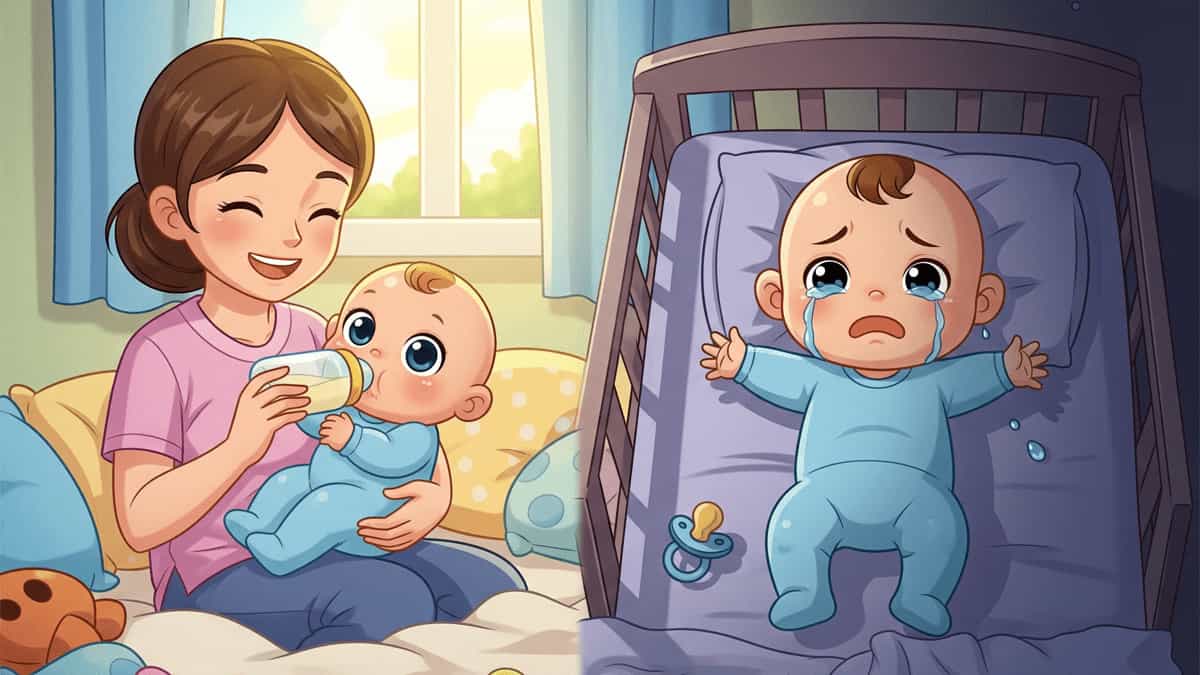
When people talk about personality, confidence, or “trust issues,” they usually jump straight to adulthood. But according to Erik Erikson, a large part of how we relate to the world may begin far earlier — in the first year of life.
This is the foundation of Erikson’s first psychosocial stage:
Quick Summary – Trust vs. Mistrust
| Feature | Details |
|---|---|
| Stage | Trust vs. Mistrust |
| Age Range | Birth to ~18 months |
| Core Conflict | Safety vs. Uncertainty |
| Key Question | “Is the world reliable?” |
| Psychosocial Virtue | Hope |
| Significant Relationship | Primary Caregiver |
| Maladaptation (If Imbalanced) | Withdrawal / Fearfulness |
The Trust vs Mistrust stage is the first stage in Erik Erikson’s 8 stages of psychosocial development, a theory explaining how personality develops across the human lifespan.
What Is Trust vs. Mistrust?
Trust vs. Mistrust is the very first conflict in Erikson’s model of human development.
Age Range: Birth to ~18 months
Core Question: “Is the world safe and reliable?”
At this stage, infants are not consciously evaluating life. There is no logical reasoning or self-reflection. Instead, the brain is forming basic emotional expectations about the environment.
KEY INFANT QUESTIONS
- Can my needs be met?
- Is someone consistently there for me?
- Is comfort predictable or random?
The answers to these early experiences shape what Erikson called basic trust.
Understanding “Trust” in Psychological Terms
In this context, trust does not mean moral trust (“this person is honest”).
It refers to something more primitive:
👉 A deep, emotional sense that the world is stable, predictable, and safe.
WHAT A TRUSTING INFANT INTERNALIZES
- “When I am distressed, someone responds.”
- “Discomfort is temporary.”
- “My environment is not chaotic.”
This creates a baseline sense of security.
How Trust Develops
Trust forms primarily through consistent caregiving.
Key elements include:
1. Reliability
When feeding, soothing, and comfort occur regularly, the infant’s brain learns patterns.
Predictability = Psychological safety.
This doesn’t require perfection. It requires consistency.
2. Emotional Responsiveness
Trust is not built through physical care alone.
Two babies may both be fed and clothed, but:
- One receives warmth, touch, eye contact
- The other experiences emotional detachment
The psychological outcomes differ significantly.
Infants are highly sensitive to tone, touch, and emotional presence.
3. Comfort During Distress
Crying is not manipulation at this stage — it is communication.
When distress is repeatedly met with soothing:
👉 The brain learns regulation through connection.
This becomes the earliest template for emotional stability.
How Mistrust Develops
Mistrust emerges when the environment feels inconsistent, neglectful, or unpredictable.
COMMON CONTRIBUTORS TO MISTRUST
- Chronic neglect
- Highly inconsistent caregiving
- Emotional coldness
- Harsh or chaotic environments
The infant brain begins forming a different expectation:
👉 “The world is unreliable.”
👉 “Needs may not be met.”
👉 “Safety is uncertain.”
This does not mean the child becomes permanently “damaged.” But it does influence later tendencies.
Psychological Outcomes
Erikson emphasized that development is not all-or-nothing. Every person develops some mixture of trust and mistrust.
UPSIDES
- ✓ Greater emotional security
- ✓ Easier bonding with others
- ✓ Higher tolerance for uncertainty
- ✓ Healthier exploration of the world
DOWNSIDES
- ✕ Heightened anxiety
- ✕ Suspicion or guardedness
- ✕ Difficulty depending on others
- ✕ Fear of unpredictability
Long-Term Effects in Everyday Life
This stage is often linked to later relational and emotional patterns.
While no single stage determines destiny, early trust formation may influence:
1. Relationships
Individuals with stronger basic trust often find it easier to:
- Form close bonds
- Assume positive intent
- Feel secure in intimacy
Those with stronger mistrust may struggle with:
- Fear of abandonment
- Chronic doubt
- Emotional defensiveness
2. Emotional Regulation
Trust contributes to an internal sense that distress is manageable.
Mistrust may contribute to:
- Stronger fear responses
- Difficulty calming under stress
- Greater sensitivity to uncertainty
3. Risk & Exploration
Basic trust encourages curiosity.
👉 “Trying new things feels safer.”
Mistrust may encourage caution or avoidance.
👉 “Unknown situations feel threatening.”
Modern Psychology Connections
Erikson’s ideas align closely with later research in attachment theory.
Particularly:
- Secure attachment → Often associated with stronger early trust
- Insecure attachment → Often associated with inconsistent early experiences
Both frameworks emphasize the role of early caregiver interactions in shaping emotional expectations.
PRACTICAL IMPLICATIONS FOR CAREGIVERS
- ✓ Be reasonably consistent
- ✓ Respond to distress with care
- ✓ Provide emotional warmth
- ✓ Create predictable routines
Trust grows from repeated experiences of safety.
Not from grand gestures.
Why This Stage Still Matters
Trust vs. Mistrust is not just an infant concept.
It represents the beginning of a lifelong psychological theme:
👉 “Can I rely on my environment and the people in it?”
Many adult struggles — anxiety, insecurity, relational tension — often echo this fundamental question.
Erikson described the positive outcome of this stage as Hope — the enduring belief that needs can be met and the world is fundamentally reliable. Importantly, a healthy personality contains both trust and mistrust in a favorable ratio. Complete trust without any mistrust would leave a child dangerously naive. The goal is not to eliminate mistrust, but to ensure trust outweighs it. This balance prepares the child for Erikson’s second great challenge: Autonomy vs. Shame and Doubt, where the toddler, now confident in the world’s safety, begins to test their own power and will.
15 Things You Can Learn from Trust vs. Mistrust
WHAT BABIES LEARN THROUGH TRUST
- Consistency Builds Security — When care is reasonably predictable, infants learn that their environment can be relied upon.
- Responsive Care Matters — Responding to distress teaches an infant that their feelings are valid and manageable.
- Warmth Is Part of Care — Touch, eye contact, and a calm voice build emotional security beyond physical needs.
- Routines Create Predictability — Repeated patterns help infants form baseline emotional expectations.
- Comfort Teaches Regulation — Being soothed during distress builds early templates for stress management.
- Needs Do Not Require Perfection — Trust grows from overall reliability, not flawless caregiving every time.
- Safety Encourages Exploration — A dependable base allows children to step out and explore the world.
WHAT MISTRUST CAN TEACH YOU LATER IN LIFE
- Not Everyone Is Unreliable — Past inconsistency creates expectations, but one experience does not define future relationships.
- Caution and Fear Are Different — Healthy caution protects you; constant suspicion isolates you from genuine connection.
- You Can Learn to Ask for Help — Early mistrust creates extreme self-reliance, but accepting support is a strength.
- Predictability Can Be Created — When external environments feel chaotic, personal routines and boundaries restore stability.
- Trust Can Be Built Gradually — Trust is not all-or-nothing; small, consistent actions reveal true reliability.
- Watch Patterns, Not Promises — Psychological safety is judged by repeated behavior rather than reassuring words.
- Your Past Is Not Your Whole Future — Early relational patterns shape assumptions, but new environments can reshape them.
- Healthy Trust Includes Boundaries — The goal is balance; healthy trust leaves room for discernment and self-protection.
Trust vs. Mistrust forms the psychological groundwork for how individuals experience safety, connection, and stability. It does not lock a person into a fixed future. But it may shape early emotional assumptions about the world. Understanding this stage helps explain why some people move through life with ease and openness, while others operate with caution and guardedness. Often, the roots are deeper than they appear.
Related Articles



Sponsored


You May Also Like

The Green-Eyed Gaze: Why Jealousy Exists in Human Relationsh…

How a Strict Grooming Routine Reprograms Personal Accountabi…

Why Roller Coasters Cause Anxiety
What Exactly Is Dyslexia? Understanding the Learning Differe…
The Psychology Behind the Viral Punch Monkey Story