

Positive psychology is the scientific study of what makes life worth living. It examines human strengths, well-being, happiness, and optimal functioning through rigorous research methods. Unlike traditional psychology’s focus on pathology, this field asks: “What’s right with people?” instead of “What’s wrong?” It builds on evidence-based interventions designed to enhance life satisfaction, build resilience, and promote thriving. This isn’t motivational fluff—it’s a data-driven approach to understanding and cultivating the best aspects of human experience.
This article is designed as a global, real-world guide, offering:
- A clear, practical definition of positive psychology.
- A breakdown of its main sub-branches and focus areas.
- Country-specific insights into how these ideas are applied in real life—from work to daily routines.
- Actionable ways to apply the concepts without academic jargon.
The Core Idea (In Plain Language)
The fundamental mission of positive psychology is to help individuals, communities, and organizations flourish. It serves as a crucial bridge between clinical psychology (which treats mental illness) and lifestyle wellness (which promotes general health). By focusing on prevention and enhancement, it aims to improve overall quality of life, emotional balance, meaning, and fulfillment. The field doesn’t ignore suffering but complements traditional approaches by building psychological resources that help people not just survive challenges, but thrive through and beyond them.
At its heart, positive psychology studies the habits, mindsets, and environments that help people feel good, function well, and thrive. This can be understood through three core layers:
- Feeling Better (Emotions): This involves cultivating positive emotions like gratitude, calm, and joy.
- Doing Better (Functioning): This focuses on improving performance and well-being through strengths, flow states, goals, and resilience.
- Matter More (Meaning): This is about finding a sense of purpose, aligning with your values, and contributing to something greater than yourself.
Key Pillars: Seligman’s PERMA Model
Martin Seligman’s PERMA model represents the cornerstone of modern positive psychology and remains its most searched concept. This framework identifies five essential elements of well-being:
- P – Positive Emotions: Cultivating joy, gratitude, serenity, interest, hope, and love.
- E – Engagement: Achieving “flow”—that state of complete absorption in challenging, rewarding activities.
- R – Relationships: Building deep, positive connections that provide love, support, and meaning.
- M – Meaning: Belonging to and serving something larger than oneself.
- A – Accomplishment: Pursuing goals, mastery, and achievement for personal fulfillment.
This comprehensive model moves beyond simple “happiness” to provide a multidimensional blueprint for building a fulfilling life. To understand how such frameworks integrate into broader psychological study, explore our guide to the different types of psychology.
Key Sub-Branches and Focus Areas
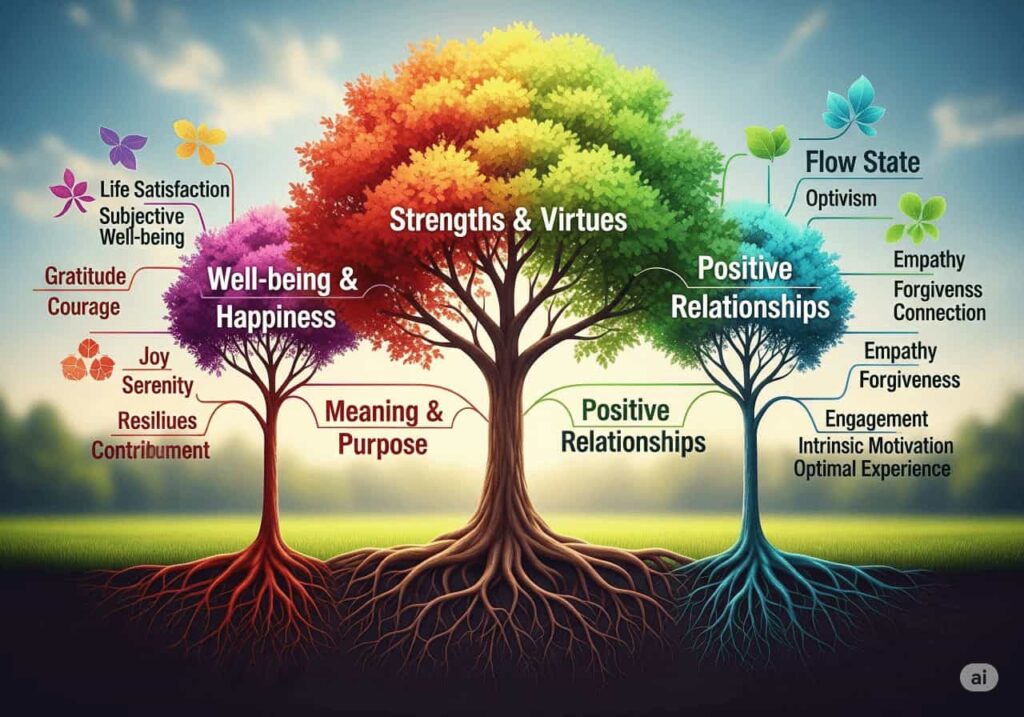
Positive psychology is a mosaic of practical tools and concepts. Below are its key sub-branches, along with a brief explanation and a real-world application for each. A list is often the most effective way to grasp these distinct areas quickly. PERMA Model of Well-being.
- Gratitude Psychology: The practice of training your attention to notice what is working in your life.
- Practice: Write a “3-good-things” list at the end of each day or send a gratitude text to a teammate.
- Strengths-Based Psychology: The study of how to identify and leverage your top character strengths.
- Practice: Take a strengths inventory and consciously redesign tasks to use your strengths daily.
- Flow Psychology: Research into the state of deep absorption where a challenge perfectly matches your skills.
- Practice: Schedule 60–90 minute “focus blocks” for a single, meaningful task without interruption.
- Optimism & Hope Studies: The science of future-oriented belief combined with proactive pathway planning.
- Practice: Visualize your best possible self in the future, then reverse-engineer the steps to get there.
- Mindfulness & Well-Being: The practice of training attention and cultivating a non-judgmental awareness of the present moment.
- Practice: Take a five-minute breath practice between meetings to reset and refocus.
- Resilience & Post-Traumatic Growth: The capacity to bounce back from adversity and, in some cases, grow stronger because of it.
- Practice Create an “Adversity → Meaning Map” by reflecting on what you learned from a difficult experience and what you will change as a result.
- Compassion & Altruism: The understanding that helping others boosts your own well-being.
- Practice: Practice weekly acts of kindness or participate in peer-support circles.
- Forgiveness Studies: The process of releasing grudges to reduce rumination and improve well-being.
- Practice: Use short letter-writing exercises or rituals to set boundaries and let go.
- Positive Relationships: The study of how high-quality connections predict individual and collective thriving.
- Practice: Practice “active-constructive responding” by showing genuine interest when someone shares good news with you.
- Positive Organizational Psychology: Research into creating workplace cultures where people can do their best work.
- Practice: Implement strengths-based feedback, provide autonomy, and ensure fair policies to build psychological safety.
- Meaning & Purpose Psychology: The science behind finding a coherent life narrative and a sense of contribution.
- Practice: Conduct a values audit and write a “from-to” purpose statement for the next 12 months.
- Positive Health Psychology: The study of habits that create a powerful link between your mood and your body.
- Practice: Prioritize sleep, protein, and sunlight, and try pairing a gratitude practice with physical movement.
- Positive Education: The field of teaching well-being skills alongside academic subjects.
- Practice: Implement class rituals like a gratitude wall, “strengths tickets,” or calm-start exercises.
Popular Evidence-Based Interventions
These practical tools dominate search queries because they answer real user needs:
- Gratitude Journaling: Daily recording of things one is thankful for, proven to increase long-term well-being.
- Strengths Assessment (VIA): Identifying and applying one’s core character strengths in daily life.
- Mindfulness & Self-Compassion: Practices that enhance present-moment awareness and reduce self-criticism.
- Flow Activities: Designing tasks that match skill with challenge to create optimal engagement.
- Acts of Kindness: Intentional prosocial behavior that benefits both giver and receiver.
- Hope-Building Exercises: Techniques that foster goal-setting and pathway thinking.
These interventions work because they actively reshape thought patterns. To understand the mechanism behind habit change, see our article on behavioral psychology and conditioning.
Country-Wise Lenses: How People Engage with Positive Psychology

These are not stereotypes but rather practical tendencies to help you localize content and coaching. Different Types of Psychology
Singapore (SG): The style is pragmatic and outcomes-driven. People respond to “high-performance habits” and KPI-linked well-being.
Hong Kong (HK): A fast-paced, high-pressure culture. Resonant tools include short mindfulness practices and resilience skills for managing volatility.
United States (US): The style is individualistic and enthusiastic. People are drawn to “peak performance,” purpose-driven work, and self-branding around their strengths.
Canada (CA): A balanced and prosocial culture. People resonate with themes of belonging, kindness, and nature-based well-being.
Australia (AU): A straight-talking, outdoorsy culture. “Get your mojo back” and “train your mental fitness” are common phrases.
Switzerland (CH): The culture values precision and work-life boundaries. Quiet strengths, deep-work routines, and meaning found through craftsmanship are key.
South Africa (SA): The community-centric philosophy of Ubuntu is central. Group gratitude and purpose via community impact are highly resonant.
India (IN): A blend of modern hustle and collective orientation. Spiritual frames like Seva (service) and Dharma (duty) help connect with the concepts.
New Zealand (NZ): A strong emphasis on work-life balance and outdoors. Well-being is often discussed in terms of whānau (family/community) and whenua (land).
Global and Cultural Perspectives
Well-being is understood differently across cultures, giving positive psychology rich diversity:
- Western Perspectives: Emphasize individual happiness, autonomy, personal strengths, and self-actualization.
- Eastern Perspectives: Draw from Buddhism, Yoga, and Taoism to focus on mindfulness, balance, compassion, and harmony.
- Indigenous Perspectives: Highlight collective well-being, community connection, and ancestral wisdom.
These perspectives converge in practical applications worldwide, from Australia’s positive education initiatives to India’s happiness curriculum and the OECD’s well-being indicators.
Scientific Foundations
Positive psychology stands firmly on empirical evidence, distinguishing it from self-help speculation. Groundbreaking researchers established its credibility:
- Martin Seligman shifted psychology’s focus toward learned optimism and flourishing.
- Mihaly Csikszentmihalyi pioneered the study of “flow” states.
- Barbara Fredrickson developed the “Broaden-and-Build Theory,” showing how positive emotions expand thinking and build lasting resources.
The field relies on randomized controlled trials (RCTs) and meta-analyses that consistently demonstrate measurable improvements in well-being outcomes.
How to Use This (Wherever You Live)

- Choose One: Pick one focus area (like gratitude, strengths, or mindfulness) and work with it for 2–4 weeks.
- Localize: Adapt the language and metaphors to fit your culture or workplace.
- Make It Social: Find a buddy to share wins with or start a 10-minute team ritual.
- Track Tiny Wins: Note small outcomes like your mood (on a 0–10 scale), sleep hours, or focus minutes.
- Add Meaning: Link your new habits to a personal value. For example, “I practice mindfulness to be a more present partner.”
- Protect Recovery: Remember that you can’t thrive if you don’t rest. Prioritize recovery as a non-negotiable part of your well-being.
Why Positive Psychology Matters Today
In our era of burnout, loneliness, digital overload, and rising depression rates, positive psychology offers essential tools for building psychological immunity. It’s being implemented globally in innovative ways: in schools as “positive education,” in corporations for employee well-being, and in public policy through well-being metrics. The field addresses modern crises not by merely treating symptoms, but by building foundational capacities for resilience, connection, and meaning.
Critiques and Balanced Understanding
Acknowledging limitations strengthens the field’s credibility:
- Risk of “Toxic Positivity”: Misapplication can invalidate genuine suffering with forced optimism.
- Cultural Bias: Early models heavily reflected Western, educated, industrialized values.
- Structural Blind Spots: Individual interventions can’t solve systemic issues like poverty or trauma.
- Not a Replacement: It complements but doesn’t replace necessary psychotherapy for mental disorders.
Understanding these boundaries helps apply positive psychology ethically and effectively. For perspectives on addressing deeper psychological challenges, explore our guide to abnormal psychology.
The Future of Positive Psychology
The field continues evolving in exciting directions:
- AI-Based Well-Being Tools: Personalized interventions delivered through technology.
- Cross-Cultural Models: More inclusive frameworks that respect diverse conceptions of flourishing.
- Neuropsychology Integration: Brain imaging revealing the neural correlates of strengths and well-being.
- Global Mental Health Movements: Integrating positive psychology with public health initiatives worldwide.
- Preventative Focus: Earlier implementation in schools and communities to build resilience from youth.
The integration of positive psychology with neuropsychology is particularly promising, revealing how practices like gratitude literally reshape our brains. Learn more about this intersection in our article on neuropsychology and brain-behavior links.
Ready to Apply Positive Psychology?
- Begin with our complete guide: What Is Positive Psychology?
- Deepen your understanding of well-being with the PERMA Model
- Discover how your personality influences your well-being journey through the Big Five Personality Traits
- Explore the mind-body connection in our article on stress and health psychology
In Short
Positive psychology provides practical, evidence-based tools to feel better, do better, and matter more. The fundamental concepts are universal, but their implementation and language should be tailored to the local culture. Start small, make it social, track your progress, and connect your habits to a deeper sense of purpose. Psychology Quotes for Daily Motivation
Disclaimer
This website is for educational purposes only and should not be considered medical advice. While the author has academic training, this content is not a replacement for therapy or professional medical care. If you are struggling, please seek help from a licensed professional.
Related Articles



Sponsored


You May Also Like

Online Projection: Instagram, Reels & Fake Perception

Social Media vs. Real Communities: Why Interaction Isn’t Alw…

Impulse vs. Identity: The Dark Psychology of Fast Fashion an…

Dissociative Amnesia vs. Retrograde Amnesia: Understanding t…

The Ruler Archetype – Control, Leadership & the Desire t…
