
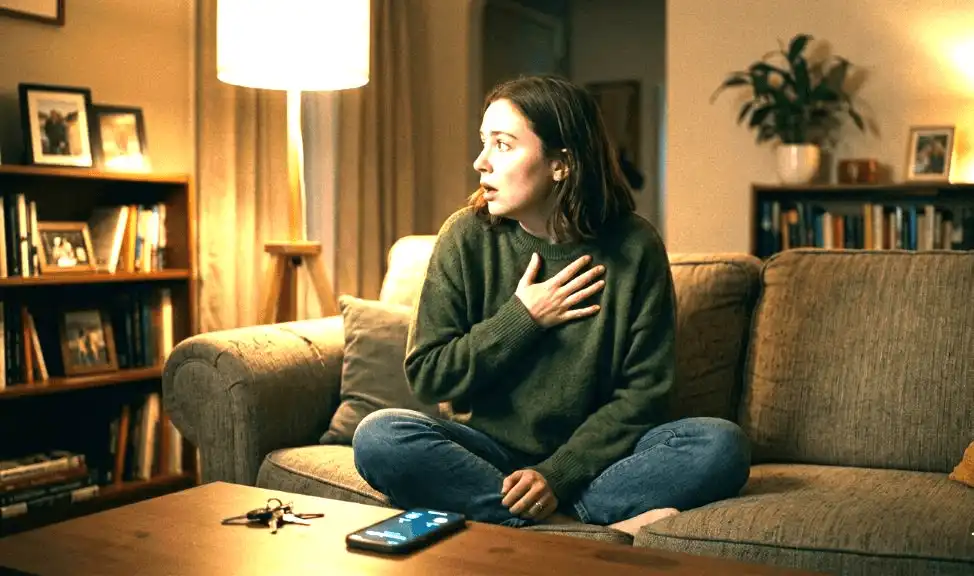
The brain’s lightning-fast reaction to unexpected noise—and why it’s so hard to ignore
A car backfires, a door slams in the wind, a fire alarm tests without warning—and before the conscious mind can even identify the sound, the body is already in full alarm. Heart racing, muscles tensed, a flash of heat or dizziness. This reaction isn’t irrational or oversensitive. It’s the brain’s ancient, life-saving acoustic startle reflex working exactly as it evolved to: prioritizing speed over accuracy in a world where a sudden sound once meant a predator, a falling rock, or a threat approaching fast.
Understanding this reflex can make the moments after a loud noise feel less like panic and more like a curious window into the brain’s protective wiring. For a broader look at how the body responds to perceived danger, the Why Anxiety Feels Overwhelming article explains the cascade from a trigger to a full-body alarm.
Why Sudden Sounds Get Immediate Attention
Sound is the only sense that can wake the brain from deep sleep or break through intense concentration. Unlike sight, which requires the eyes to be open and directed, hearing operates 360 degrees and in darkness. This makes the auditory system the brain’s primary surveillance channel.
A sudden, sharp sound bypasses normal sensory processing. It reaches the ear and shoots directly to the brainstem via a dedicated fast pathway. The brain doesn’t wait to analyze whether the sound is a threat; it reacts first and asks questions later. This is the acoustic startle reflex, and it fires in a fraction of a second.
From an evolutionary standpoint, this speed advantage was crucial. A snap of a twig in the bushes couldn’t be paused for analysis. The animals that froze or fled instantly were the ones that survived. Modern humans carry that same circuitry, which is why a dropped plate can feel—for a split second—like the world is ending.
How the Brain Detects Possible Danger Fast
The neural pathway for sudden-sound processing is brutally efficient.
Sound enters the ear and travels to the cochlea, then to the cochlear nucleus in the brainstem. From there, signals are sent almost immediately to the caudal pontine reticular nucleus, which activates the entire startle response—muscle tensing, eye blink, heart rate spike—within 10 to 20 milliseconds. The cortex, the thinking part of the brain, only gets the signal later.
This is why a person often jumps before they even know what the noise was. By the time the prefrontal cortex has identified “just a car horn,” the body has already jerked, the heart is pounding, and the breath has caught. The brain has prioritized survival over composure, as it was designed to do.
Why Loud or Unexpected Noise Feels Shocking
Two properties of a sound determine how strongly the startle reflex fires: loudness and unpredictability.
A loud sound overloads the auditory system momentarily, triggering a protective contraction of the middle ear muscles. This physical sensation, combined with the neural alarm, creates a jolt that the brain interprets as significant. Loudness correlates with proximity and power—from an evolutionary perspective, things that were loud were nearby and potentially dangerous.
Unpredictability amplifies the response even further. A fire alarm that blares at a known testing time may cause only mild annoyance. The same alarm, sounding without warning, can trigger full panic. The brain’s threat-detection system is tuned to the unexpected. When a sound is both loud and surprising, the brain treats it like an emergency, even if the rational mind knows it’s only a door slamming two floors down.
Common Examples in Daily Life
Sudden-sound panic doesn’t require a major event. Everyday life is full of triggers, including:
- 🎈 A balloon popping unexpectedly
- 🚨 Sirens from emergency vehicles passing close by
- 🍽️ A plate or glass shattering on a hard floor
- 🐕 A dog barking sharply from behind a fence
- 📱 A phone ringing at maximum volume in a quiet room
- ⛈️ Thunder cracking directly overhead
- 🚗 A car horn in traffic when attention was elsewhere
In each case, the sound violates the brain’s prediction of what the next moment would contain. That violation is the cue for the startle cascade. Some people react with a brief flinch and a nervous laugh; others may feel their heart race for several minutes. Both are normal.
Why Some People React Stronger Than Others
Not everyone startles the same way. Individual differences in the startle response can be traced to a combination of genetics, nervous system sensitivity, and life experience.
Some people have a naturally more reactive amygdala and sympathetic nervous system, which amplifies the intensity and duration of the startle response. This is not a flaw—it’s a temperamental variation, like having a more sensitive smoke alarm.
Past experience also shapes the reflex. A person who has been in a genuinely dangerous situation involving loud sounds—such as a car crash, an explosion, or an aggressive confrontation—may develop a sensitized startle response. The brain, having learned that loud unexpected noises can signal real harm, treats every loud noise as a potential repeat of the traumatic event.
The Why Humans Are Naturally Afraid: Psychology of Survival article explains how the brain’s threat detection can become tuned to a finer pitch after negative experiences, making even small triggers feel large.
How Stress Levels Affect Sound Sensitivity
Stress doesn’t just make people irritable—it physically changes how the brain processes sound.
When the body is under chronic stress, cortisol levels remain elevated, and the nervous system stays closer to its fight-or-flight threshold. The auditory startle pathway becomes more excitable. A noise that would be merely annoying on a relaxed day can feel like an electric shock on a stressful one.
Sleep deprivation has a similar effect. The tired brain is less able to filter out irrelevant stimuli and slower to recover from a startle response. Multiple days of poor sleep can leave a person feeling constantly on edge, jumping at the slightest sound, and that hyper-reactivity can itself feed anxiety, creating a loop that’s hard to escape.
Physical Reactions People Often Notice
The body’s response to a sudden sound is all-encompassing and fast. Common reactions include:
- ⚡ A powerful, involuntary flinch or jump
- ❤️ A spiking, pounding heart rate
- 😮💨 Sharp, shallow intake of breath
- 🫳 Sweaty or tingling palms
- 💪 Muscle tension, especially in the neck, shoulders, and back
- 🌡️ A rush of heat or a wave of cold
- 🌊 Trembling afterward as the adrenaline subsides
These symptoms are the sympathetic nervous system activating the “emergency protocol.” They peak within seconds and can take several minutes to fully fade. Crucially, they are not signs of a heart attack or any medical emergency—they are simply the body doing what it was built to do.
Why Repeated Exposure Reduces the Reaction
The brain can learn to quiet its startle response, but only through safe, repeated experience.
When a person hears the same loud sound over and over—such as living near a fire station where sirens are frequent—the brain gradually recognizes the sound as predictable and non-threatening. The amygdala reduces its response, and the startle reflex diminishes. This process is called habituation.
However, habituation is context-specific. A person who is comfortable with sirens at home may still startle violently at the same sound in an unfamiliar city. The brain treats the known environment as safe and the new one as uncertain, which keeps the startle response primed. This is why gradual exposure in a controlled, safe setting is the most effective way to dampen the reflex.
Why Silence Makes Sudden Sounds Feel Worse
A loud noise in a quiet room always feels more intense than the same noise in a busy street.
When the environment is silent, the auditory system turns up its internal gain. The brain becomes more sensitive, listening harder for any input. A sudden sound that breaks that silence therefore hits auditory circuits that are already cranked to maximum sensitivity, producing a stronger startle.
Silence also removes the background noise that normally provides context. In a noisy office, a loud laugh might go unnoticed. In a dark, empty house at night, the same laugh—unexpected and unexplained—can be terrifying. The combination of silence, isolation, and darkness amplifies the brain’s alarm, turning a simple sound into something that feels like a genuine threat.
For those who find that startle responses linger and feed into broader anxiety, the Manage Anxiety Naturally: Psychology Methods article offers practical techniques to help the nervous system return to a calmer baseline after being triggered.
Final Wrap
Sudden sounds trigger panic not because they are truly dangerous in the modern world, but because the brain’s auditory alarm system is one of its oldest and fastest defenses. The flinch, the racing heart, the held breath—all of these are echoes of a time when a sharp crack in the undergrowth could mean life or death.
Understanding the neurobiology behind that response doesn’t make it vanish, but it can drain some of its power. The jolt becomes less frightening and more curious when the mind can say, “That’s just my brainstem doing its job.” With time, patience, and gentle, repeated exposure, the startle reflex can soften, allowing unexpected sounds to be just sounds again.
Related Articles


Sponsored


You May Also Like

Public-to-Private Transitions: The Psychology of “Deco…

The Vulnerability Paradox: Why “Flawless” Behavi…

The Recompression Loop: Transitioning Mindsets From the Publ…

Vocal Anchoring: How Pitch Modulation and Inflection Command…

Personality Types — Why People Think, Feel, and Act So Diffe…
