

Understanding the human experience of height-related unease
Acrophobia isn’t simply being “afraid of heights.” It’s a layered, deeply physical and psychological response that many people feel even when they know they’re safe. By looking at it through the lens of human behaviour, we can understand why heights trigger such intense reactions—and why those reactions vary so much from person to person.
If you want a full breakdown of what acrophobia involves, the Acrophobia (Fear of Heights) Explained article gives a thorough, curiosity-driven look at the real psychology behind the fear.
Why Heights Feel Different for Different People
Not everyone experiences heights the same way. Some feel mildly unsettled on a balcony; others feel their entire body tense up near a steep staircase.
These differences come from how our brains combine past experience, sensory information, and personal temperament. What one person finds exhilarating, another finds overwhelming—not because one is “braver,” but because their brain’s threat-detection system is calibrated differently. Past falls, early warnings from caregivers, or even a natural tendency toward caution can shape how heights feel to you.
What People Usually Feel Near High Places
Rather than a single emotion, acrophobia often shows up as a cocktail of sensations: a pull toward the edge (the high place phenomenon), an urge to grab something stable, a sudden rush of heat or cold, or a flash of dizziness. This pull is the high place phenomenon—a fleeting, intrusive thought of jumping or losing control that occurs not because the person wants to, but because the brain’s danger signal briefly misinterprets the situation.
Some describe it as a loud internal signal that says “move back.” Others feel a surreal detachment, as if the scene in front of them isn’t entirely real. None of these reactions is a sign of weakness—they’re the brain’s built-in way of saying “pay attention.”
Why the Body Reacts So Quickly
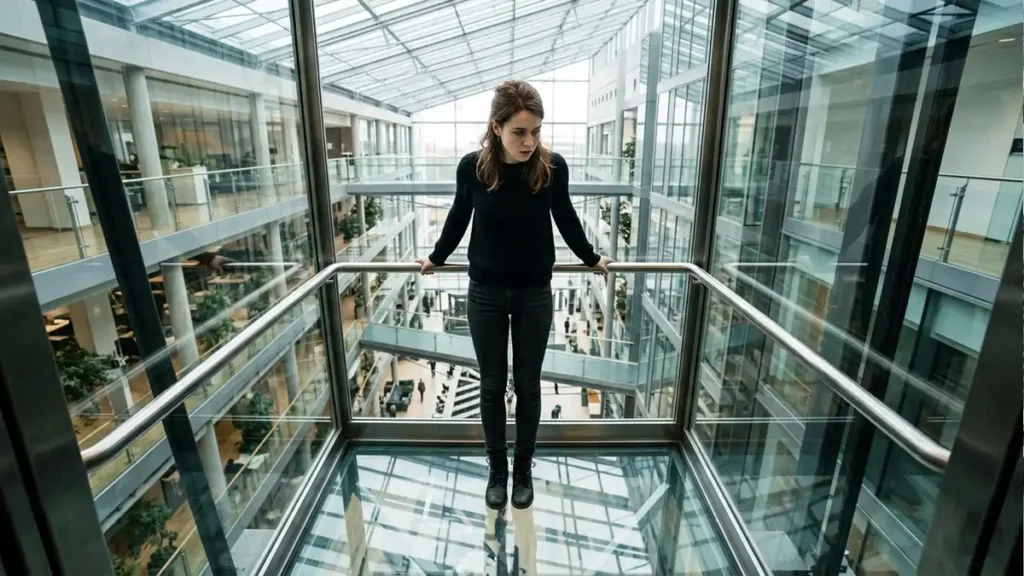
The body’s response to perceived height danger is almost instant. Before you’ve even consciously thought about the drop, your vestibular system (which controls balance) and your visual system are already sounding alarms. Your heart rate climbs, breathing becomes shallow, and muscles tense—all part of an ancient survival pattern designed to make you freeze or retreat. This reflex helped ancestors avoid fatal falls. Today, it can fire in perfectly safe environments, simply because the brain’s prediction of danger outpaces the rational awareness that a railing is solid.
Common Triggers Like Balconies, Ladders, and Glass Floors
Certain situations reliably trigger height discomfort:
- 🏙️ Open balconies or rooftops – where there’s no solid wall, only a railing.
- 🪜 Ladders and step stools – even low heights can feel unstable when your body isn’t fully anchored.
- 🪟 Glass floors or transparent bridges – the visual input of a drop under your feet sends a strong mismatch signal to the brain.
- ⬆️ Escalators in open atriums – movement combined with height adds an extra layer of unease.
- 🌉 Driving over high bridges – the sense of suspension can make the height feel more immediate.
These triggers are common because they introduce a feeling of vulnerability, not because the structure is actually dangerous.
Why Looking Down Feels Worse Than Looking Up
Many notice that peering downward creates a much stronger reaction than looking out or up. This makes evolutionary sense: looking down gives the brain a direct measurement of the distance to impact. The visual system registers the vertical drop and instantly calculates the time it would take to fall, while the vestibular system simultaneously reports small shifts in balance. When the two inputs clash—for example, when you feel steady but your eyes see a deep void—the brain often resolves the confusion by leaning toward caution.
The Brain Misjudges Height and Distance article dives deeper into how visual cues and neural pathways create this compelling illusion of danger.
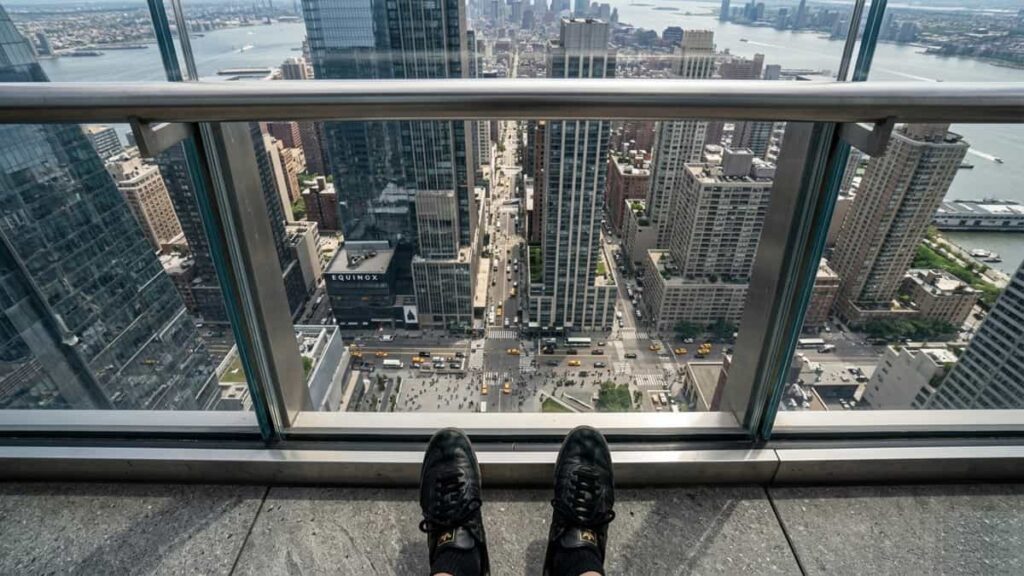
Physical Signs Many People Notice
Height-induced unease doesn’t just stay in the mind. Common physical signs include:
- ❤️ A racing heartbeat or palpitations
- 🌬️ Shallow, rapid breathing
- 🫳 Sweaty palms
- 🦵 Trembling legs or a sensation of weakness in the knees
- 🌀 Lightheadedness or vertigo-like dizziness
- 😮💨 A tight chest or throat
- 🪑 A sudden urge to crouch, sit, or hold onto something
These signs tend to escalate the more a person focuses on them, creating a feedback loop between body and brain.
Why Some People Avoid Heights Completely
Avoidance is a natural human strategy for reducing discomfort. If being near a high edge repeatedly triggers a powerful stress response, the brain learns to steer clear of those situations entirely.
Over time, this can lead to skipping hikes with scenic overlooks, choosing ground-floor apartments, or avoiding open staircases at work. Avoidance doesn’t mean someone is “overreacting”; it’s an understandable attempt to feel safe. The downside is that the fear can grow in the darkness of never being tested, making everyday life subtly more restricted.
Can Fear of Heights Change Over Time?
Yes. Height-related unease can shift as people move through different life stages, accumulate positive experiences, or consciously work on their reactions. For some, confidence comes naturally with exposure—like becoming comfortable on a rooftop after spending time there with friends. For others, the fear lessens once they understand why their body reacts so strongly.
The key is that change often happens gradually, through small, repeated interactions with heights rather than a single dramatic event.
Small Ways People Try to Feel More Comfortable
Many people find relief through simple, practical approaches:
- Standing near a solid wall or barrier and gradually moving closer to the edge
- Focusing on the horizon rather than the drop below
- Using slow breathing to calm the body’s arousal system
- Practicing on lower platforms before moving to higher ones
- Engaging a trusted companion to act as a calming presence
These are not “cures” but gentle adjustments that help the brain learn a new, less alarmed response. For those curious about how the body’s anxiety system can be settled naturally, the Manage Anxiety Naturally: Psychology Methods article explains complementary techniques that work with—not against—human biology.
When Height Fear Starts Affecting Daily Life
Occasionally feeling uneasy near a cliff edge is normal. The concern becomes more significant when it changes behaviour: avoiding travel, refusing promotions that require working on higher floors, or feeling dread days before an unavoidable height situation. This is when the fear shifts from a quirk to a functional limitation.
Recognising this shift is not about labeling or diagnosing; it’s about noticing when the brain’s protective system is over-exerting itself. The article When Anxiety Becomes a Problem: Signs offers a broader look at how to spot when everyday unease begins to interfere with life, without any pathologising language.
Common Myths About Fear of Heights
- Myth 1: People with acrophobia are just looking for attention.
Reality: The physical symptoms are real and involuntary. No one chooses a racing heart or dizziness for attention. - Myth 2: It always comes from a bad experience with heights.
Reality: Many develop height unease without any specific trauma; it can emerge from biological sensitivities or learned observation. - Myth 3: If you can stand on a chair, you can’t be afraid of heights.
Reality: Acrophobia is often context-dependent. A stable, low-height surface feels different from an open, high ledge. - Myth 4: Telling someone “just don’t look down” solves it.
Reality: The brain processes peripheral visual information automatically. The discomfort often persists even when not looking directly down.
Final Thoughts
Acrophobia feels like a full-body alarm system firing in a situation that logic knows is safe. It’s the racing heart, the dizzy sensation, the overwhelming compulsion to step back—all working together to keep you from harm, even when harm is unlikely. Seeing this reaction as a normal, explainable part of human behaviour—rather than a personal flaw—opens the door to greater compassion and more effective coping.
Height unease is one of the many ways our ancient wiring shows up in a modern world, and understanding it is the first step toward gently reshaping it.
Related Articles


Sponsored


You May Also Like

Bipolar Disorder in the Digital Age: How Social Media and Da…

The Consideration Matrix: How Commute Etiquette Shapes Invis…

Why Procrastination Is Not Just Laziness

Projection in Friendships: When Friends Mirror Their Issues

The Psychological Weight of Response Velocities
