Have you ever been so absorbed in an activity that hours felt like minutes? That’s not just “being busy” — it’s engagement, the second pillar of Martin Seligman’s PERMA model of well-being. Psychologists call this state flow: complete immersion where your skills perfectly match the challenge at hand.
This article unpacks the science of flow, why engagement beats passive entertainment, and how to build deep focus habits that make work and hobbies feel effortless.
KEY TAKEAWAYS
- Engagement requires active use of skills, unlike passive entertainment.
- Flow occurs at the sweet spot where challenge perfectly matches skill.
- Deep focus boosts productivity by up to 500% while reducing mental fatigue.
What is Engagement ?
In positive psychology, engagement means being fully absorbed, energized, and focused on an activity. Unlike passive pleasure (watching TV), engagement requires active use of your strengths and attention. When you’re engaged, you’re not just happy — you’re alive.
Think of a musician lost in a solo, a coder solving a bug, or a painter mixing colors for hours. That’s engagement.
“Lost in work” feeling
That feeling of “losing yourself” isn’t a distraction — it’s a sign of optimal experience. Your sense of self disappears. Worries about bills, social media, and tomorrow’s deadlines vanish. Only the present moment exists.
This is why engagement is so powerful: it’s a natural antidepressant and productivity booster rolled into one.
Flow State Explained
Flow was first identified by psychologist Mihaly Csikszentmihalyi. He described it as “being completely involved in an activity for its own sake.” Time flies. Every action flows into the next.
Deep focus concept
Deep focus is the engine of flow. It’s the ability to direct sustained attention to a single task without mental wandering. Unlike shallow work (checking emails), deep focus creates high-quality output and intrinsic satisfaction.
Forgetting about time
In flow, your brain’s time perception changes. The prefrontal cortex (responsible for self-monitoring) quiets down, and you stop clock-watching. Hours feel like minutes. This “temporal distortion” is one of the most pleasurable aspects of engagement.
Core Elements of Engagement
| Element | Description |
|---|---|
| Challenge-Skill Balance | Task difficulty matches your ability. Too hard = anxiety. Too easy = boredom. |
| Clear Goals | You know exactly what to do next (e.g., “write one paragraph,” “clear this level”). |
| Immediate Feedback | You see results instantly — a chess move works, a line of code runs. |
| Concentration | Full attention on the task, no mental residue. |
| Sense of Control | You feel you can handle the situation. |
| Loss of Self-Consciousness | No inner critic, no overthinking. |
| Autotelic Experience | The activity is rewarding in itself, not for external rewards. |
The most critical is challenge vs skill balance. If you’re stuck in boredom or anxiety, you’re not engaged.
Benefits of Engagement
1. Higher Productivity
Flow states produce 500% more output than normal work, according to some studies. You work faster, make fewer errors, and need less mental energy.
2. Deep Satisfaction
Unlike hedonic happiness (ice cream, Netflix), engagement provides eudaimonic happiness — the satisfaction of growth and mastery. It’s what makes you feel proud at the end of a day.
3. Reduced Mental Fatigue
Counterintuitively, deep focus is less tiring than multitasking. Flow restores mental energy because your brain operates in a coherent, efficient mode.
4. Improved Mental Health
Regular engagement lowers risk of depression and anxiety. It gives you a break from rumination and negative thought loops — something also explored in why the brain overthinks simple situations.
Behavior Patterns
People who experience engagement regularly tend to:
Avoiding Distractions
They don’t rely on willpower alone. They design their environment — phone on silent, notifications off, dedicated workspace. They know that every interruption costs up to 25 minutes to recover focus.
Deep work habit
Author Cal Newport popularized “deep work”: professional activities performed in a distraction-free concentration state. This is a trainable habit. Start with 60–90 minute blocks, no breaks.
Single-tasking
They do one thing at a time. No email while coding. No social media during writing. Single-tasking is the foundation of flow.
Common Barriers & Solutions
UPSIDES
- ✓ Designing an environment that removes phone/notification distractions
- ✓ Single-tasking with clear, actionable immediate objectives
- ✓ Stretching challenge levels by ~4% beyond your current skill level
DOWNSIDES
- ✕ Multitasking or rapid switching between emails and deep work
- ✕ Vague goals like ‘work on project’ without immediate physical next steps
- ✕ Low challenge leading to boredom or high stress leading to anxiety
Real-Life Examples
Coding
A developer fixing a bug feels frustration until the solution clicks. Then hours disappear. The constant feedback (code runs or doesn’t) creates perfect flow conditions.
Gaming
Games are flow machines. They provide clear goals (beat the level), immediate feedback (score, health bar), and adjustable difficulty. This is why why gamers love cyberpunk anti-heroes — the intense engagement of open-world RPGs creates powerful flow experiences.
Sports
A tennis player in “the zone” sees the ball bigger, reacts without thinking, and feels effortless power. That’s pure engagement.
Creative work
Writing, painting, composing — when the external world fades and only the creation exists.
How to Improve Engagement
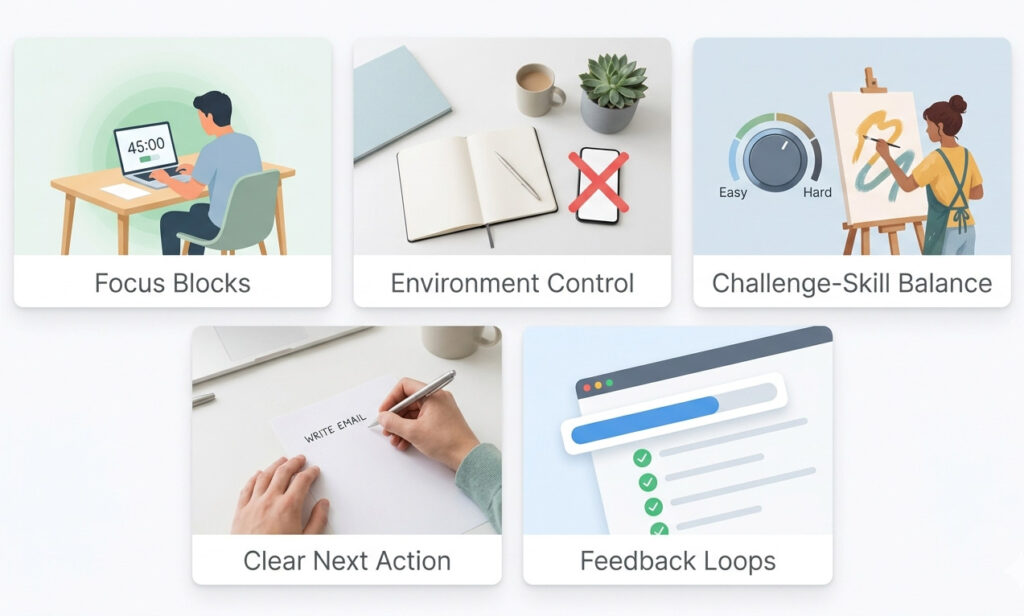
1. Focus Blocks (Pomodoro variation)
Work for 90 minutes (not 25 — flow takes time to enter). Then break for 15–20 minutes. Adjust based on your natural rhythm.
2. Environment Control
ENVIRONMENT CONTROL CHECKLIST
- ✓ Remove your phone completely from the room
- ✓ Use website blockers like Freedom or Cold Turkey
- ✓ Wear noise-cancelling headphones or play ambient audio
- ✓ Keep only your active task visible on your workstation
3. Match Challenge to Skill
If bored: increase difficulty. If anxious: break task into smaller steps or learn a new skill. Aim for a 4% stretch beyond current ability.
4. Clear Next Action
Before starting, write down the single next physical action. Example: “Write 200 words about flow benefits” not “Work on article.”
5. Immediate Feedback Loops
Create ways to see progress instantly. Checklists, timers, progress bars, or even a tally mark each time you complete a subtask.
You May Also Like
Willpower vs Systems: The Science of Self-Control
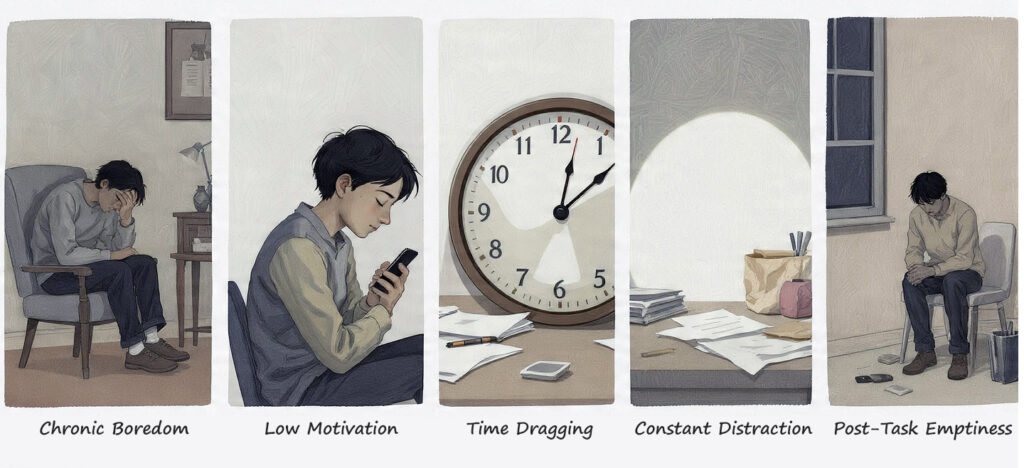
Signs You Lack Engagement
- Chronic boredom – Even interesting activities feel dull
- Low motivation – You start tasks but quit quickly
- Time dragging – Work feels like an eternity
- Constant distraction – You check your phone every few minutes
- Post-task emptiness – Instead of satisfaction, you feel drained or numb
If this sounds familiar, start with one 30-minute focus block tomorrow morning. No phone. One clear task. Notice how different it feels.
FAQs
What is the difference between engagement and happiness?
Happiness can be passive (like eating ice cream or watching TV), whereas engagement requires active effort, skill utilization, and total mental absorption (eudaimonic happiness).
How long does it take to enter a flow state?
It typically takes 10 to 15 minutes of uninterrupted, deep focus for the brain to quiet down its self-monitoring functions and enter a true flow state.
Can you force yourself into a flow state?
While you cannot force it instantly, you can create the optimal triggers: remove all distractions, set a hyper-specific goal, and ensure the task stretches your skill level by about 4%.
Engagement isn’t a luxury — it’s a psychological need. Flow states reduce stress, boost productivity, and create genuine happiness that passive entertainment never can.
You don’t need a new career to find engagement. You need to remove distractions, match challenge to skill, and protect deep focus. Start small. One flow block today. Then another tomorrow.
For the full picture of well-being, explore the entire PERMA model of positive psychology — including positive emotion, relationships, meaning, and accomplishment.
Related Articles



Sponsored


You May Also Like

The Creator Archetype – Driven by Innovation, Expression &am…

Why Do Some People Seem Naturally Confident in Any Situation…

Online Projection: Instagram, Reels & Fake Perception

The Explorer Archetype – The Drive for Freedom, Adventure &a…

Projection in Friendships: When Friends Mirror Their Issues