

For decades, psychology revolved around a single fundamental question — are we shaped more by our genes, or by the environment we grow up in? This debate, often framed as “Nature vs Nurture,” assumed one side had to dominate the other. But modern psychological science has moved far beyond that binary view. Today, research shows that human behavior is not Nature or Nurture — it is the result of Nature × Nurture working together.
KEY TAKEAWAYS
- Nature × Nurture Interaction: Human behavior isn’t driven purely by genetics or environment, but by their multiplication across time.
- Layered Chain of Influence: Development unfolds through a continuous system starting from geography down to social circles.
- Epigenetic Control: Environmental factors influence how genetic predispositions manifest without altering DNA sequences.
Your genes provide the biological blueprint, but your environment decides how that blueprint is expressed, reinforced, modified, or suppressed across life. This interaction becomes clearer when viewed through Bronfenbrenner’s Ecological Systems Theory, which explains that we are shaped not by one environment, but by multiple layers — from geography and climate to parenting, education, peers, and even digital spaces.
In reality, human development follows a layered chain:
Geography & Climate → Culture → Parenting → Education → Social Circles → Behavior
Each layer influences the next, and together they determine how our biological potential unfolds into personality, habits, coping styles, and life choices.
Geography & Climate — The Silent Foundation of Nurture
Long before a child learns to speak, the physical world they live in begins shaping their experiences. Geography and climate form the outermost layer of nurture, quietly influencing lifestyle patterns, stress responses, emotional expression, and community behavior.
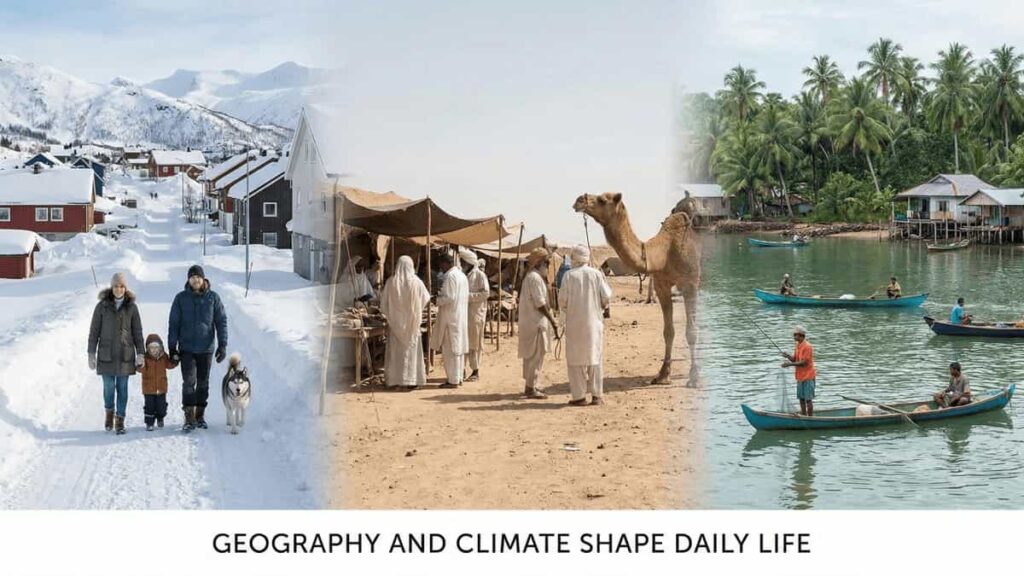
Regions with harsh or cold climates often require long-term planning, coordination, and discipline simply to survive seasonal demands. These conditions promote structured routines and cautious decision-making. Meanwhile, warmer and humid climates tend to create “outdoor social cultures,” where interpersonal bonding, collective participation, and expressive communication become part of daily life. In resource-limited environments, communities often develop a survival-first mindset based on cooperation, caution, and shared responsibility.
Climate does not directly determine personality — but it shapes the economic lifestyle, social rhythms, and cultural habits people grow up inside. Geography builds the stage upon which culture develops, and that culture eventually shapes how individuals learn to think, behave, and relate to others.
Culture & Society — The Default Operating System of the Mind
If genes are the hardware, culture functions as the default operating system. It programs our worldview long before we are capable of questioning it. Culture influences what is seen as “normal,” “moral,” “successful,” or “acceptable,” shaping everything from communication style to conflict-handling and emotional expression.
Culture does not erase genetics — it filters how genetic tendencies show up in behavior. Culture decides which traits are reinforced, which are suppressed, and which are rewarded.
Parenting & Early Attachment — Where Traits Take Direction
As we move inward from society to the immediate environment, parenting becomes the most direct force of nurture. This is where a child’s innate temperament meets environmental moulding. Early attachment — consistent, secure, unstable, or neglectful — forms the emotional template through which a child views relationships, trust, and safety.

Supportive and structured parenting (authoritative) often produces confident and emotionally balanced adults who feel grounded yet independent. Strict and controlling parenting (authoritarian) may create disciplined children, but it can also increase anxiety, fear of failure, or emotional suppression. Permissive parenting may encourage creativity and openness but can weaken boundaries and self-regulation. Neglectful or inconsistent parenting, meanwhile, is strongly associated with insecurity, emotional instability, and identity confusion.
This phase is not where genes disappear — rather, it is where genetic tendencies begin to take direction. The same naturally bold child may grow into a confident leader under supportive guidance, or into a rebellious risk-taker under restrictive control. Parenting determines whether traits become strengths or vulnerabilities.
You May Also Like
Erik Erikson’s Stages of Psychosocial Development
Education & Cognitive Exposure — The Layer that Shapes Thinking
Education is more than academics — it is the cognitive shaping layer of development. Schooling determines how a child interprets success, failure, competition, social comparison, and their own sense of ability.
Supportive educational environments encourage curiosity, resilience, exploration, and a growth mindset. Students learn that effort improves ability. On the other hand, rigid or fear-based systems can create conformity, performance anxiety, and a fixed mindset — where failure is seen as a permanent limitation instead of a learning stage.
Education also exposes children to their first large-scale social ecosystem outside the family. It influences identity formation, belongingness, self-confidence, and future aspirations. The lessons we internalize here continue shaping our worldview well into adulthood.
Social Circles & Digital Environments — The Reinforcement Engine of Behaviour
As we move into adolescence and adulthood, peers gradually become the strongest reinforcement force in behaviour. We begin to mirror the habits, ambitions, communication styles, and emotional responses of the people we spend the most time with. Our social environment normalizes behaviour — whether healthy, disciplined, chaotic, or self-destructive.

Today, this layer is no longer limited to real-world relationships. The digital world has become a psychological microsystem of its own. Algorithms, online communities, parasocial interaction, and constant comparison can reinforce tendencies such as anxiety, insecurity, impulsive behaviour, or validation-seeking. Social media environments shape how individuals evaluate self-worth, belonging, and identity expression.
In many ways, the “peer environment” now exists simultaneously in both physical and digital space — and both influence behaviour patterns across time.
Where Nature Fits In — Genetics, Temperament & Epigenetics
Nature determines the baseline — temperament, emotional reactivity, cognitive potential, and biological sensitivity to stress. But these traits are not absolute. Through Gene–Environment Interaction and Epigenetics, life experiences can influence how genes are expressed.
Epigenetics does not change DNA itself — instead, environmental conditions can turn certain genes “on” or “off,” affecting how traits manifest. For example, a person may have a genetic predisposition toward anxiety. In a stable and supportive environment, these traits may remain controlled or even adaptive, leading to emotional awareness and empathy. In a chaotic or high-stress environment, the same predisposition may intensify into clinical anxiety.
The same genetic wiring can therefore produce very different outcomes depending on the environment it interacts with.
Final Reality — Human Behaviour Is a Multiplying Effect
Human behaviour is not Nature vs Nurture — it is Nature multiplied by Nurture.
THE CHAIN OF INFLUENCE
- ✓ Geography builds the structural stage.
- ✓ Culture writes the rules of living.
- ✓ Parenting sets the emotional direction.
- ✓ Education shapes cognitive thinking patterns.
- ✓ Social circles and digital spaces reinforce identity.
Genes provide the possibilities —
Environment decides which possibilities become reality —
And life experiences continue reshaping us along the way.
We are not simply born as a finished personality. We are continuously shaped by where we live, who we grow with, what we experience, and how our environment interacts with our biology across time.
You May Also Like
Perception Psychology: How the Brain Constructs Reality
Frequently Asked Questions (FAQ)
1. Can my environment really change my personality?
Yes. Your core temperament is largely stable, but your environment shapes how you express those traits in real life. This is called characteristic adaptation — meaning the same personality trait can look very different depending on parenting style, culture, social circle, and life experiences.
2. Which is more important: Nature or Nurture?
Neither one is “more important.” They work together. The relationship is like a rectangle — you cannot say the length matters more than the width. Your genes provide potential, and your environment determines how that potential develops and is expressed.
3. What is “Epigenetics” in simple terms?
Epigenetics explains how life experiences — such as stress, parenting, lifestyle, or nutrition — can influence how certain genes are activated or suppressed without changing your DNA sequence. In simple words: the environment can affect how your genes behave, not what they are.
4. Can a positive environment reduce the impact of genetic risk?
Yes. Genetics may create a predisposition or vulnerability, but a supportive environment can act as a protective factor. Strong relationships, stable nurturing, positive peer groups, and healthy coping systems can significantly reduce the chances that a genetic risk develops into a real problem.
5. Does the digital world also count as “Nurture”?
Absolutely. Modern psychology considers the digital world part of our microsystem. Social media, online communities, and algorithm-driven interactions can influence self-esteem, emotional behavior, and social habits — sometimes as strongly as real-world relationships.
Note: This article is for educational purposes only and does not constitute professional clinical advice.
Related Articles



Sponsored


You May Also Like

Why We Buy Things We Don’t Need: The Science of Consumer Psy…

Psychology Quotes – Words That Understand the Mind

Industrial-Organizational Psychology: The Science of Making …
The Smartphone “Brain Drain”: Why Having Your Ph…

Psychosexual Stages: Why Your Childhood Shapes You
