Why Anxiety Can Feel So Intense for Many People
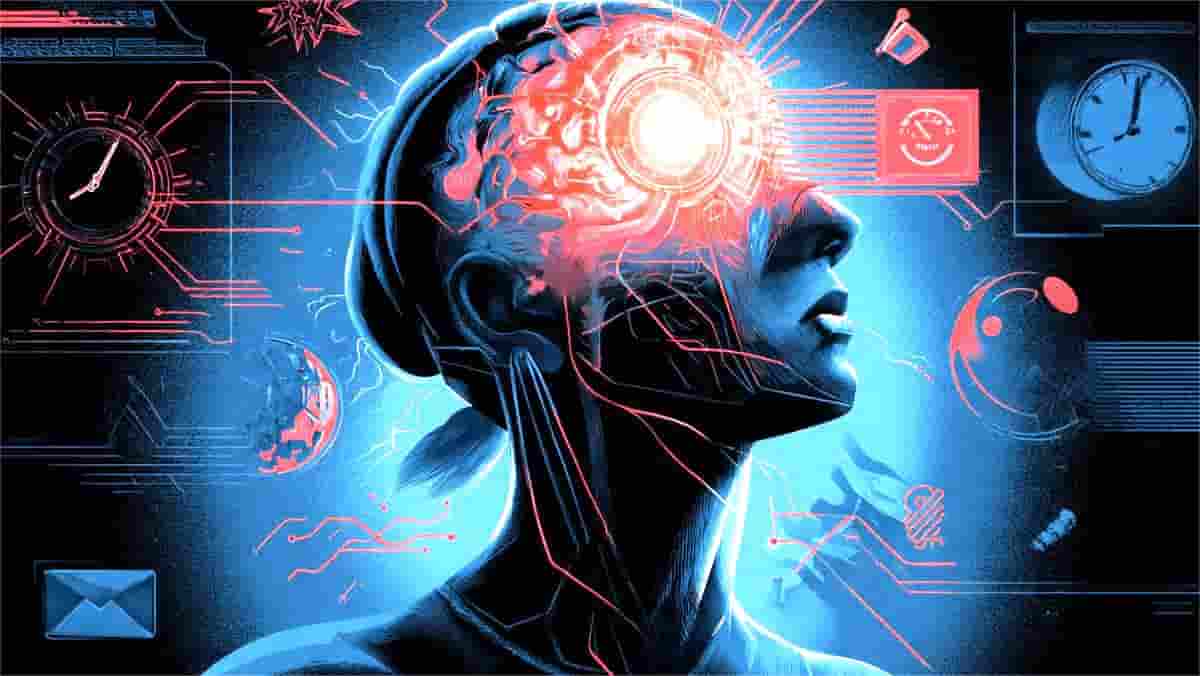
A visually striking digital illustration of a human profile with a glowing red alarm interface over the brain and eye area. The silhouette is surrounded by blue circuitry, clock icons, and data HUD elements on a dark background, representing the overwhelming sensory input of anxiety.

While observing how people describe anxiety, one pattern keeps repeating. They don’t just say they feel worried—they say it feels overpowering, consuming, and difficult to control. Even small uncertainties trigger intense physical and mental reactions. This raises an essential psychological question: why does anxiety feel so much bigger than the situation itself? Understanding this begins … Read more

Why Mental Health Issues Often Go Unnoticed

A cinematic, painterly illustration of a dense city crowd where individuals appear isolated. Many people wear masks and look down at their smartphones, symbolizing how mental health struggles can remain hidden even in plain sight.

We notice a broken arm immediately. We notice when a colleague has a flu. Yet, according to the National Institute of Mental Health (NIMH), there is an average delay of 11 years between the first onset of mental health symptoms and when an individual finally receives treatment. We often operate under the assumption that if … Read more

Why Smart People Make Bad Career Decisions Under Pressure

Smart young professional standing at a city intersection under pressure while making a career decision

While observing high-performing students and professionals make major career choices, I noticed something unexpected. Intelligence did not always protect them from poor decisions—especially under pressure. In fact, the more capable the person, the more complex their reasoning often became. Cognitive psychology suggests that under stress, even sharp minds rely on shortcuts, emotional signals, and social … Read more

Why Mental Health Challenges Can Develop Over Time

Conceptual representation of mental health complexity and multiple contributing factors

When someone develops a mental disorder, the world often offers simple explanations. “They’re not trying hard enough.” “They just need to think positive.” “They had a difficult childhood—that’s obviously why.“ These explanations feel satisfying because they’re simple. But simplicity is dangerous when it comes to mental health. The truth is more complex, more scientific, and … Read more

Why Do People Have Such Different Personalities?

Group of individuals showing varied expressions and body language, representing personality differences

Same world. Same species. Same basic human hardware. Yet one person thrives at loud parties while another needs silence to recharge. One wakes up at 5 AM to plan their week; another flows spontaneously. One feels deeply wounded by a critical comment; another shrugs and moves on. Why? The answer is surprisingly complex—a dance between … Read more

Why Do Childhood Experiences Shape Adult Behavior?

Adult with subtle child silhouette overlay, symbolizing how childhood experiences shape adult behavior

Have you ever reacted to something and thought, “Where did that come from?” A flash of anger at a minor inconvenience. Sudden tears during a work review. An inexplicable urge to disappear when someone raises their voice. You’re not crazy. You’re not broken. You’re programmed—and the programmer was a child. Your childhood didn’t just happen … Read more

Why Are Habits So Hard to Break?

Young adult hesitating while reaching toward a distraction, representing the psychological struggle of breaking habits

You know the feeling. You promised yourself you’d scroll less, eat better, or stop biting your nails. You lasted three days. Maybe four. Then, without warning, you found yourself reaching for the phone, the cookie, or your mouth again. And then came the shame. “Why can’t I just stop? What’s wrong with me?” Nothing is … Read more

Why Do People Behave Differently in Groups?

Person standing in a crowd with subtle visual emphasis on individuality, representing group influence and social behavior dynamics

Think about the quietest person in your office. Now imagine them at a concert, screaming lyrics along with thousands of strangers. Or consider your most outspoken friend—the one who dominates every dinner conversation—turning completely silent in a meeting full of senior executives. Same people. Completely different behavior. This isn’t hypocrisy or inconsistency. It’s the group … Read more

Why Do We Overthink Everything?

Man sitting thoughtfully with abstract symbols of branching thoughts, representing the psychology of overthinking

Why Do We Overthink Everything? You’ve probably done it today. Replayed a conversation. Analyzed a text. Imagined a disaster that didn’t happen. Overthinking is not a modern affliction — it’s a natural feature of the human brain. But why do we do it? And why does it feel so automatic? The short answer: your brain … Read more