

The brain’s response to quiet, darkness, and the feeling of being alone
Silence is not simply the absence of sound. It’s an environment all its own, and after dark, it can change from peaceful to deeply unsettling. The same quiet that feels calming during a morning meditation can become heavy and watchful past midnight. This shift is not strange. It’s the result of millions of years of evolution, combined with how the brain processes sensory information and builds expectations about safety.
Understanding why silence at night feels different can make it less threatening and more a reflection of normal, healthy brain function.
You May Also Like
Perception vs Reality: How the brain pieces together incomplete data—and what happens when the pieces don’t fit.
Why Silence Feels Different After Dark
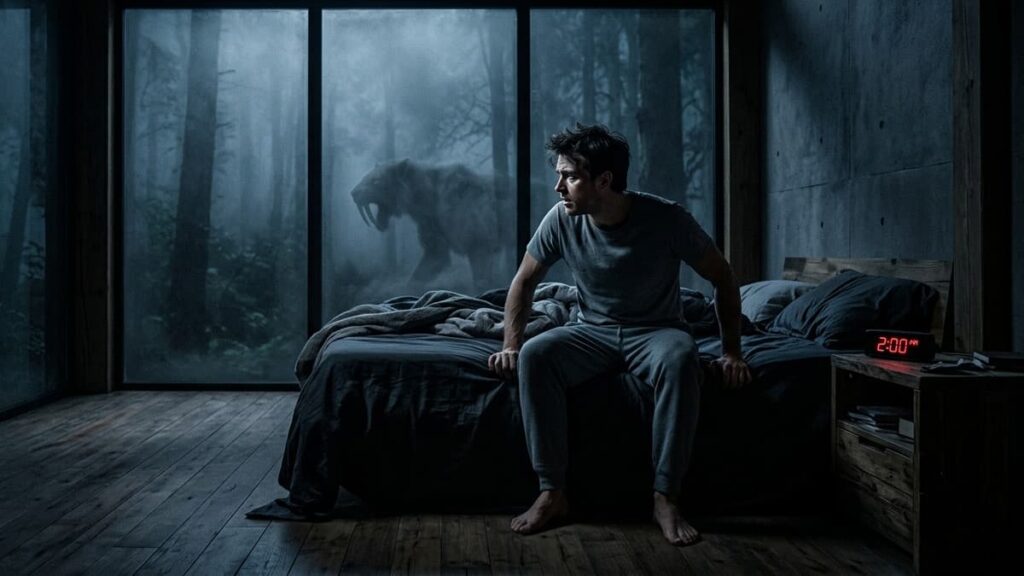
During the day, silence is a pause. At night, it can feel like a presence.
This difference is rooted in the brain’s circadian biology. As natural light fades, the body begins to produce melatonin, shifting the nervous system toward rest. But alongside that shift, ancient survival mechanisms also activate. Night was the most dangerous time for early humans, when predators hunted and visibility dropped. The brain learned to pair darkness with heightened vigilance, even when the body was preparing to sleep.
Silence at night lands differently because the brain interprets it not as peace but as a potential warning. In the ancestral world, a quiet night could mean that danger was near—that even the insects and animals had gone still in the presence of a predator. That old instinct still hums beneath modern life.
How the Brain Reacts to Quiet Environments
Total silence confuses the brain. The auditory system is designed to receive a constant stream of input, even if only the gentle sound of one’s own breath or the faint hum of a refrigerator.
When that input drops to near zero, the brain does not relax. It turns up its internal gain, searching for any signal at all. This increase in auditory sensitivity is a survival adaptation. If the environment is silent, the brain assumes it must be because something has made it silent, and it prepares to detect the smallest sound that might break the quiet.
This is why, in a very still room at night, the slightest sound—a settling floorboard, a distant car—can feel startling. The auditory system is now operating at maximum sensitivity, and any input is amplified beyond its normal significance.
Why Humans Become More Alert at Night
Humans are diurnal creatures. We evolved to be active in daylight and vulnerable in darkness. The brain’s alertness system shifts accordingly, increasing attention to potential threats when light disappears.
The amygdala, the brain’s rapid-response fear center, becomes more reactive at night. Studies show that the same neutral image or faint sound that would go unnoticed during the day can trigger a brief stress response after dark. This nocturnal vigilance is hardwired and does not require any actual danger—the brain is simply running its evolutionary software.
Coupled with silence, this heightened alertness creates the perfect conditions for unease. The brain is already scanning for threats, and the quiet gives it very little data to work with. In that data vacuum, imagination rushes in.
Why Small Sounds Feel Louder in Silence
In a noisy environment, the brain filters out background sounds automatically. In silence, every tiny noise—a pipe creaking, the rustle of fabric, a distant hum—moves to the foreground.
This is partly a physical adaptation. The muscles of the middle ear adjust to control the amount of sound reaching the inner ear, and in quiet conditions, this acoustic reflex relaxes, making the ear more sensitive. Sound level that would be imperceptible in the daytime becomes vivid.
Psychologically, the brain also assigns more meaning to these sounds because there is nothing else to process. A random settling noise in a house might go completely unnoticed during a busy afternoon, but at 2 a.m., in total silence, it can spark a cascade of alarmed thoughts: What was that? Is someone there? The sound hasn’t changed—only the brain’s interpretation of it has.
How Imagination Fills Empty Space
When sensory input decreases, the brain’s predictive processing system doesn’t stop working. It keeps generating expectations, filling the silence with internal content.
That internal content often takes the form of imagined scenarios. The mind might create a faint voice, a footstep, or a shadow just beyond the edge of sleep. These are not hallucinations but rather the brain’s best guesses based on past experience, memory fragments, and a healthy dose of caution.
The brain’s negativity bias pushes these imagined scenarios toward the threatening. An ambiguous sound becomes an intruder. A shadow in the corner of the eye becomes a figure. This is not because the person is irrational but because the brain, when faced with incomplete data, assumes the worst in order to stay safe.
Why Isolation Increases Unease
Silence is rarely just silence. It often arrives with a sense of being completely alone.
Isolation amplifies the brain’s threat response because, historically, being alone meant being vulnerable. Without others to share the watch, every sound and every shadow had to be assessed alone. The modern brain still carries this social safety calibration.
At night, when the world is asleep and communication is shut down, isolation can feel absolute. The quiet confirms that no one else is awake, no one else is listening. This sense of being the only conscious person in a dark, silent house can trigger a feeling of existential vulnerability that has nothing to do with real danger and everything to do with the brain’s deeply social wiring.
Why Some People Find Silence Relaxing Instead
Not everyone experiences night silence as creepy. For many, it’s the most peaceful part of the day.
Individual differences in brain chemistry and personality play a major role. People with lower baseline levels of amygdala reactivity find the quiet soothing rather than threatening. Their brain interprets the absence of noise as a signal that everything is fine, that no threats are present.
Past experience also shapes the response. A person who grew up in a quiet house, or who associates silence with safety and comfort, is less likely to feel uneasy. In contrast, someone who has experienced a frightening event in a quiet environment may carry that association forward.
Context matters enormously. The same deep silence that feels frightening in an unfamiliar hotel room may feel absolutely safe at home in one’s own bed, surrounded by familiar shapes and smells.
Common Situations Where This Feeling Happens
The sensation of creepy silence at night often shows up in specific, recognizable settings. Many people report feeling it most acutely:
HIGH-VIGILANCE ENVIRONMENTS
- When home alone for the first time, or after others have gone to bed
- In an unfamiliar place, like a hotel room or a friend’s house
- During a power outage, when the usual hum of appliances and electronics vanishes
- Outside in a quiet rural area or at a campsite, far from city noise and artificial light
- After waking from a nightmare, when the brain is already primed for threat
- In complete darkness with no visual cues, which removes an additional layer of orientation
In each case, the brain is asked to process an environment stripped of its usual sensory anchors, and it responds with heightened vigilance.
Can Background Noise Reduce the Feeling?
Yes, and the reason lies in how the brain processes predictability.
A low, steady background sound—a fan, a white noise machine, a distant radio—gives the auditory system something consistent to latch onto. This continuous input prevents the brain from turning its internal gain up so high, reducing the startling impact of small, random noises.
White noise in particular works by raising the general sound floor without creating meaningful auditory events. The brain stops scanning for faint signals because the channel is already filled. This can dramatically lower the feeling of creepiness in a silent house at night.
Soft music or a quiet podcast can also provide social comfort. Hearing a human voice, even a recorded one, can reduce the sense of isolation that silence brings. The brain registers another presence, even if only imagined, and the threat-detection system eases.
RECOMMENDED READ
Manage Anxiety Naturally: Psychology Methods — Discover gentle, body-based techniques that work seamlessly with your nervous system.
Final Thoughts
Silence at night feels creepy not because it is truly dangerous, but because the brain has evolved to be suspicious of sensory emptiness in the dark. The auditory system amplifies small sounds, the amygdala stays on alert, and the imagination fills the quiet with cautious possibilities.
This response is not a weakness or a sign of an overactive mind. It’s the same protective programming that kept ancestors safe through millions of nights. Understanding why silence feels this way can drain some of its power, turning an unsettling stillness into just another quiet night.
Related Articles


Sponsored


You May Also Like

Why Some People Seem Naturally Confident

Cultural Lenses: How Modern vs. Traditional Style Alters Soc…
Social Media vs. Real Communities: Why Interaction Isn’t Alw…

Why Personal Growth Requires Discomfort: Embracing the Edge …

Big 5 Personality Test
