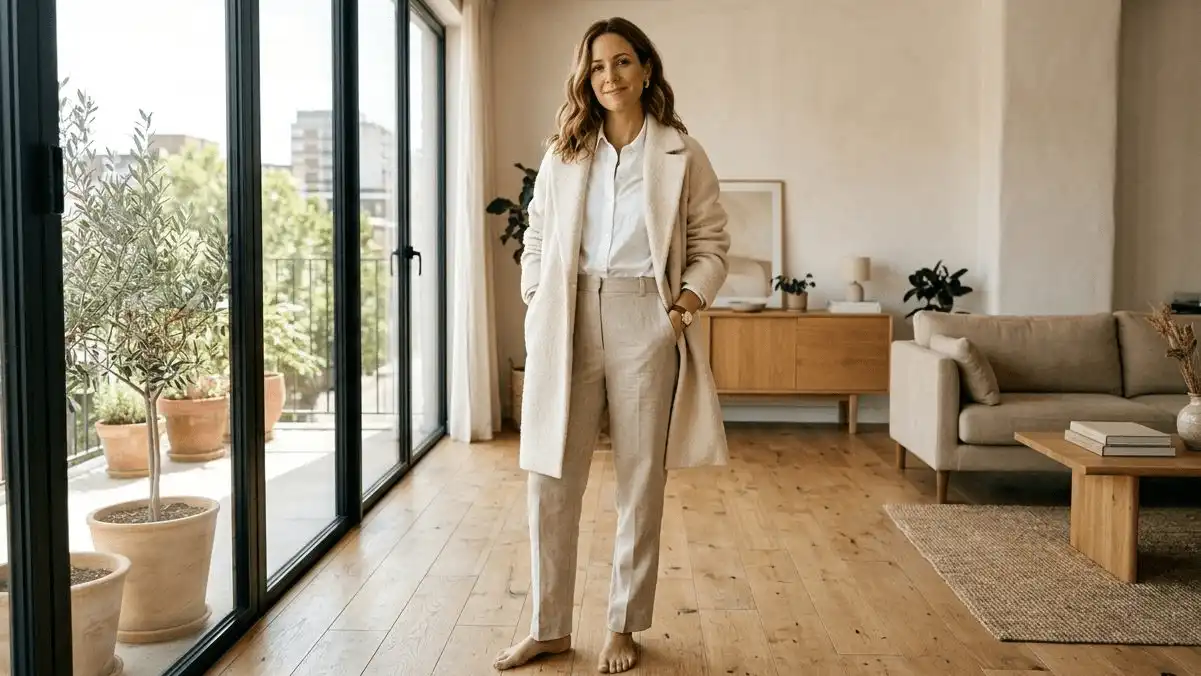
What Is the Minimalist Aesthetic?
Minimalist polish is not about expense. It is about intentional simplicity. Clean lines, neutral colors, perfect fit, and zero clutter — whether in clothing, grooming, or surroundings.
The brain reads minimalist polish as: “I have nothing to prove. I have already arrived.”
This is the opposite of loud luxury (logos, flashy accessories, excessive ornamentation). Minimalist polish whispers status. Loud luxury shouts it. And in high‑trust environments, whispers are heard more clearly.
Why Quiet Luxury Feels Powerful
Quiet luxury — high‑quality materials, impeccable tailoring, no visible branding — triggers a specific psychological response: deference without resentment.
When someone wears a logo‑covered designer outfit, the brain may think “wealthy, but trying too hard.” When someone wears an unbranded cashmere sweater that fits perfectly, the brain thinks “effortless, secure, probably very wealthy.” The lack of branding signals that external validation is unnecessary.
| Style | Signal | Brain Response |
|---|---|---|
| Loud logos (Gucci, Louis Vuitton all over) | “I need you to know I have money” | Mild admiration + suspicion of insecurity |
| Flashy colors + excessive accessories | “Look at me, I am important” | Attention followed by fatigue |
| Minimalist, unbranded, quality materials | “I do not need your approval” | Respect, curiosity, higher trust |
| Sloppy or neglected | “I do not care about myself or you” | Disrespect, avoidance |
Minimalist polish occupies the sweet spot: high status without arrogance, effort without visible strain.
The Psychology of Effortless Style
Effortless style is a paradox: it requires significant effort to appear as if no effort was made.
The brain respects this because it recognizes the discipline beneath the surface. A perfectly tied silk knot, trousers hemmed to the exact length, a shirt that moves without wrinkling — these details require planning, tailoring, and maintenance. But they do not scream for attention.
People who master effortless style are perceived as:
PERCEIVED TRAITS
- ✓ Higher in emotional stability
- ✓ More socially intelligent
- ✓ Less needy for external approval
- ✓ More trustworthy in high‑stakes situations
Over-Grooming and Social Suspicion
There is a ceiling to grooming. Beyond a certain point, perfection triggers suspicion.
Over‑groomed individuals — with hair shellacked into place, skin airbrushed with makeup, clothing without a single crease — signal obsession with image. The brain wonders: “What are they hiding? Why are they so controlling?”
Signs of over‑grooming that backfire:
RED FLAGS
- Hair that never moves (too much product)
- Makeup that looks painted on (no skin texture visible)
- Clothing that looks unworn (stiff, obviously dry‑cleaned daily)
- Nails that are excessively long or elaborate
- Scent that announces arrival from across the room
Minimalist polish avoids these extremes. It is groomed but human. Perfect but approachable.
Simplicity and High-Status Perception
The association between simplicity and high status is ancient. Royal courts historically favored solid colors and fine materials over patterns and baubles. The aristocracy wore understated elegance; the nouveau riche wore brocade and jewels.
This bias persists. In studies, participants rated minimalist‑dressed individuals as higher in social class and occupational prestige than flashily dressed individuals — even when told the minimalist outfit cost less.
Why? Because simplicity signals choice, not constraint. A person who can wear anything and chooses quiet elegance is perceived as having the confidence to ignore trends.
Minimalism vs. Flashiness
| Dimension | Minimalist Polish | Flashy Style |
|---|---|---|
| Colors | Neutrals (black, navy, beige, olive, white) | Bright, neon, contrasting |
| Logos | None or tiny | Large, prominent, repeated |
| Fit | Tailored, precise | Varies (can be tight or baggy for effect) |
| Accessories | One or two quality pieces | Multiple, statement pieces |
| Message | “I am secure” | “Notice me” |
| Trust in professional settings | High | Low‑Medium |
| Trust in social/creative settings | Medium | Medium‑High (context dependent) |
The right choice depends on the environment. For professional and serious dating contexts, minimalist polish consistently outperforms flash.
You May Also Like
Discover why people have different personalities — some are drawn to flash, others to minimalism
Grooming and Wealth Signals
Minimalist grooming follows the same principles: clean, natural, maintained — but not overdone.
GROOMING ELEMENTS
- ✓ Hair — Clean, simple cut, natural color. No extreme styling or obvious dye jobs.
- ✓ Skin — Clear, moisturized, but with visible pores and small imperfections.
- ✓ Nails — Clean, trimmed, buffed but not necessarily polished (or neutral polish only).
- ✓ Teeth — Clean, straight enough, but not unnaturally white (which signals vanity).
The brain reads natural maintenance as “old money.” It reads aggressive grooming as “new money trying too hard” or “insecure.”
The Rise of “Old Money” Psychology
The “old money aesthetic” — neutral colors, quality fabrics, no logos, understated accessories — has exploded on social media. But the psychology behind it is not new.
Old money style signals inherited status — wealth so secure that it does not need to be displayed. Even if you are not old money, dressing this way borrows the psychological halo. The brain does not know your bank account. It only knows what it sees.
Key elements:
KEY ELEMENTS
- Well‑fitted blazers and trousers
- Cashmere, wool, linen, cotton (no synthetics)
- Leather shoes (polished but not mirror‑shine)
- Simple watch (leather or metal band, no diamonds)
- Neutral palette with one subtle accent
Why Understatement Builds Trust
Understatement signals that you are not trying to manipulate the observer’s perception. You are simply being — and letting them draw their own conclusions.
This is deeply trust‑building. People trust those who do not seem to be performing. Minimalist polish is the opposite of performance. It says: “This is just how I am. Take it or leave it.”
In negotiations, job interviews, and first dates, understatement consistently wins over overstatement. The person who dresses quietly is listened to more carefully. Their words carry more weight because they are not competing with their clothes.
Must Read
Understand why real confidence is calm, steady, not loud — minimalist polish embodies that principle
Final Thoughts
Minimalist polish is not about spending more. It is about caring with restraint.
Buy fewer things. Maintain them better. Choose neutrals that fit perfectly. Skip the logos. Let your clothes whisper so your presence can speak.
The highest status signal is not what you wear. It is that you do not need anyone to notice what you wear. Minimalist polish delivers that message every time.
Related Articles


Sponsored


You May Also Like

The Everyman Archetype – The Need to Belong, Connect & F…

Initiative vs. Guilt (Erikson’s Third Stage of Psychosocial …

The “Nihilist Penguin” Effect: Why a Lonely Peng…

Educational Psychology: What It Is, Key Theories, Examples &…

The Explorer Archetype – The Drive for Freedom, Adventure &a…