

Why Some People Decide Faster Than Others
Have you ever noticed how some people seem to make the right decision almost instantly—while others hesitate, overthink, and miss the moment?
In everyday life, that delay can cost opportunities. On a football field, it can cost the game.
Football is not just a physical sport. It is a high-speed decision-making environment where players constantly process information, predict outcomes, and act—all within seconds. At elite levels, this decision window can shrink to under a second, often requiring the brain to prepare an action before the ball even arrives.
Over time, this repeated exposure doesn’t just improve performance—it reshapes how the brain works.
KEY TAKEAWAYS
- Football functions as a high-speed cognitive environment shrinking decision windows to under a second.
- Repeated fast-paced play triggers neural plasticity and strengthens intuitive fast thinking.
- The decision-making skills, emotional control, and pattern recognition trained on the pitch transfer directly to real-world scenarios.
What Makes Football a High-Speed Decision Sport
Unlike stop-start sports, football is continuous. There are no long pauses to analyze situations. Players must constantly:
In-Game Decision Demands
- ✓ Track the ball, teammates, and opponents simultaneously
- ✓ Adjust positioning in real time based on developing space
- ✓ Make critical tactical decisions under immediate physical pressure
Most decisions happen within 1–3 seconds, forcing the brain to rely on fast, automatic thinking rather than slow analysis.
The Science Behind Split-Second Decisions
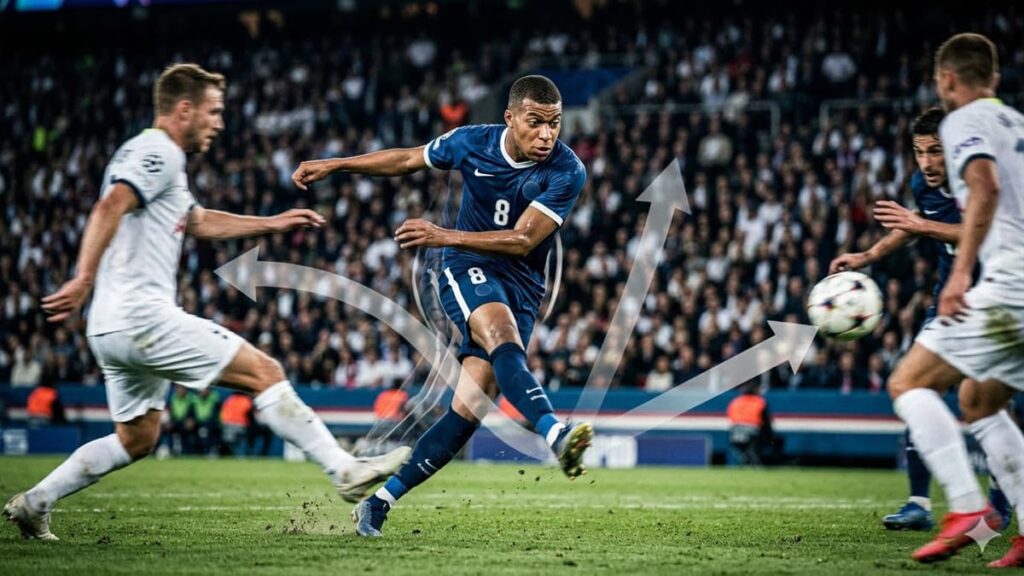
The brain operates using two primary systems:
- Fast thinking (automatic, intuitive)
- Slow thinking (analytical, deliberate)
Football heavily trains the fast system.
Through repetition, the brain builds mental shortcuts (known as heuristics)—allowing players to make quick, effective decisions without consciously analyzing every option.
At the same time, repeated play strengthens neural plasticity, meaning the brain physically adapts to handle speed, pressure, and complexity more efficiently.
🧠 The Football Brain in Action
| Brain Function | What Happens in Football | Psychological Benefit |
|---|---|---|
| Executive Function | Changing a pass mid-action | Improves control under pressure |
| Working Memory | Tracking multiple players at once | Reduces cognitive overload |
| Pattern Recognition | Reading opponent movements | Enables faster prediction |
| Emotional Regulation | Taking penalties under pressure | Maintains composure |
Spatial Awareness: Seeing Space Before It Exists
Experienced players don’t just react—they anticipate.
Football trains the brain’s visuospatial system (often called the visuospatial sketchpad), which helps players map the environment in real time.
Combined with proprioception (the body’s awareness of position and movement), players develop a kind of internal radar—allowing them to move and act without constantly looking down or pausing to think.
Reaction Speed: Training the Brain to Respond Instantly
Every moment in football is built on a simple loop:
stimulus → recognition → action
Through repeated drills, these pathways become faster and more efficient. What once required conscious thought becomes automatic.
This is why experienced players often appear to “react” instantly—they are not reacting, they are executing pre-trained responses.
Pattern Recognition: Predicting the Next Move
Football is full of repeating patterns.
Over time, players begin to recognize:
- Opponent behaviors
- Passing structures
- Movement trends
This builds anticipatory timing—the ability to predict what will happen next based on subtle cues.
This is what makes elite players seem “one step ahead.”
Emotional Control Under Pressure
Football is played in high-pressure environments—crowds, competition, and constant evaluation.
The brain’s emotional center (limbic system) is constantly active, especially in intense moments like penalties.
However, trained players develop strong emotional regulation, allowing them to:
- Stay calm
- Maintain focus
- Execute decisions clearly
This balance between emotion and control is a critical part of fast decision-making.
Team Coordination and Non-Verbal Intelligence
Football is not just individual—it is deeply social.
Players often rely on:
- Body language
- Movement cues
- Positioning patterns
This develops non-verbal intelligence, where decisions are made collectively without explicit communication.
Over time, this strengthens social awareness and coordination.
Developmental Impact: How Football Shapes Young Minds
When introduced early, football supports cognitive development in multiple ways:
- Faster reaction time
- Improved decision confidence
- Better risk assessment
This is driven by continuous exposure to dynamic environments, which strengthens both cognitive and behavioral flexibility.
When Fast Decisions Go Wrong
Fast thinking is powerful—but not perfect.
BENEFITS
- ✓ Executes actions instantly in high-speed situations
- ✓ Saves crucial cognitive energy by reducing overthinking
- ✓ Builds confidence under extreme temporal pressure
DRAWBACKS
- ✕ Can lead to misjudging complex or unfamiliar scenarios
- ✕ Risk of acting impulsively on inaccurate heuristics
- ✕ Potential overconfidence in initial assumptions
These errors highlight the need for experience to refine decision-making accuracy.
Real-Life Benefits of Football Thinking
The mental skills developed through football extend beyond the field.
Players often become better at:
- Making quick decisions in business or daily life
- Handling pressure without freezing
- Adapting to fast-changing situations
In many ways, football trains the brain for real-world complexity.
HOW TO TRAIN YOUR FOOTBALL BRAIN OFF THE FIELD
- 1. Scanning Practice (360° Awareness): Train yourself to observe surroundings actively in daily life.
- 2. Visualization: Mentally simulate high-pressure situations to prepare neural responses.
- 3. Pattern Watching: Watch matches and focus on player movement without the ball.
📘 Key Psychology Terms Explained
Heuristics → Mental shortcuts used for quick decisions
Neural Plasticity → The brain’s ability to adapt through repetition
Executive Function → Control system for decision-making and focus
Anticipatory Timing → Predicting future actions based on patterns
Proprioception → Awareness of body position and movement
Final Wrap: Football Trains More Than the Body
Football is more than a physical game—it is a mental training system.
It develops the brain’s ability to process information quickly, recognize patterns instantly, and act confidently under pressure. Over time, this creates not just better players—but sharper, faster thinkers.
FAQs
How quickly do elite football players make decisions?
At elite levels, players often have less than a second (frequently 1 to 3 seconds down to split-seconds) to evaluate options, choose an action, and execute it before receiving the ball.
Can decision-making speed in sports be improved through training?
Yes. Through continuous drills, match exposure, and visualization, the brain utilizes neural plasticity to strengthen heuristics and pattern recognition, making high-speed decision-making automatic.
How do mental decision-making skills in football apply to real life?
The brain functions trained on the pitch—such as emotional regulation under pressure, executive function, and rapid spatial processing—help individuals make quicker, calmer decisions in business, emergencies, and daily life environments.
You May Like to Read:
Related Articles



Sponsored


You May Also Like

Relationships in Psychology – Why Social Connection Is Essen…

Why Do We Feel Overwhelmed? (And Words That Describe It Bett…

Contagious Emotion: How Audible Audience Reactions Change th…

Why Introverts and Extroverts Think Differently: The Science…

Why Families Struggle to See the Grown-Up Version of You
