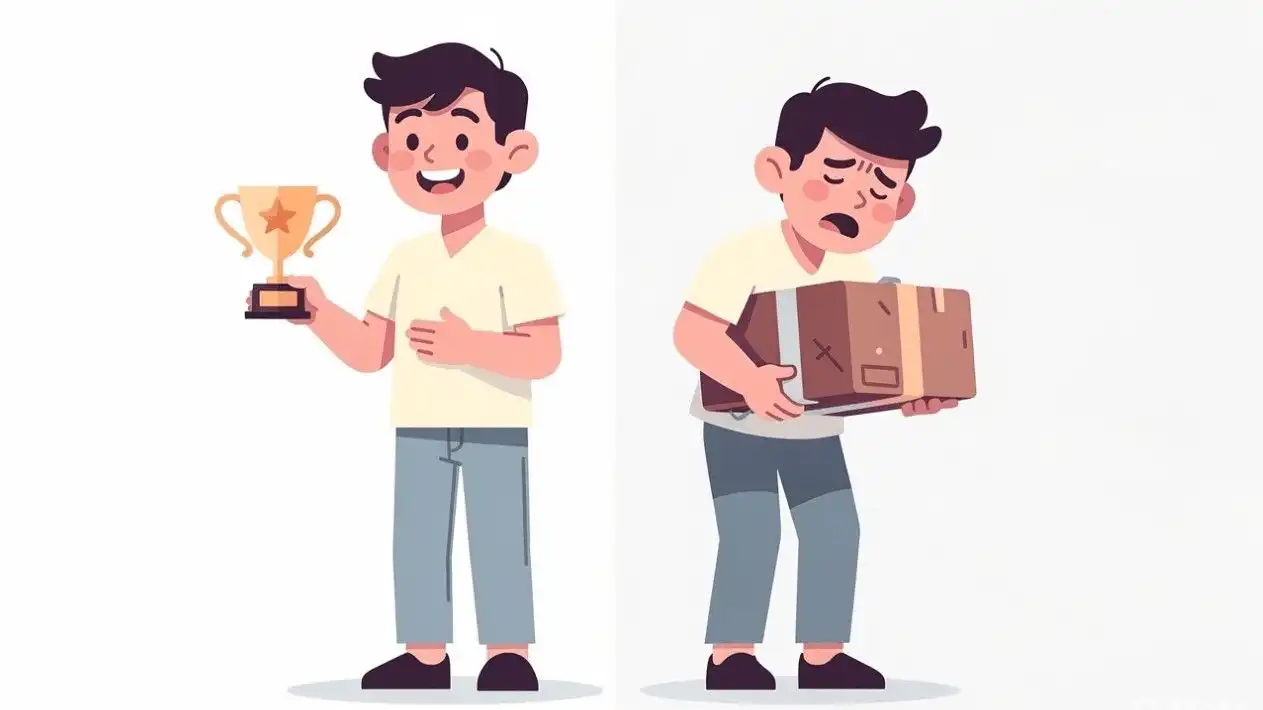
We have all heard the classic sports clichés: “Win as a team, lose as a team,” “It’s just a game,” or “You learn more from losing than winning.” While these sentiments are well-intentioned, they often fail to address the raw, gut-wrenching feeling that accompanies defeat.
Whether it’s losing a championship game, missing out on a promotion, or failing a crucial exam, the pain of losing often feels disproportionately heavy compared to the fleeting joy of winning. But why is that? Why does a single loss sometimes linger in our minds for years, while victories fade into distant memories?
KEY TAKEAWAYS
- Defeat stings worse than victory feels good due to our evolutionary Negativity Bias and Loss Aversion.
- Winning is often external and temporary, while losing causes internal rumination and identity crises.
- Reframing loss as actionable feedback turns emotional pain into long-term psychological resilience.
This post explores the psychology behind the sting of defeat, examining why our brains are wired to hate losing, and how we can transform that pain into a catalyst for growth.
The Hidden Pain of Losing
Winning feels great, but it is often external. We celebrate with trophies, applause, and accolades. Losing, however, is internal. It is quiet. It is the voice in the shower the next morning replaying the mistake you made. It is the knot in your stomach when someone asks, “How did it go?” This hidden pain is what makes losing so psychologically complex. It isn’t just about the scoreboard; it is about the narrative we build in our heads. This internal process is a central theme in different types of psychology, as it touches on both our emotional and cognitive frameworks.
The Brain’s Bias Toward Negative Experiences
To understand why losing hurts so much, we have to look at evolution. Our brains are wired with a Negativity Bias. Thousands of years ago, missing a threat (like a predator) could mean death, while missing an opportunity (like a nice berry bush) was just a missed meal.
Today, this means our brains treat social and professional losses with the same intensity as physical threats. We ruminate on the negative feedback from a boss far longer than we savor the praise. This is a classic example of evolutionary psychology: ancient mind, modern life. The brain holds onto the “threat” of loss to prevent it from happening again, making defeat a much more potent psychological event than victory.
Loss Aversion: Why Defeat Feels Stronger Than Victory
In behavioral economics, there is a principle called Loss Aversion, popularized by psychologists Daniel Kahneman and Amos Tversky. Their research found that the pain of losing is psychologically about twice as powerful as the pleasure of winning.
If you win $100, you feel happy. If you lose $100, the frustration and anger are significantly more intense. In competition, this translates to the agony of defeat overshadowing the ecstasy of victory. The emotional weight of a loss simply carries more gravity than an equivalent win.
UPSIDES
- ✓ Drives internal reflection and exposes underlying vulnerabilities
- ✓ Acts as a strong motivator for intense future preparation
- ✓ Builds long-term psychological resilience and empathy
DOWNSIDES
- ✕ Triggers intense emotional reactions like shame and self-doubt
- ✕ Can induce severe pressure and fear of failure in future tasks
- ✕ Causes unhealthy rumination and overthinking
Emotional Impact: Shame, Frustration, and Self-Doubt
Losing rarely brings just one emotion; it brings a cocktail of them.
EMOTIONAL REACTIONS TO LOSS
- ✓ Shame: The feeling that we have been exposed as inadequate.
- ✓ Frustration: The anger at circumstances, opponents, or ourselves.
- ✓ Self-Doubt: The creeping question of, ‘Am I actually good enough?’
These emotions are heavy. They attack our self-worth, whereas winning tends to boost our confidence without forcing us to confront our weaknesses. This is often why anxiety feels so overwhelming following a high-stakes failure.
Identity and Ego: When Losing Feels Personal
If you define yourself as a “successful entrepreneur,” a failed business venture isn’t just a financial loss; it is an identity crisis. The same goes for athletes or academics. When our ego is tied to our performance, losing feels like an annihilation of the self. We equate doing badly with being bad. This fusion of performance and identity is often rooted in how childhood experiences shape adult behavior.
Social Comparison and Fear of Judgment
Humans are social creatures. We have an innate desire for status and belonging. Losing threatens both.
- The Opponent: They won. They are now “above” us in the hierarchy of that specific contest.
- The Audience: We fear the judgment of peers, family, and colleagues. “What will they think of me now?”
This fear of social degradation adds a layer of anxiety to the loss that isn’t present in a private victory. This social aspect explains why people behave differently in groups and feel more pressure when observed.
The Role of Expectations in Intensifying Loss
Pain is often the distance between expectation and reality. If you expect to lose and you lose, the pain is minimal. But if you expect to win—if you have trained for months and visualized the trophy—and you lose, the gap is massive. High expectations create high stakes. When those stakes are unmet, the psychological crash is far more severe than if you had been the underdog all along.
Why Winning Feels Temporary but Losing Lingers
Winning is a moment of relief and joy, but it is often followed by the question, “What’s next?” It is fleeting. Losing, however, acts as a “freeze frame.” It feels permanent because it stops our momentum. We replay the loss in our minds, trying to find the exact moment it went wrong. This Rumination solidifies the memory, which is a major reason why the brain overthinks simple situations long after the event has passed.
Cognitive Distortions After a Loss
In the aftermath of defeat, our thinking often becomes irrational. Common cognitive distortions include:
COMMON COGNITIVE DISTORTIONS
- Overgeneralization: ‘I lost this game, so I’ll fail at everything.’
- Catastrophizing: ‘This is the worst thing that could have happened.’
- Mental Filtering: Only focusing on the negative plays, ignoring any positives.
These distortions magnify the loss, making it seem larger and more defining than it actually is. Recognizing these is the first step in behavior modification therapy for lasting change.
The Pressure to Prove Yourself Again
One of the most exhausting parts of losing is the “redemption arc” that follows. Suddenly, the next game or task isn’t just another step; it is a test of character. You feel the weight of having to prove that the loss was a fluke. This pressure can lead to anxiety and “choking” under pressure, creating a vicious cycle where the fear of losing again actually causes another loss—a phenomenon discussed in why smart people make bad decisions under pressure.
How Athletes and High Performers Experience Loss
For elite performers, the stakes are higher, and so is the fallout. Studies on athletes show that losing can trigger elevated cortisol (stress hormone) levels that take longer to return to baseline than after a win. This physiological response is explored in the psychology of stress and physical health. However, high performers also exhibit a “growth mindset,” viewing the loss as data rather than a verdict.
The Science of Resilience and Recovery
Resilience isn’t about being immune to pain; it is about recovery time. Psychologically, the key to bouncing back lies in emotional regulation. Allowing yourself to feel the disappointment (acknowledging the loss) without letting it define you (dwelling on it) is the biological sweet spot for recovery. Just as muscles need rest after a workout, the psyche needs time to heal.
Reframing Loss as Growth and Learning
The most powerful shift you can make is to reframe the narrative. Instead of asking, “Why did I fail?” ask, “What did this experience teach me?”
ADVANTAGES OF REFRAMING LOSS
- ✓ Loss reveals weaknesses: Winning can hide flaws; losing exposes them cleanly.
- ✓ Loss builds humility: It reminds us that we are not infallible.
- ✓ Loss increases motivation: For many, the sting of defeat becomes fuel for future success.
This focus on personal development is at the heart of what positive psychology is all about.
Practical Strategies to Cope with Losing
If you are currently reeling from a loss, try these strategies:
ACTIONABLE COPING STRATEGIES
- 1. Practice Self-Compassion: Treat yourself with the same kindness you would offer a friend.
- 2. Separate Behavior from Identity: You performed badly, but you are not a ‘bad person.’
- 3. The 24-Hour Rule: Give yourself 24 hours to be angry or sad. After that, shift focus.
- 4. Talk It Out: Verbalizing the loss can reduce its psychological power.
- 5. Focus on Controllables: Analyze what you could control versus what you couldn’t.
Turning Defeat into Psychological Strength
Ultimately, losing is hard because it matters. If it didn’t matter, you wouldn’t care enough to feel the pain. The key takeaway is this: Winning is a result, but losing is a lesson.
The psychological strength required to get back up after being knocked down is the very foundation of character. While winning might build confidence, learning to cope with losing builds resilience. And resilience is the one trait that will carry you through a lifetime of challenges, long after the trophies have tarnished and the applause has faded.
Frequently Asked Questions About the Psychology of Losing
Why does losing hurt twice as much as winning feels good?
According to Loss Aversion research by Kahneman and Tversky, human psychology is wired so that the emotional pain of losing an asset or game is roughly twice as potent as the joy of gaining the equivalent win.
How can I stop overthinking a recent defeat or failure?
Enforce the 24-Hour Rule to process emotions, reframe your thinking from ‘Why did I fail?’ to ‘What can I learn?’, and separate your personal identity from your performance.
Is the fear of losing an evolutionary trait?
Yes. Evolutionary psychology suggests that our ancestors prioritized avoiding loss (threats, predators, social rejection) over gaining benefits because avoiding threats directly determined survival.
Related Articles



Sponsored


You May Also Like

The Status Signal: How Clothing Triggers Instant Assumptions…

Social Media vs. Real Communities: Why Interaction Isn’t Alw…

Recovered vs False Memory in Amnesia: The Shocking Truth Abo…

Social Hierarchies in Animals vs Humans: Same Patterns, Diff…

The Psychology of Discounts: Why “Limited Time” Overrides Lo…