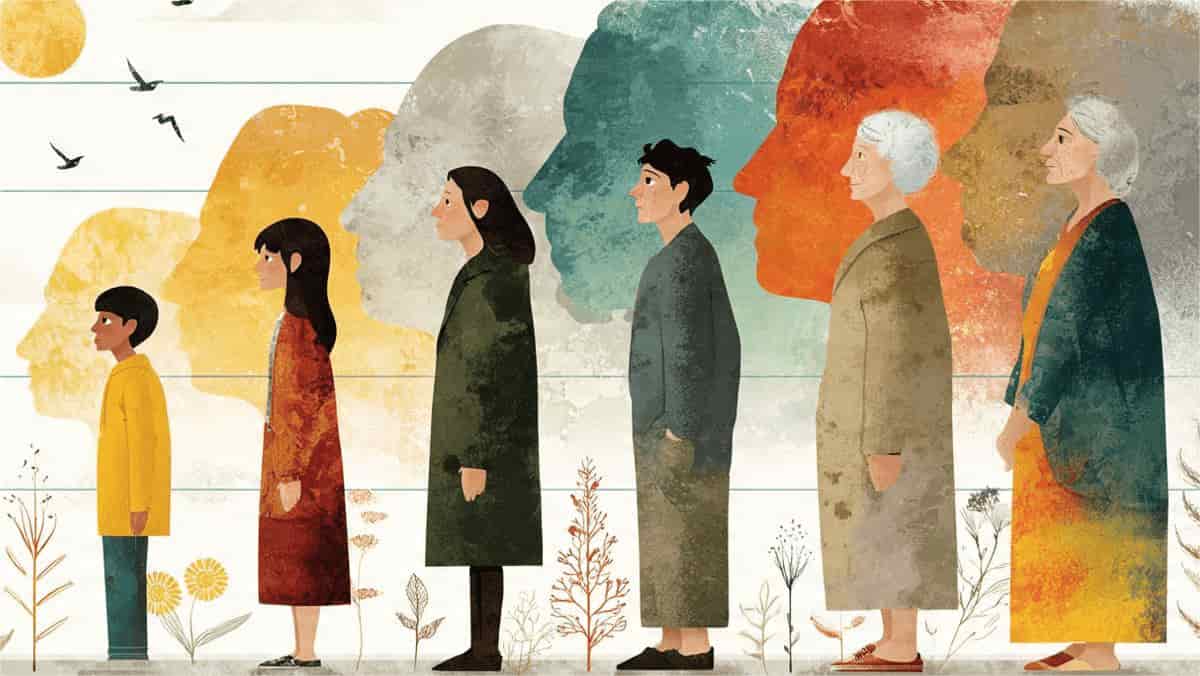
While observing people at different ages, I noticed that identity was never fixed. Teenagers questioned who they were, adults adjusted roles, and even older individuals reshaped self-concept. Developmental psychology views identity as an evolving process—one that responds continuously to experience, context, and change.
KEY TAKEAWAYS
- Identity is a dynamic, lifelong process rather than a static discovery.
- Self-concept evolves across childhood, adolescence, adulthood, and late transitions.
- Social contexts, values, and psychological flexibility drive identity adaptation.
Identity Is Not Static
Identity is often spoken about as something we “discover,” but psychological research suggests it is something we construct and reconstruct across the lifespan. From early childhood to late adulthood, identity adapts to cognitive growth, social expectations, and life transitions. Rather than a finished product, identity is a dynamic psychological process shaped by relationships, culture, and self-reflection.
STRENGTHS
- ✓ Evolves dynamically across the entire lifespan
- ✓ Adapts to changing social roles and personal values
- ✓ Encourages resilience through psychological flexibility
WEAKNESSES
- ✕ Mistakenly viewed as a fixed or one-time discovery
- ✕ Pressure to conform can lead to premature closure
- ✕ Unpredictable life transitions can temporarily disrupt self-concept
As Erik Erikson famously stated, “Identity is a process located in the core of the individual and yet also in the core of their communal culture.” This dual influence—internal and social—frames identity development at every stage of life.
Early Identity Signals in Childhood
In childhood, identity begins with simple self-recognition: name, gender, family role, and preferences. Children learn who they are largely through attachment relationships and feedback from caregivers. A child consistently validated for curiosity or emotional expression often integrates those traits into their emerging self-concept.
Developmental studies highlight that emotionally safe environments help children form a coherent sense of self, while inconsistent or critical environments may lead to confusion or fragile self-esteem later in life. These early identity “signals” form the psychological foundation for later exploration.
Adolescence and Self-Definition
Adolescence represents the most visible period of identity formation. Cognitive maturity allows teenagers to question beliefs, values, and social roles. Erikson described this stage as identity vs. role confusion, where individuals actively explore “Who am I?” and “Where do I belong?”
A longitudinal study in the United States found that adolescents encouraged to explore identity—rather than conform prematurely—showed higher psychological well-being in adulthood (APA, developmental research). This phase often includes experimentation with appearance, ideology, and peer groups, reflecting a search for authentic self-definition.
Role Changes in Adulthood

Contrary to popular belief, identity work does not end in adulthood. Career shifts, parenthood, marriage, or caregiving roles require individuals to revise how they see themselves. Many adults experience identity renegotiation, especially when long-held roles change or disappear.
A UK-based case study on midlife career transitions showed that professionals who reframed identity around values rather than job titles adapted more successfully to change. This highlights that adult identity is less about labels and more about meaning and purpose.
Social Influence on Identity
Identity is deeply social. Culture, community, gender norms, and digital spaces shape how individuals define themselves. Social media, in particular, has introduced performative identity, where self-concept can be influenced by validation metrics like likes and followers.
Research from Canada suggests that individuals with strong offline relationships are better able to maintain identity stability despite online pressures. Social influence does not determine identity, but it powerfully frames the options available for self-expression.
Identity Shifts During Life Transitions
Major life transitions—migration, illness, divorce, retirement, or loss—often trigger identity shifts. Older adults, for example, may move from productivity-based identity to wisdom-based identity, redefining worth beyond work.
A U.S. gerontological study found that retirees who actively re-authored their life narrative reported higher life satisfaction than those who clung to former roles. These findings reinforce that identity remains adaptable across the lifespan.
Embracing Identity Flexibility
Psychological flexibility allows individuals to integrate change without losing coherence. Rather than asking “Who am I really?” a healthier question may be “Who am I becoming?” Embracing identity as flexible reduces distress during transitions and supports mental resilience.
BENEFITS OF PSYCHOLOGICAL FLEXIBILITY
- ✓ Easier navigation through major life transitions
- ✓ Reduced emotional distress during role changes
- ✓ Greater openness to personal growth and new experiences
Becoming Is Ongoing
Identity formation is not a single milestone but a lifelong journey. From childhood signals to adolescent exploration, adult role shifts, and later-life redefinition, identity continuously evolves. Understanding this process helps individuals approach change with curiosity rather than fear—recognizing that becoming is always ongoing.
Note: This article is for educational purposes only and does not constitute professional clinical advice.
FAQs
1. Is identity fully formed by adulthood?
No. Identity continues to evolve throughout adulthood and older age in response to roles, relationships, and life events.
2. Can identity change later in life?
Yes. Research shows that later-life transitions often lead to meaningful identity redefinition.
3. How does culture influence identity formation?
Culture shapes values, roles, and norms, providing the social framework within which identity develops.
Related Articles



Sponsored


You May Also Like

Small Positive Habits Matter More Than Big Life Changes

Overwhelming Synonym: 25 Powerful Alternatives (With Meaning…

The Vulnerability Paradox: Why “Flawless” Behavi…

Dissociative Amnesia vs. Retrograde Amnesia: Understanding t…

Attention Psychology: Your Beginner’s Guide to Masteri…