Why Families Struggle to See the Grown-Up Version of You

An adult standing in a family living room, looking confident, while family members sit on a couch, appearing to still see them as younger.

What Family Role Locking Really Is You are a confident professional at work. You lead meetings, make decisions, and earn respect. Then you walk through your parents’ front door, and within five minutes, you are sixteen again — defensive, quiet, or desperately seeking approval. This is systemic role locking. Family systems tend to freeze individuals … Read more

The Psychological Fallout of Read Receipts and “Left on Seen”

A person holding a smartphone, staring at a messaging screen with a “Read” receipt and no reply, late night lighting, tired expression.

Why Being Ignored Hurts Physically You see the message: “Read.” Minutes pass. Hours. Days. No reply. Your chest tightens. Your mind races. You check the app again, hoping the status will change. It does not. Being left on read is not just an annoyance. It is a form of social ostracism — and the brain … Read more

Why Our Closest Relations Misread Our Micro-Behaviors

A family sitting at a dinner table, one person looking slightly tired or thoughtful, another family member looking concerned or suspicious, misinterpretation in the air.

Why Families Jump to Conclusions Faster A stranger on the street sees you lost in thought and thinks nothing of it. Your spouse sees the same distant expression and thinks: “They are angry with me.” Your mother sees it and thinks: “Something is wrong — are you sick?” This is hyper‑familiarity bias — the tendency … Read more

The Hidden Geometry of Nightclub Approaches

A crowded nightclub dance floor, one person approaching another at a 45‑degree angle with open body language, both making eye contact.

Why Personal Space Still Exists in Crowded Clubs You are shoulder‑to‑shoulder with strangers. The bass vibrates through your chest. Yet somehow, you still know when someone is too close. This is proxemics — the study of personal space and how humans use distance to regulate social interaction. Even in high‑density environments like nightclubs, your brain … Read more

The Biomechanics of “Owning the Room” without Speaking

A person standing calmly in a crowded nightclub, relaxed posture, open shoulders, slow scanning, standing out from the moving crowd around them.

Why Movement Gets Judged Before Words In a nightclub, conversation is nearly impossible. The music is too loud, the crowd is too dense, and the lighting is too low. In this high‑stimulus environment, your voice is irrelevant. Your movement does all the talking. The human brain is exquisitely tuned to read kinetic signals — posture, … Read more

Why Cleanliness Signals Evolutionary Fitness and Social Safety

A person in fresh, clean clothing, showering or washing hands in a bright bathroom, representing daily hygiene rituals.

Why Humans Fear Contamination Your disgust for bad smells, dirty surfaces, and unwashed bodies is not a personality flaw. It is a survival adaptation. Throughout human evolution, contact with contaminated individuals or environments meant risk of infection, disease, and death. The humans who felt strong disgust toward potential contaminants avoided those risks and lived longer … Read more

How Different Scent Profiles Secretly Signal Your Personality Traits

A collection of perfume bottles with different scent families — woody, citrus, vanilla — arranged on a wooden table, representing personality signaling.

Why Humans Judge Personality Through Smell You have likely heard the phrase “I like his vibe.” Part of that vibe is visual. Part is vocal. But a surprisingly large part is olfactory — and most people never realize it. Your brain constantly evaluates the personality of others through their scent, often without conscious awareness. A … Read more

Why Scent Memories Outlast Visual First Impressions

A person holding a vintage perfume bottle, eyes closed, smiling as if remembering something deeply emotional and personal.

Why Smell Bypasses Rational Thinking Of the five senses, only one connects directly to the brain’s emotional core without a detour through the analytical filter. That sense is smell. When you see a face, that visual signal travels to the thalamus, then to the visual cortex for processing, and only later reaches the amygdala (emotion) … Read more

How Environmental Alertness Shifts Public Respect

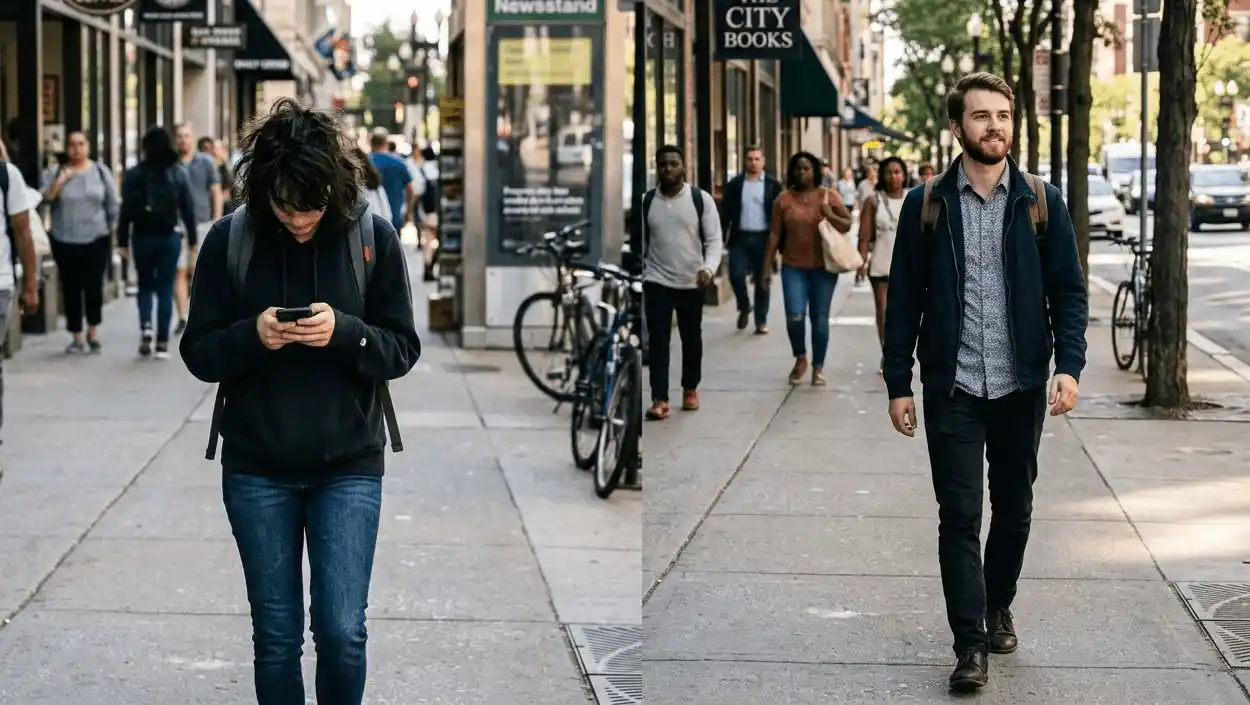
Two pedestrians on a sidewalk — one walking with head down looking at phone, shoulders curved; another walking with head up, relaxed shoulders, scanning ahead.

Why Posture Changes Public Perception You have seen them everywhere: heads down, shoulders curved, eyes locked on a glowing screen. They drift across sidewalks, bump into slow walkers, and step into crosswalks without looking up. This is text neck — and it is destroying public respect. Posture is not just about spinal health. It is … Read more