
Why Posture Changes Public Perception
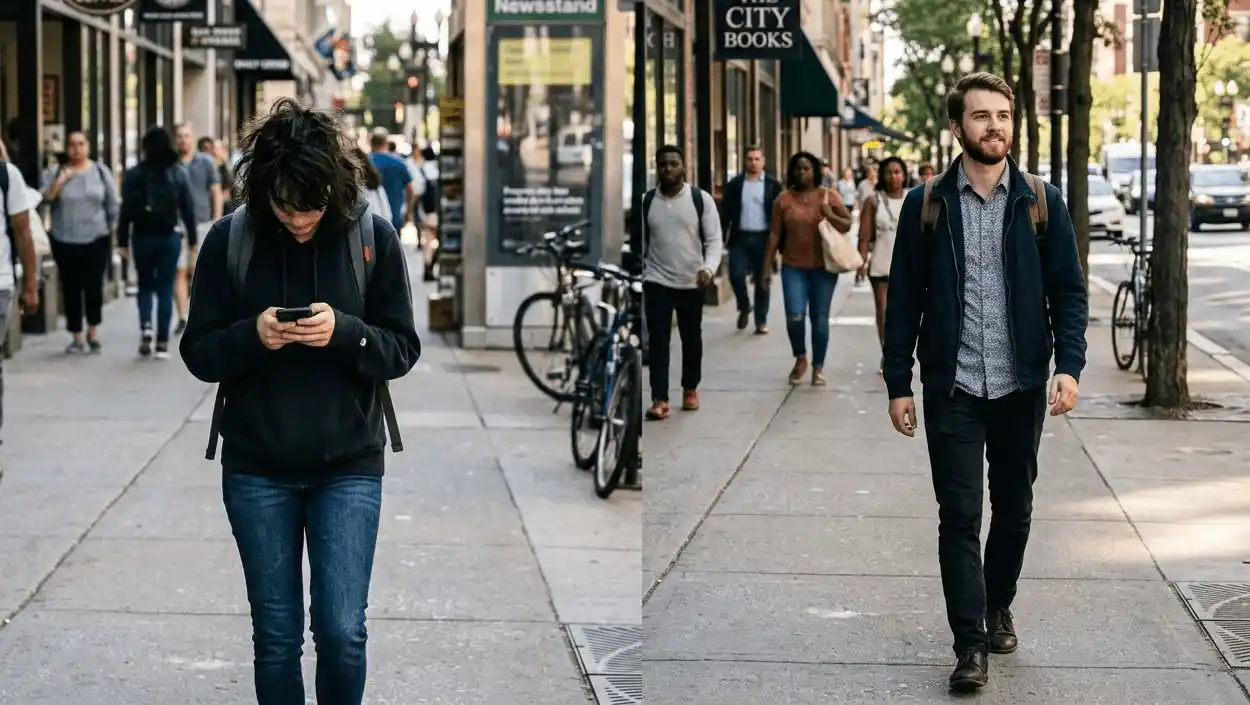
You have seen them everywhere: heads down, shoulders curved, eyes locked on a glowing screen. They drift across sidewalks, bump into slow walkers, and step into crosswalks without looking up. This is text neck — and it is destroying public respect.
Posture is not just about spinal health. It is a social signal broadcast to everyone in your vicinity. When you walk with your head down and shoulders collapsed, you project vulnerability, distraction, and low situational awareness. Observers read this instantly:
“This person is not in control. They are not safe to be near. They are not worthy of deference.”
Postural gravity is the force that pulls your body toward the earth when you disengage from your environment. The higher you hold your head and the more open your chest, the more respect you command. This is not about height — it is about presence.
The Psychology of “Text Neck”
Text neck is more than a physical condition. It is a behavioral signal of cognitive absence.
When you look down at a phone while walking, your brain enters a state of narrow focus. Peripheral vision shuts down. Auditory processing of the environment reduces. You become, for all practical purposes, not fully present in public space.
Observers notice this. The person behind you cannot tell if you are checking a map or watching a video. They only see a walking hazard — unpredictable, unaware, likely to stop suddenly or veer without warning.
| Postural Signal | Observer Perception | Public Respect Level |
|---|---|---|
| Head up, eyes scanning, relaxed shoulders | Aware, confident, in control | High |
| Slight forward head lean, occasional phone glance | Distracted but still aware | Medium |
| Deep text neck (head down, shoulders rounded) | Oblivious, low status, hazardous | Low |
| Looking down AND wearing headphones | Completely disengaged, unsafe | Very Low |
| Head up but tense shoulders, rigid neck | Anxious, potentially aggressive | Medium‑Low |
You May Also Like
Explore why the brain overestimates danger — distracted pedestrians trigger threat responses in others
Phone Addiction and Situational Blindness
Situational blindness occurs when attention is so absorbed by a screen that the brain stops processing environmental cues. This is not rudeness — it is a cognitive limitation. The brain cannot simultaneously process complex phone content and navigate dynamic public space.
However, observers do not care about the cause. They only care about the effect. A person who nearly collides with a stroller because they were looking at Instagram is judged as selfish and careless. Their character is questioned, not their cognition.
The public contract of walking requires shared responsibility for safety. When you violate that contract by choosing screen over situational awareness, you signal that your convenience matters more than others’ comfort or safety. That signal damages your reputation with every witness.
Why Alert People Look Safer
Alert posture — head up, shoulders back, eyes moving naturally — signals that you are processing the environment. This makes you predictable. Predictable pedestrians are safe pedestrians.
Perception of Alert Walkers
- ✓ More trustworthy
- ✓ More competent
- ✓ Higher status
- ✓ More approachable (if needed)
In contrast, distracted walkers are perceived as unpredictable and therefore risky. Other pedestrians will unconsciously give them a wider berth, avoid eye contact, and feel irritation rather than goodwill.
The alert walker does not need to be stiff or aggressive. They simply need to show that they are present.
Must Read
Discover why we feel unsafe in certain places — lack of environmental alertness is a major cue
Peripheral Awareness and Social Reading
Peripheral vision is the brain’s early warning system. It detects movement, people approaching, and potential collisions without requiring direct focus. People with good posture (head up, chin level) maintain full peripheral field.
People with text neck lose up to 50% of their peripheral awareness. They cannot see the person about to pass on their left, the child running toward them, or the cyclist approaching from behind.
This is not just a safety issue. It is a social reading issue. You cannot read the body language of people around you if you never look at them. You miss signals: someone stepping aside to let you pass, someone trying to make eye contact to ask a question, someone expressing irritation at your slow pace.
Good posture keeps you socially literate.
Calm Competence vs. Distracted Movement
The contrast between calm competence and distracted movement is visible from a block away.
| Behavior | Signal | Social Outcome |
|---|---|---|
| Walking with purpose, occasional phone glance | Efficient, aware, busy but not rude | Neutral to positive |
| Stopping to side to check phone | Respectful of pedestrian flow | Positive |
| Walking slowly while staring at phone | Oblivious, inconsiderate | Negative |
| Weaving unpredictably while on phone | Hazardous, low social intelligence | Strongly negative |
| Walking without phone, head up, scanning | Confident, respectful, safe | Very positive |
The most respected pedestrians are those who separate phone time from walking time. Need to check a message? Step to the side. Need to navigate? Put the phone away.
Trending
Learn why habits are so hard to break — phone-checking while walking is a powerful habit loop
The Cognitive Cost of Constant Screen Focus
Constant screen focus during walking imposes a cognitive tax. Your brain is switching rapidly between the phone (high detail, close focus) and the environment (low detail, distance focus). Each switch costs time and mental energy.
Effects of Rapid Attention Switching
- Mental fatigue
- Reduced environmental memory
- Increased collision risk
- Higher stress (because the brain never fully relaxes)
People who walk without screens arrive at their destination more alert, less stressed, and more socially attuned. They also appear more confident and capable to everyone who saw them along the way.
Final Thoughts
Postural gravity pulls your head down when you disengage from the world. The cost is not just a sore neck — it is the quiet erosion of public respect.
Look up. Roll your shoulders back. Scan your environment. Step aside to check your phone. Walk with presence.
The person who walks with alert, upright posture is not trying to impress anyone. They are simply present. And presence is the foundation of respect.
Related Articles

Sponsored


You May Also Like

Initiative vs. Guilt (Erikson’s Third Stage of Psychosocial …

Why Giant Objects Feel Terrifying to Some People

Positive Emotion in Psychology – How Joy, Gratitude & Op…

The Deception of Dress: How to Ethically Weaponize Your Ward…

Loneliness Isn’t a Personal Failure — It’s a Community Gap
