Quick Jump: Find Synonyms by Context
What Is Another Word for “Overwhelming”?
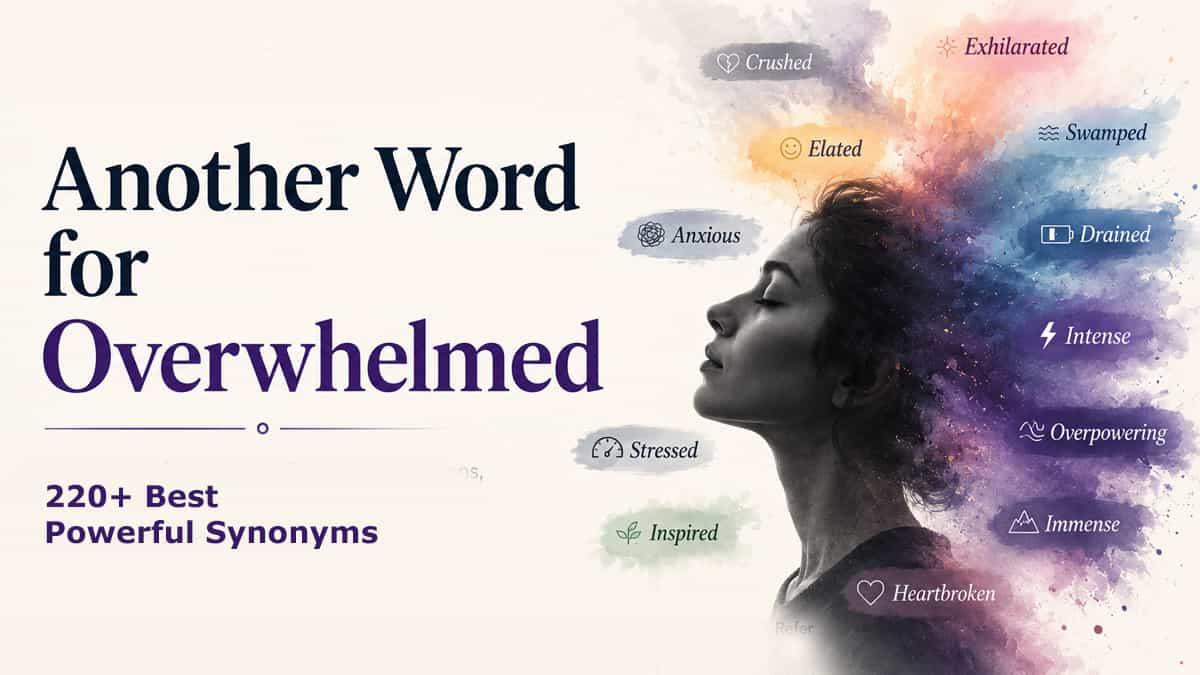
“Overwhelming” is a useful word, but it can describe many very different experiences. You might feel overwhelmed by grief, fear, a demanding workload, unexpected kindness, intense love, or the sheer beauty of something. Because the emotional meaning changes with the situation, one synonym does not work equally well in every sentence.
For example, “crushing” can describe severe emotional pain, while “breathtaking” may describe something beautiful or awe-inspiring. A difficult project might be “daunting,” while constant workplace pressure may feel “relentless.” These words are related to “overwhelming,” but each one highlights a different kind of experience.
That is why choosing the right alternative depends on more than simply finding a word with a similar dictionary definition. Consider what you are feeling, what caused the reaction, how intense it is, and the situation in which you are describing it.
This guide brings together 200+ alternatives to “overwhelming”, organized by context. You will find words for emotional situations, positive experiences, work and stress, and different levels of intensity. Each section explains when a word fits best so you can choose an alternative that is precise rather than simply similar.
KEY TAKEAWAYS
- Context matters: The best alternative depends on the situation and emotion you are describing.
- Match the intensity: Use moderate words for manageable pressure and stronger words when the emotional impact is severe.
- Choose precision over repetition: Words such as crushing, breathtaking, and daunting describe different types of experiences rather than functioning as interchangeable synonyms.
For a broader list of 25 synonyms with examples, see our companion guide: overwhelming synonym: 25 powerful alternatives. Here, we focus on when and why to use each one.
Use the lists below to find the word that best matches the experience you want to describe.
Overwhelming in Emotional Situations: 75 Words to Describe Intense Feelings
When emotions become too strong to process easily, “overwhelming” can feel too general. The right alternative depends on the emotion you are experiencing and how strongly it affects you. Grief may feel crushing, fear can be paralyzing, repeated frustration may become exasperating, and emotional exhaustion can feel draining.
The 75 words below describe different forms of intense emotional experiences. They are grouped by context so you can find a word that communicates not only that an emotion is strong, but what kind of emotional impact it creates.
Grief, Loss & Deep Sadness
Use these words when sadness, grief, disappointment, or emotional pain feels particularly heavy or difficult to bear.
01. Crushing — Use when emotional pain feels extremely heavy. “The loss was crushing.”
02. Heartbreaking — Use when something causes profound sadness or emotional pain. “The goodbye was heartbreaking.”
03. Devastating — Use when an experience causes severe emotional distress or loss. “The news was devastating.”
04. Shattering — Use when an event seriously disrupts someone’s emotional stability or expectations. “The sudden loss was shattering.”
05. Unbearable — Use when emotional pain feels extremely difficult to tolerate. “The grief felt unbearable.”
06. Agonizing — Use when emotional suffering is intense and painful. “Waiting for the results was agonizing.”
07. Sorrowful — Use when an experience or expression is deeply marked by sadness. “She gave him a sorrowful smile.”
08. Distressing — Use when something causes significant emotional discomfort or worry. “The situation was deeply distressing.”
09. Painful — Use when an experience causes clear emotional hurt. “It was painful to remember what happened.”
10. Devastatingly sad — Use when sadness is unusually severe and emotionally difficult to process. “The ending was devastatingly sad.”
Fear, Anxiety & Dread
These words describe emotional experiences in which fear or anxiety becomes powerful enough to dominate attention or interfere with normal responses.
11. Paralyzing — Use when fear makes it difficult to think or act. “The fear was paralyzing.”
12. Terrifying — Use when something produces extreme fear. “The experience was terrifying.”
13. Frightening — Use when something creates strong fear or apprehension. “The uncertainty was frightening.”
14. Alarming — Use when something creates serious concern or fear. “The sudden change was alarming.”
15. Consuming — Use when anxiety occupies most of a person’s thoughts or attention. “Her worry became consuming.”
16. Overpowering — Use when fear feels stronger than your ability to control it. “He felt an overpowering sense of fear.”
17. Intimidating — Use when a situation feels threatening, daunting, or difficult to face. “The first day felt intimidating.”
18. Unnerving — Use when something makes you feel nervous, uneasy, or unsettled. “The silence was unnerving.”
19. Disturbing — Use when an experience creates strong emotional discomfort or unease. “The incident was deeply disturbing.”
20. Panic-inducing — Use when something triggers an unusually strong fear response. “The uncertainty was panic-inducing.”
Anger, Frustration & Emotional Pressure
Use these alternatives when irritation, anger, or frustration becomes unusually intense or difficult to contain.
21. Infuriating — Use when something produces intense anger. “The repeated delays were infuriating.”
22. Maddening — Use when a situation is extremely frustrating or irritating. “The constant interruptions were maddening.”
23. Exasperating — Use when repeated problems seriously test your patience. “The situation became exasperating.”
24. Enraging — Use when something provokes very strong anger. “The unfair decision was enraging.”
25. Aggravating — Use when something repeatedly causes irritation or frustration. “The problem was increasingly aggravating.”
26. Oppressive — Use when emotional pressure feels heavy and difficult to escape. “The atmosphere felt oppressive.”
27. Stifling — Use when circumstances suppress emotional freedom or expression. “The constant criticism felt stifling.”
28. Suffocating — Use when emotional pressure feels almost impossible to escape. “The pressure became suffocating.”
29. Intolerable — Use when an emotional situation becomes extremely difficult to endure. “The tension became intolerable.”
Emotional Exhaustion & Feeling Drained
These words are useful when an emotional situation consumes your energy and leaves you mentally or emotionally depleted.
30. Draining — Use when an experience gradually uses up emotional energy. “The constant conflict was draining.”
31. Exhausting — Use when an experience leaves you emotionally or mentally depleted. “The situation was emotionally exhausting.”
32. Depleting — Use when something steadily reduces your emotional resources. “The uncertainty was emotionally depleting.”
33. Taxing — Use when an experience requires considerable emotional or mental effort. “Supporting everyone else was taxing.”
34. Burdensome — Use when emotional responsibilities feel like a heavy burden. “The responsibility became burdensome.”
35. Wearisome — Use when something repeatedly causes emotional tiredness or frustration. “The ongoing conflict was wearisome.”
36. Debilitating — Use when emotional distress seriously interferes with normal functioning. “The fear became debilitating.”
37. Fatiguing — Use when an experience creates significant mental or emotional fatigue. “The prolonged uncertainty was fatiguing.”
38. Demanding — Use when an emotional situation requires sustained mental or emotional effort. “Caring for everyone else was demanding.”
Emotional Conflict & Inner Turmoil
These words fit situations where several difficult emotions collide or your feelings become difficult to organize and understand.
39. Turbulent — Use when emotions are unstable and constantly shifting. “She went through a turbulent period.”
40. Tumultuous — Use when emotional life is highly disturbed or chaotic. “It was a tumultuous few months.”
41. Chaotic — Use when many conflicting thoughts or emotions occur at once. “His thoughts felt chaotic.”
42. Confusing — Use when strong emotions make it difficult to understand what you feel. “The experience was confusing and painful.”
43. Conflicted — Use when two or more powerful feelings compete with each other. “She felt conflicted about leaving.”
44. Agitating — Use when something creates emotional restlessness or disturbance. “The conversation was deeply agitating.”
45. Unsettling — Use when something disrupts your emotional sense of security. “The discovery was unsettling.”
46. Disorienting — Use when strong emotions make your feelings or circumstances difficult to process. “The sudden change was disorienting.”
47. Troubling — Use when something causes persistent concern, discomfort, or emotional unease. “The situation was deeply troubling.”
Shock, Disbelief & Sudden Emotional Impact
Use these words when unexpected news or events create such a strong reaction that they are difficult to process immediately.
48. Staggering — Use when something has an unexpectedly powerful emotional impact. “The news was staggering.”
49. Astonishing — Use when something produces intense surprise. “The revelation was astonishing.”
50. Astounding — Use when something is remarkably difficult to process or believe. “The discovery was astounding.”
51. Shocking — Use when something produces sudden and powerful emotional surprise. “The announcement was shocking.”
52. Stunning — Use when something leaves a person temporarily surprised or speechless. “The revelation was stunning.”
53. Startling — Use when something causes an abrupt emotional reaction. “The sudden message was startling.”
54. Disconcerting — Use when something disrupts emotional confidence or composure. “The unexpected response was disconcerting.”
55. Unbelievable — Use when something seems difficult to accept as real. “The turn of events was unbelievable.”
56. Mind-boggling — Use when something is extremely difficult to comprehend. “The scale of the problem was mind-boggling.”
Love, Affection & Deep Connection
Not all intense emotions are negative. Love and attachment can also feel overwhelming when they become exceptionally strong or absorbing.
57. Profound — Use when an emotional connection feels unusually deep. “They shared a profound connection.”
58. Intense — Use when an emotional experience is exceptionally strong. “Their reunion was intensely emotional.”
59. Passionate — Use when affection or love is expressed with strong intensity. “They shared a passionate connection.”
60. Devoted — Use when strong affection is combined with loyalty and commitment. “She was devoted to her family.”
61. Adoring — Use when someone shows exceptionally strong affection. “He gave his daughter an adoring smile.”
62. Affectionate — Use when warmth and fondness are openly expressed. “She gave him an affectionate hug.”
63. Moving — Use when an experience creates a powerful emotional response. “Her story was deeply moving.”
64. Touching — Use when a gesture or experience affects you deeply. “His message was incredibly touching.”
65. Overflowing — Use when a positive feeling seems abundant and difficult to contain. “She was overflowing with gratitude.”
Awe, Emotional Intensity & Being Deeply Affected
These final words describe experiences that create an unusually powerful emotional response, whether through beauty, meaning, admiration, or sheer intensity.
66. Powerful — Use when an experience has a strong emotional or psychological impact. “It was a powerful emotional experience.”
67. Overpowering — Use when an emotion temporarily feels stronger than your ability to control it. “An overpowering wave of emotion came over her.”
68. Awe-inspiring — Use when something creates deep wonder and admiration. “The experience was awe-inspiring.”
69. Breathtaking — Use when beauty or emotional impact leaves you stunned. “The moment was breathtaking.”
70. Extraordinary — Use when an experience is far beyond what is ordinary or expected. “It was an extraordinary emotional moment.”
71. Spellbinding — Use when something holds attention through powerful emotional impact. “Her performance was spellbinding.”
72. Mesmerizing — Use when something fascinates or absorbs attention intensely. “The scene was mesmerizing.”
73. Intoxicating — Use when an emotion feels exhilarating and difficult to resist. “The excitement was intoxicating.”
74. Transcendent — Use when an experience feels exceptionally profound or beyond ordinary emotion. “The moment felt almost transcendent.”
75. Stirring — Use when something awakens strong feelings or emotions. “The music was deeply stirring.”
These words describe situations where positive emotions can also become so intense that they feel difficult to contain or process.
Quick Guide: Which Word Fits the Emotion?
- Deep sadness: crushing, heartbreaking, devastating, shattering
- Fear: paralyzing, terrifying, unnerving, overpowering
- Anger: infuriating, maddening, enraging, exasperating
- Emotional exhaustion: draining, exhausting, depleting, taxing
- Inner turmoil: turbulent, tumultuous, conflicted, disorienting
- Shock: staggering, astonishing, startling, stunning
- Deep affection: profound, passionate, touching, moving
- Strong positive emotion: heartwarming, overflowing, exhilarating, awe-inspiring
- Extremely powerful experience: overpowering, breathtaking, extraordinary, transcendent
When anxiety becomes overwhelming to the point of interference, professional support can help. Learn more in why anxiety can feel so intense for many people.
Overwhelming in Positive Situations: 75 Words for Powerful Positive Experiences
Not every overwhelming experience is unpleasant. Sometimes a feeling becomes so strong because something is beautiful, joyful, inspiring, generous, exciting, or deeply meaningful. In these situations, words such as “breathtaking,” “heartwarming,” or “exhilarating” can communicate the experience more precisely than simply saying it was overwhelming.
The best word depends on what makes the experience powerful. Use the list below to describe positive experiences involving beauty, happiness, gratitude, love, kindness, achievement, excitement, inspiration, and unexpected good news.
Beauty, Awe & Wonder
Use these words when something is so beautiful, impressive, or extraordinary that it creates a powerful emotional response.
01. Breathtaking — Use when beauty or scale leaves you almost speechless. “The mountain view was breathtaking.”
02. Awe-inspiring — Use when something creates deep wonder and admiration. “The cathedral was awe-inspiring.”
03. Magnificent — Use when something is exceptionally grand or beautiful. “The sunset was magnificent.”
04. Majestic — Use when something has impressive beauty, scale, or dignity. “The mountains looked majestic at sunrise.”
05. Wondrous — Use when something inspires amazement and delight. “The children discovered a wondrous world beneath the water.”
06. Spectacular — Use when something is visually impressive or extraordinary. “The fireworks were spectacular.”
07. Stunning — Use when beauty or impact is immediately striking. “The garden looked stunning in spring.”
08. Spellbinding — Use when something captures attention through exceptional beauty or power. “Her performance was spellbinding.”
09. Mesmerizing — Use when something is so fascinating that it holds your attention completely. “The northern lights were mesmerizing.”
10. Transcendent — Use when an experience feels unusually profound or beyond ordinary experience. “The concert became a transcendent experience.”
Joy, Happiness & Delight
These words fit situations where happiness becomes unusually strong, energetic, or emotionally absorbing.
11. Exhilarating — Use when an experience creates intense excitement and happiness. “Crossing the finish line was exhilarating.”
12. Euphoric — Use when happiness feels exceptionally intense. “The team was euphoric after the victory.”
13. Ecstatic — Use when someone is extremely happy or delighted. “She was ecstatic about the news.”
14. Elated — Use when someone feels extremely cheerful after something positive. “He felt elated after receiving the offer.”
15. Jubilant — Use when joy is openly expressed, especially after a success. “The crowd was jubilant after the win.”
16. Exuberant — Use when happiness is energetic, lively, and openly expressed. “Her exuberant reaction made everyone smile.”
17. Joyous — Use when an experience is filled with strong happiness. “It was a joyous family celebration.”
18. Delightful — Use when something creates strong pleasure or enjoyment. “The surprise was absolutely delightful.”
19. Rapturous — Use when joy or enthusiasm is exceptionally intense. “The audience gave the performers a rapturous reception.”
20. Thrilling — Use when something creates strong excitement and pleasure. “The final few minutes of the game were thrilling.”
Gratitude, Appreciation & Emotional Warmth
Use these words when generosity, support, or a meaningful gesture creates a strong feeling of gratitude or emotional warmth.
21. Heartwarming — Use when an experience creates warmth, affection, and happiness. “The community’s support was heartwarming.”
22. Touching — Use when a gesture or moment affects you emotionally. “Her handwritten note was deeply touching.”
23. Moving — Use when something creates a strong emotional response. “His speech was incredibly moving.”
24. Meaningful — Use when an experience has deep personal or emotional significance. “Their reunion was deeply meaningful.”
25. Precious — Use when a moment or relationship feels deeply valuable. “Those memories are precious to me.”
26. Cherished — Use when something is deeply loved and valued over time. “It became one of her most cherished memories.”
27. Heartfelt — Use when an emotion or expression is sincere and deeply felt. “He offered a heartfelt thank-you.”
28. Gratifying — Use when an outcome produces strong satisfaction or pleasure. “Seeing the project succeed was gratifying.”
Love, Affection & Connection
These words work when affection or emotional connection becomes especially deep, intense, or difficult to contain.
29. Profound — Use when a feeling or connection is unusually deep. “They developed a profound bond.”
30. Passionate — Use when love or affection is expressed with strong intensity. “They shared a passionate connection.”
31. Devoted — Use when affection involves strong loyalty and commitment. “She was devoted to her family.”
32. Adoring — Use when someone shows exceptionally strong affection. “The parents gave their child an adoring smile.”
33. Affectionate — Use when warmth and fondness are openly expressed. “He gave his grandmother an affectionate hug.”
34. Intimate — Use when an experience involves deep personal closeness. “They shared an intimate conversation.”
35. Consuming — Use when a positive feeling occupies a person’s thoughts intensely. “Her love for music became consuming.”
36. Overflowing — Use when a feeling seems abundant and difficult to contain. “His heart was overflowing with gratitude.”
Kindness, Generosity & Support
When unexpected kindness or generosity feels much greater than expected, these words can capture the emotional impact.
37. Generous — Use when someone gives more help, time, or resources than expected. “Their generous support meant everything.”
38. Compassionate — Use when kindness is motivated by understanding and care. “Her compassionate response was reassuring.”
39. Selfless — Use when someone helps without focusing on personal benefit. “His selfless act touched the entire community.”
40. Considerate — Use when someone shows thoughtful concern for another person. “It was incredibly considerate of her to remember.”
41. Nurturing — Use when support creates a strong feeling of care and security. “The nurturing environment helped her recover her confidence.”
42. Supportive — Use when someone provides meaningful emotional or practical help. “Her friends were remarkably supportive.”
43. Encouraging — Use when someone’s words or actions create hope and confidence. “The response from readers was incredibly encouraging.”
44. Uplifting — Use when an experience noticeably improves your emotional state. “The community project was deeply uplifting.”
Success, Achievement & Positive Results
Use these words when an achievement or result creates a reaction that feels unusually powerful or impressive.
45. Remarkable — Use when a result is unusually impressive. “The team’s progress was remarkable.”
46. Extraordinary — Use when an achievement goes far beyond what is ordinary. “She achieved extraordinary results.”
47. Astounding — Use when a result is surprisingly impressive. “The transformation was astounding.”
48. Astonishing — Use when success produces strong surprise and admiration. “His recovery was astonishing.”
49. Staggering — Use when the scale or size of a result is difficult to believe. “The campaign received a staggering amount of support.”
50. Phenomenal — Use when performance or success is exceptionally impressive. “The athlete had a phenomenal season.”
51. Triumphant — Use when success follows a difficult challenge or struggle. “Her return to competition was triumphant.”
52. Monumental — Use when an achievement is exceptionally significant or important. “It was a monumental achievement for the organization.”
Excitement, Anticipation & Positive Energy
These words fit situations where excitement becomes so strong that it dominates attention or creates a powerful physical and emotional reaction.
53. Exciting — Use when something creates strong interest and anticipation. “The announcement was incredibly exciting.”
54. Electrifying — Use when energy and excitement feel unusually intense. “The atmosphere in the stadium was electrifying.”
55. Exhilarating — Use when excitement produces an intense feeling of pleasure. “The first flight was exhilarating.”
56. Thrilling — Use when an experience produces strong excitement. “The final match was thrilling.”
57. Stimulating — Use when something strongly engages the mind or senses. “The discussion was intellectually stimulating.”
58. Invigorating — Use when an experience creates renewed energy and enthusiasm. “The morning hike was invigorating.”
59. Animated — Use when people become highly energetic and expressive. “The conversation became increasingly animated.”
60. Feverish — Use when excitement or activity reaches an unusually intense level. “The city was in a feverish mood before the final.”
Inspiration, Admiration & Personal Growth
Some experiences feel overwhelming because they change how we see ourselves, other people, or what seems possible.
61. Inspiring — Use when something motivates or encourages you deeply. “Her story was deeply inspiring.”
62. Motivating — Use when an experience creates a strong desire to act. “The feedback was surprisingly motivating.”
63. Empowering — Use when something creates a strong sense of ability or confidence. “Learning the skill was empowering.”
64. Enlightening — Use when an experience provides a powerful new understanding. “The conversation was enlightening.”
65. Illuminating — Use when something makes an important idea clearer. “The lecture was genuinely illuminating.”
66. Transformative — Use when an experience produces a significant positive change. “The journey was transformative.”
67. Life-affirming — Use when an experience strongly reinforces appreciation for life. “The experience was deeply life-affirming.”
68. Inspirational — Use when something strongly encourages admiration or positive action. “Her recovery was inspirational.”
Positive Surprise & Unexpected Good News
When something unexpectedly wonderful produces a strong emotional reaction, these words can communicate surprise without suggesting anything negative.
69. Delighted — Use when someone is extremely pleased by unexpected good news. “She was delighted by the surprise.”
70. Overjoyed — Use when happiness becomes exceptionally strong. “They were overjoyed to hear the news.”
71. Thrilled — Use when unexpected news creates strong excitement and pleasure. “He was thrilled to receive the invitation.”
72. Amazed — Use when something exceeds expectations in a positive way. “We were amazed by the response.”
73. Flabbergasted — Use when someone is extremely surprised, especially in an informal context. “I was completely flabbergasted by the generosity.”
74. Astounded — Use when something positive creates an exceptionally strong reaction of surprise. “She was astounded by how quickly everything came together.”
75. Delightedly surprised — Use when an unexpected event produces strong happiness as well as surprise. “He was delightedly surprised by the celebration.”
Quick Guide: Positive Alternatives to “Overwhelming”
- Beautiful or awe-inspiring: breathtaking, magnificent, majestic, spectacular
- Deeply joyful: ecstatic, euphoric, elated, rapturous
- Warm and emotional: heartwarming, touching, moving, heartfelt
- Deep love or affection: profound, passionate, adoring, devoted
- Unexpected kindness: generous, compassionate, selfless, supportive
- Major achievement: remarkable, extraordinary, phenomenal, triumphant
- Intense excitement: exhilarating, electrifying, thrilling, invigorating
- Personal inspiration: inspiring, empowering, transformative, enlightening
- Wonderful surprise: delighted, overjoyed, thrilled, amazed
Remember: these words are not all direct synonyms for “overwhelming.” They describe different ways a positive experience can become emotionally powerful. Choose the word that explains what makes the experience intense rather than simply replacing “overwhelming” with another impressive-sounding word.
Positive overwhelm can actually be good for mental health — it builds emotional reserves. For more on cultivating positive emotions, read types of positive emotions.
Overwhelming at Work / Under Stress: 75 Words for Pressure, Burnout & Mental Load
Work can become overwhelming when responsibilities, deadlines, expectations, interruptions, or uncertainty pile up faster than you can handle them. But “overwhelming” does not always describe the exact problem. You may feel overloaded by too many tasks, pressured by deadlines, drained by constant demands, or frazzled by nonstop interruptions.
The 75 words below describe different forms of workplace pressure and stress. They are grouped by context so you can choose a word that explains what is making the situation difficult, rather than using “overwhelming” for everything.
Too Much Work & Heavy Workloads
Use these words when the main problem is having more work, responsibilities, or tasks than you can comfortably manage.
01. Overloaded — Use when you have more tasks or responsibilities than you can reasonably handle. “I feel overloaded with work this week.”
02. Overburdened — Use when responsibilities have become an excessive burden. “The team is overburdened with additional responsibilities.”
03. Swamped — Use informally when you have an unusually large amount of work. “I’m completely swamped with emails today.”
04. Snowed under — Use informally when work has accumulated to an unmanageable level. “We’re snowed under with end-of-month requests.”
05. Buried — Use informally when there is so much work that it feels difficult to get through it. “I’ve been buried in paperwork all morning.”
06. Inundated — Use when an unusually large volume of work, requests, or messages arrives at once. “The support team was inundated with requests.”
07. Besieged — Use when demands or requests seem to come continuously from multiple directions. “The manager felt besieged by urgent requests.”
08. Stretched — Use when available time, energy, or resources are being pushed close to their limits. “The small team is stretched thin.”
09. Overextended — Use when someone has taken on more commitments than they can comfortably manage. “She became overextended after accepting several new projects.”
10. Burdensome — Use when responsibilities feel unusually heavy or difficult to carry. “The additional reporting became burdensome.”
Deadlines, Pressure & Urgency
These words fit situations where deadlines, targets, or expectations create intense pressure.
11. Pressured — Use when external demands make you feel pushed to perform or decide quickly. “Employees felt pressured to meet the new targets.”
12. Pressing — Use when something requires immediate attention or action. “We have several pressing deadlines this week.”
13. Demanding — Use when a task requires substantial time, effort, skill, or attention. “The new project is extremely demanding.”
14. Time-sensitive — Use when work must be completed within a limited period. “This is a highly time-sensitive request.”
15. Urgent — Use when something requires immediate action because delay could cause problems. “The client sent an urgent request.”
16. High-pressure — Use when performance is expected under significant stress or demanding conditions. “It is a high-pressure working environment.”
17. Intense — Use when the pace, demands, or concentration required are unusually strong. “The final week of the project was intense.”
18. Relentless — Use when demands continue without giving you much opportunity to recover. “The relentless deadlines left little time to rest.”
19. Unrelenting — Use when pressure or demands continue persistently. “The unrelenting workload affected team morale.”
20. Grueling — Use when work requires prolonged and exhausting effort. “The team completed a grueling week of preparation.”
Mental Load & Too Many Things to Think About
Use these words when the problem is not simply the amount of work, but the number of decisions, thoughts, details, or responsibilities competing for your attention.
21. Mentally taxing — Use when work requires sustained mental effort. “The constant decision-making was mentally taxing.”
22. Mentally demanding — Use when a task requires substantial concentration or cognitive effort. “The analysis was mentally demanding.”
23. Cognitively demanding — Use when work requires significant attention, reasoning, or problem-solving. “The project was cognitively demanding.”
24. Distracting — Use when competing information or interruptions make concentration difficult. “The constant notifications were distracting.”
25. Distracted — Use when your attention is repeatedly pulled away from important work. “I was too distracted to finish the report.”
26. Preoccupied — Use when your thoughts are heavily occupied by a concern or responsibility. “She was preoccupied with the upcoming presentation.”
27. Scattered — Use when thoughts or attention feel unfocused because of competing demands. “My thoughts felt scattered after a day of meetings.”
28. Mentally cluttered — Use when too many thoughts, tasks, or decisions compete for attention. “I feel mentally cluttered after handling so many requests.”
29. Consuming — Use when a work problem occupies a large part of your thoughts. “The unresolved issue became consuming.”
30. All-consuming — Use when work or a problem dominates nearly all of your attention. “The launch became an all-consuming project.”
Stress, Tension & Anxiety at Work
These words describe workplace situations that create worry, nervousness, tension, or emotional strain.
31. Stressful — Use when a situation creates significant mental or emotional strain. “The transition has been stressful.”
32. Tense — Use when the atmosphere feels nervous, strained, or uncomfortable. “The office became tense before the announcement.”
33. Anxiety-inducing — Use when a situation is likely to create strong worry or nervousness. “The uncertainty was anxiety-inducing.”
34. Nerve-racking — Use informally when something makes you especially nervous or worried. “Presenting to the board was nerve-racking.”
35. Unsettling — Use when workplace circumstances disturb your sense of security or confidence. “The sudden restructuring was unsettling.”
36. Worrying — Use when something creates persistent concern about what may happen. “The declining numbers were worrying.”
37. Troubling — Use when a situation causes serious concern or discomfort. “The pattern was troubling for the management team.”
38. Straining — Use when circumstances put sustained pressure on someone’s emotional or mental capacity. “The prolonged dispute was straining the team.”
39. Oppressive — Use when workplace pressure feels heavy and difficult to escape. “The constant pressure created an oppressive atmosphere.”
40. Suffocating — Use when demands or expectations feel extremely restrictive or difficult to escape. “The constant monitoring felt suffocating.”
Burnout, Exhaustion & Low Energy
Use these words when prolonged work pressure has begun to drain physical, mental, or emotional energy.
41. Draining — Use when work gradually consumes your mental or emotional energy. “The constant meetings were draining.”
42. Exhausting — Use when work leaves you extremely tired. “The schedule has been exhausting.”
43. Depleting — Use when repeated demands steadily reduce your available energy or capacity. “The constant interruptions were emotionally depleting.”
44. Fatiguing — Use when work produces significant physical or mental tiredness. “The repetitive process was surprisingly fatiguing.”
45. Wearisome — Use when something becomes tiring because it is repetitive, prolonged, or frustrating. “The repeated revisions became wearisome.”
46. Taxing — Use when work requires considerable sustained effort. “Managing the transition was emotionally taxing.”
47. Debilitating — Use when stress becomes severe enough to interfere with normal functioning. “The prolonged stress became debilitating.”
48. Burnout-inducing — Use when working conditions are likely to produce prolonged exhaustion and disengagement. “The unrealistic schedule was burnout-inducing.”
49. Unsustainable — Use when a workload or pace cannot reasonably continue for the long term. “The current workload is unsustainable.”
50. Exhausting — Use when repeated demands leave little energy for recovery. “The back-to-back deadlines were exhausting.”
Chaos, Interruptions & Constant Change
These words work when workplace stress comes from disorder, unpredictability, interruptions, or constantly changing priorities.
51. Chaotic — Use when work lacks order and many things happen at once. “The morning was completely chaotic.”
52. Frenzied — Use when activity becomes extremely fast, energetic, and difficult to control. “The office had a frenzied atmosphere before the launch.”
53. Hectic — Use when there is a lot of busy activity in a short period. “It has been a hectic week.”
54. Frantic — Use when activity becomes rushed because people are struggling to keep up. “Everyone became frantic as the deadline approached.”
55. Unpredictable — Use when changing circumstances make it difficult to plan ahead. “The schedule has become increasingly unpredictable.”
56. Disruptive — Use when interruptions or changes interfere with normal work. “The repeated system failures were disruptive.”
57. Disorganized — Use when poor structure or coordination makes work harder than necessary. “The process was unnecessarily disorganized.”
58. Fragmented — Use when work is divided across too many tasks, channels, or priorities. “My workday has become fragmented by constant meetings.”
59. Volatile — Use when conditions or priorities can change suddenly and significantly. “The market created a volatile working environment.”
60. Unstable — Use when workplace conditions lack consistency or predictability. “The team was operating in an unstable environment.”
Pressure From Expectations, Responsibility & Performance
Sometimes work feels overwhelming not because there is too much to do, but because the consequences, expectations, or responsibility feel extremely high.
61. High-stakes — Use when the outcome of the work has important consequences. “It was a high-stakes negotiation.”
62. Consequential — Use when decisions or actions can have significant results. “It was a highly consequential decision.”
63. Weighty — Use when a responsibility or decision carries serious importance. “She was facing a weighty decision.”
64. Responsible — Use when someone carries significant accountability for an outcome. “He felt responsible for the entire project.”
65. Accountable — Use when someone is expected to answer for performance or results. “Managers are accountable for meeting the targets.”
66. Demanding — Use when expectations require substantial effort or performance. “The role is demanding but rewarding.”
67. Challenging — Use when work requires significant effort, skill, or problem-solving without necessarily being negative. “The project was challenging but manageable.”
68. Daunting — Use when a task appears difficult or intimidating before you begin. “The size of the project was daunting.”
69. Formidable — Use when a task or challenge appears particularly difficult to overcome. “They faced a formidable deadline.”
70. Overwhelmingly demanding — Use when the level of expectation or responsibility becomes exceptionally difficult to manage. “The role became overwhelmingly demanding.”
Feeling Flustered, Frazzled & Unable to Keep Up
These words describe the personal experience of trying to keep up when work becomes too fast, complicated, or demanding.
71. Frazzled — Use when someone feels mentally exhausted, worried, and unable to stay organized. “I was completely frazzled after the morning meetings.”
72. Flustered — Use when pressure or confusion temporarily makes it difficult to think clearly. “She became flustered when several clients called at once.”
73. Rattled — Use when an unexpected problem affects your confidence or composure. “The sudden complaint left him rattled.”
74. Overwhelmed — Use when demands feel greater than your current ability to manage them. “I feel overwhelmed by everything on my schedule.”
75. Maxed out — Use informally when your available time, energy, or capacity has reached its limit. “I’m completely maxed out this week.”
Quick Guide: Which Word Fits Work Stress?
- Too much work: overloaded, swamped, inundated, overburdened
- Deadline pressure: pressured, urgent, high-pressure, relentless
- Mental overload: mentally taxing, scattered, preoccupied, all-consuming
- Anxiety: stressful, tense, nerve-racking, anxiety-inducing
- Emotional exhaustion: draining, depleting, taxing, exhausting
- Chaos: chaotic, hectic, frenzied, fragmented
- High responsibility: high-stakes, weighty, consequential, daunting
- Unable to keep up: frazzled, flustered, rattled, maxed out
- Long-term pressure: unsustainable, burnout-inducing, relentless, unrelenting
Remember: these words are not all direct synonyms for “overwhelming.” Some describe the amount of work, some describe the source of pressure, and others describe how the pressure makes you feel. Choosing the more specific word makes workplace writing clearer and more useful.
If work overwhelm is affecting your performance, you’re not alone. Many high‑achievers struggle with pressure. See why smart people make bad decisions under pressure for insights.
Overwhelming by Intensity: 30 Words for Extremely Powerful Experiences
Sometimes something feels overwhelming not because of the specific emotion involved, but because of its sheer intensity, force, scale, or impact. These words are useful when you want to describe an experience that feels unusually powerful without limiting it to sadness, fear, happiness, or stress.
Use these alternatives when the main idea is that something is extreme, powerful, forceful, immense, or difficult to ignore.
Extreme Power & Force
01. Overpowering — Use when something feels stronger than your ability to resist or control it. “The emotion was overpowering.”
02. Overwhelming — Use when the intensity of an experience becomes difficult to process or manage. “The scale of the response was overwhelming.”
03. Intense — Use when an experience has an unusually high degree of emotional, physical, or sensory force. “The experience was incredibly intense.”
04. Powerful — Use when something creates a strong emotional, psychological, or physical impact. “It was a powerful experience.”
05. Forceful — Use when something has strong energy, impact, or influence. “The speech delivered a forceful message.”
06. Potent — Use when something has a particularly strong effect. “The memory had a potent emotional effect.”
07. Compelling — Use when something is powerful enough to demand attention or involvement. “The story was compelling from beginning to end.”
08. Dominant — Use when one feeling, sensation, or influence becomes stronger than everything else. “A dominant sense of excitement filled the room.”
Immense Scale & Magnitude
These words work when the overwhelming quality comes from the sheer size, scale, depth, or magnitude of something.
09. Immense — Use when something is extremely large, extensive, or significant. “She felt immense gratitude.”
10. Enormous — Use when the size, amount, or impact is exceptionally large. “The project created an enormous amount of interest.”
11. Colossal — Use when something is extraordinarily large or significant. “The event was a colossal success.”
12. Monumental — Use when something has exceptionally great importance, scale, or impact. “It was a monumental achievement.”
13. Tremendous — Use when something is exceptionally great in size, strength, or effect. “The project generated tremendous enthusiasm.”
14. Vast — Use when something is extremely broad, extensive, or far-reaching. “The experience opened up a vast range of possibilities.”
15. Staggering — Use when the size, extent, or impact is so great that it is difficult to comprehend. “The amount of support was staggering.”
Emotional & Sensory Impact
Use these words when the intensity is felt strongly through emotion, perception, or the senses.
16. Overwhelmingly powerful — Use when something produces an exceptionally strong emotional or psychological response. “The reunion was overwhelmingly powerful.”
17. Riveting — Use when something holds your attention with unusual strength. “The documentary was absolutely riveting.”
18. Electrifying — Use when energy or excitement feels exceptionally strong. “The atmosphere was electrifying.”
19. Breathtaking — Use when beauty, scale, or impact creates a moment of stunned reaction. “The view was breathtaking.”
20. Stunning — Use when something creates a sudden and powerful impression. “The transformation was stunning.”
21. Astonishing — Use when something is so remarkable that it produces strong surprise. “The results were astonishing.”
22. Astounding — Use when the intensity or scale of something is exceptionally difficult to believe. “The progress was astounding.”
Extreme or Hard-to-Process Experiences
These words are useful when intensity reaches a point where the experience feels difficult to comprehend, contain, or process.
23. Extraordinary — Use when something goes far beyond what is normal or expected. “It was an extraordinary experience.”
24. Phenomenal — Use when something is exceptionally impressive or powerful. “The response was phenomenal.”
25. Unprecedented — Use when the intensity or scale has no meaningful previous comparison. “The demand was unprecedented.”
26. Unbearable — Use when an experience becomes too intense or painful to tolerate. “The noise became unbearable.”
27. Consuming — Use when an experience occupies almost all of your attention or emotional energy. “The uncertainty became consuming.”
28. All-consuming — Use when something dominates nearly every thought, feeling, or action. “The project became all-consuming.”
29. Profound — Use when an experience has exceptionally deep emotional or psychological significance. “The conversation had a profound impact on her.”
30. Transcendent — Use when an experience feels so powerful or profound that it seems to move beyond ordinary experience. “The performance felt transcendent.”
Quick Guide: Words for Extreme Intensity
- Strong force or influence: overpowering, forceful, potent, compelling
- Huge scale: immense, enormous, colossal, vast
- Unexpected magnitude: staggering, astonishing, astounding, unprecedented
- Strong emotional impact: intense, powerful, profound, consuming
- Strong excitement or energy: electrifying, riveting, phenomenal
- Exceptional beauty or impact: breathtaking, stunning, extraordinary
- Difficult to process or tolerate: overwhelming, unbearable, all-consuming
- Beyond ordinary experience: transcendent, extraordinary, profound
Remember: these words describe intensity itself, rather than a particular emotion. If you know the emotion involved, a more specific word may be stronger—for example, “paralyzing” for extreme fear, “crushing” for deep grief, or “exhilarating” for intense positive excitement.
How to Choose the Right Alternative to “Overwhelming”
The closest-looking synonym is not always the best choice. A precise word should match the emotion, situation, intensity, and effect you want to communicate.
1. Match the emotional direction
First decide whether the experience is negative, positive, or simply intense.
- Negative: crushing, devastating, paralyzing, distressing
- Positive: breathtaking, heartwarming, exhilarating, awe-inspiring
- Neutral or situational: demanding, intense, staggering, daunting
For example, “The view was devastating” suggests emotional destruction rather than beauty. “The view was breathtaking” communicates intense admiration instead.
2. Match the intensity
Not every difficult experience is extreme. Words such as heavy, demanding, or intense may be more appropriate for moderate situations, while crushing, devastating, or unbearable suggest much stronger emotional impact.
Using an extreme word for a minor problem can make your writing sound exaggerated and can weaken the meaning of the word when you genuinely need to describe something severe.
3. Consider what is actually overwhelming
Ask yourself whether you are describing the emotion, the situation, the workload, or the effect it has on you.
- A difficult task can be daunting.
- Continuous pressure can be relentless.
- Severe emotional pain can be crushing.
- Fear that makes action difficult can be paralyzing.
These words point to different aspects of the same broad experience.
4. Remember that synonyms are not always interchangeable
Two words can have similar meanings without working naturally in the same sentence. “Staggering”, for example, is especially useful when something is remarkable because of its scale, amount, or impact. “Crushing” is more natural when describing severe emotional pain or disappointment.
Choosing a word for its specific meaning makes your writing clearer and more natural than simply replacing “overwhelming” with the first synonym you find.
5. Think about your audience and setting
The best word can also depend on where you are using it. A phrase such as “soul-crushing workload” may work in personal writing or casual conversation, but a professional context may call for something more measured, such as “demanding,” “taxing,” or “unsustainable.”
When in doubt, choose the word that communicates the experience clearly without overstating it.
QUICK RULE
- Describe the experience, not just the intensity. Instead of asking only “What is another word for overwhelming?”, ask “What kind of overwhelming experience am I describing?”
For more on why language precision matters for emotional regulation, see why do we feel overwhelmed? (psychology and words that describe it better).
A Note About Synonyms for “Overwhelming”
Not all of these words are direct synonyms for overwhelming. They describe different ways an emotional experience can become overwhelming. For example, “paralyzing” emphasizes the effect of fear, “crushing” emphasizes emotional pain, “draining” emphasizes exhaustion, and “staggering” emphasizes shock.
Choosing the more precise word can make your writing clearer because it tells the reader what kind of emotional impact you mean rather than simply saying that something was “overwhelming.”
FAQs
What is a professional word for overwhelming in a work setting?
In professional or formal contexts, replace ‘overwhelming’ with terms like ‘daunting’ (difficult but manageable), ‘demanding’ (requiring high effort), ‘relentless’ (continuous pressure), or ‘unprecedented’ (unusually high volume).
Is 'overwhelming' always a negative word?
No! Overwhelming can be used positively to describe intense joyful experiences, such as receiving a ‘breathtaking’ view, ‘heartwarming’ support, or ‘overflowing’ gratitude.
How do I choose between 'daunting' and 'devastating'?
Use ‘daunting’ for intimidating tasks or challenges that lie ahead (e.g., a complex project). Reserve ‘devastating’ for severe emotional distress or catastrophic events (e.g., personal loss).
Why should I avoid using extreme synonyms like 'crushing' for minor issues?
Overusing extreme language dilutes its emotional power and can lead to emotional catastrophizing. Matching the word’s intensity to the actual situation keeps communication accurate and balanced.
Final Thoughts
“Overwhelming” is a useful word, but it’s a one‑size‑fits‑all solution for many different experiences. By choosing a synonym based on context and emotion, you’ll communicate more clearly — and understand yourself better.
Next time you feel overwhelmed, pause. Ask: Is this crushing, breathtaking, daunting, or just a lot? Then pick the right word. It’s a small act of emotional intelligence that pays off.
For gentle support during genuinely overwhelming moments, you might also appreciate 7 calming verses for when life feels overwhelming.
Related Articles

Sponsored


You May Also Like
Adaptive vs. Maladaptive Perfectionism: When High Standards …

The Pheromone Myth vs. Reality: The Actual Science of Scent …

The Psychological Weight of Response Velocities

Is Adulthood Really a Stable Phase? A Developmental Psycholo…

Feeling Low Every Winter? You Might Be Experiencing Seasonal…