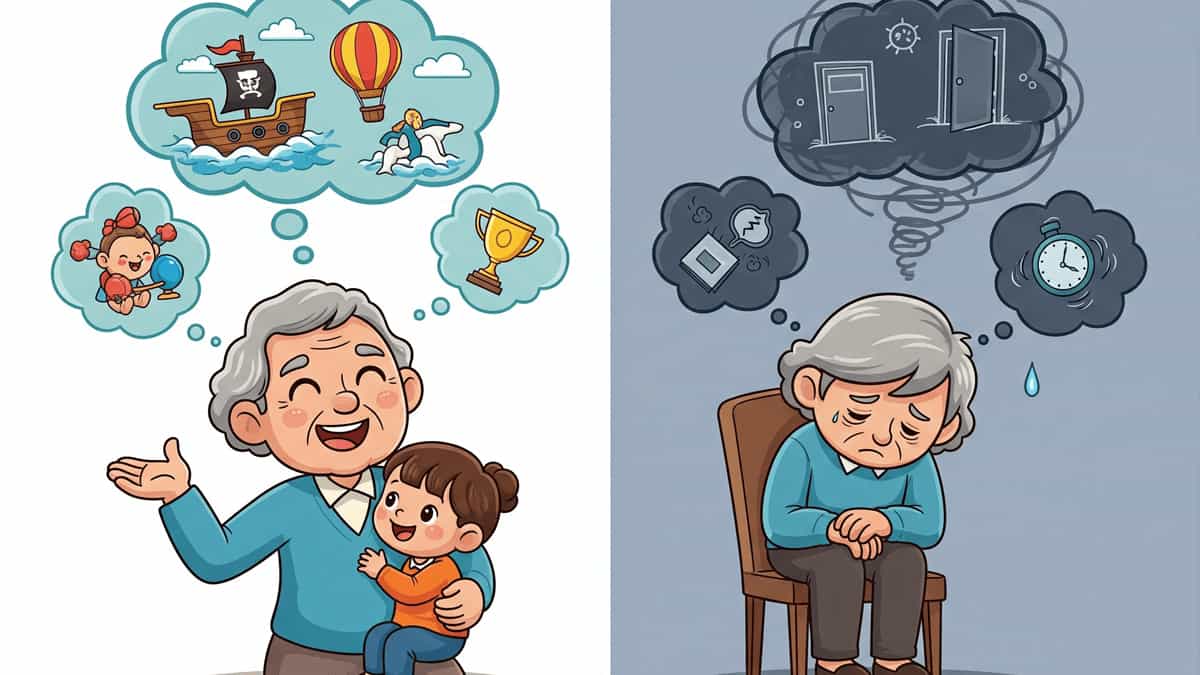
In later adulthood, psychological concerns shift once more.
The focus is no longer achievement, identity, or productivity.
Now the central question becomes:
👉 “Was my life meaningful?”
This is the eighth and final psychosocial conflict described by Erik Erikson: Integrity vs. Despair
KEY TAKEAWAYS
- Integrity vs. Despair is Erikson’s final stage focused on life review and finding meaning in late adulthood.
- Integrity brings peace, wisdom, and acceptance, while despair leads to bitterness and fear of mortality.
- Wisdom is achieved when an individual accepts their life as worth living despite past mistakes.
Quick Summary – Integrity vs. Despair
| Feature | Details |
|---|---|
| Stage | Integrity vs. Despair |
| Age Range | Late Adulthood (typically ~65 years onward, culturally variable) |
| Core Conflict | Acceptance vs. Regret |
| Key Question | “Can I accept the life I have lived?” |
| Psychosocial Virtue | Wisdom |
| Significant Relationship | Humanity, Life Reflection, Philosophical Perspective |
| Maladaptation (If Imbalanced) | Presumption / Despair / Bitterness |
The Trust vs Mistrust stage is the first stage in Erik Erikson’s 8 stages of psychosocial development, a theory explaining how personality develops across the human lifespan.
Building on Generativity
Integrity vs. Despair builds directly upon the foundation of Generativity vs. Stagnation.
Stage 7 answered: “Have I contributed to something beyond myself?“
Stage 8 asks: “Looking back — was it enough? Was I enough?“
This progression is the culmination of Erikson’s entire model. Each prior stage contributes to the final evaluation:
| Stage | Achievement | Contribution to Integrity |
|---|---|---|
| 1. Trust | Hope | “The world was safe enough.” |
| 2. Autonomy | Will | “I was allowed to become myself.” |
| 3. Initiative | Purpose | “My ideas and actions were welcomed.” |
| 4. Industry | Competence | “I learned to do things that matter.” |
| 5. Identity | Fidelity | “I knew who I was and remained faithful.” |
| 6. Intimacy | Love | “I truly connected with others.” |
| 7. Generativity | Care | “I gave something of lasting value.” |
Integrity is not a separate achievement. It is the cumulative verdict on all that came before.
As Erikson wrote:
“It is the acceptance of one’s one and only life cycle as something that had to be and that, by necessity, permitted of no substitutions.”
What Is Integrity vs. Despair?
Typical Phase: Late adulthood
Core Question: “How do I evaluate my life as a whole?”
At this stage, individuals naturally engage in life review.
Reflection becomes not merely occasional but central:
✔ Past decisions — examined and re-examined
✔ Achievements — measured against expectations
✔ Failures — confronted, perhaps forgiven
✔ Relationships — grieved, celebrated, missed
✔ Missed opportunities — paths not taken
✔ Overall meaning — the sum, not just the parts
This is not nostalgia.
It is not reminiscence for entertainment.
It is psychological evaluation — the soul’s final audit.
Understanding “Integrity” in Psychological Terms
Integrity ≠ Moral perfection, flawless choices, or a life without regret
It refers to a hard-won sense of:
👉 Acceptance and coherence
Underlying belief:
✔ “My life — with all its successes, failures, joys, and sorrows — was meaningful.”
Integrity involves:
| Element | Meaning |
|---|---|
| Acceptance of imperfections | Mistakes are integrated, not denied |
| Reconciliation with past choices | “I did what I could with what I knew” |
| Emotional resolution | Old wounds no longer bleed |
| Sense of completeness | Nothing essential is missing |
| Connectedness | Belonging to something larger than oneself |
| Mortality acceptance | Death is not defeat |
Understanding “Despair” in Psychological Terms
Despair is not sadness. It is not grief over specific losses.
Despair is the conviction that time has run out before life became meaningful.
Underlying belief:
👉 “My life was wasted — and it’s too late to fix it.”
Despair involves:
| Element | Meaning |
|---|---|
| Chronic regret | Persistent wishing to undo the past |
| Unresolved guilt | Unforgiven self; unforgiven others |
| Sense of waste | Potential unrealized; gifts ungiven |
| Persistent bitterness | “Life owed me and did not pay” |
| Fear of death | Death as final proof of meaninglessness |
| Contempt | For others, for the world, for oneself |
PROS
- ✓ Sense of completeness and peace
- ✓ Acceptance of mortality without fear
- ✓ Validation of life choices and journey
CONS
- ✕ Chronic regret and bitterness
- ✕ Severe fear of running out of time
- ✕ Contempt toward self and others
Why This Stage Becomes Central
Late adulthood naturally introduces experiences that force the existential question:
| Reality | Psychological Impact |
|---|---|
| Aging body | Former capabilities decline; the self must be redefined |
| Retirement | Loss of work-based identity and structure |
| Death of peers | Mirrors held up to one’s own mortality |
| Illness and disability | Dependence; loss of autonomy |
| Proximity to death | The future is no longer open-ended |
| Cultural ageism | Society signals that one’s relevance has passed |
These realities intensify reflection:
👉 “What did my life amount to?”
This question can no longer be deferred. The future is too short for delay; the past is too long to ignore.
How Integrity Develops
Integrity grows through deliberate and often difficult psychological work.
1. Acceptance of Life’s Imperfections
No life unfolds exactly as planned. No one escapes:
- Mistakes made
- Words regretted
- Opportunities missed
- People hurt
- Dreams unfulfilled
- Luck unequal
Integrity requires recognizing these realities without:
❌ Denial (“It didn’t happen that way”)
❌ Minimization (“It wasn’t that bad”)
❌ Self-condemnation (“I ruined everything”)
❌ Blame (“Others made my life impossible”)
Acceptance is not resignation. It is recognition without ongoing war.
2. Sense of Meaning and Purpose
People who feel their life had purpose consistently demonstrate:
✔ Greater peace in aging
✔ Emotional stability during decline
✔ Reduced existential anxiety
✔ Resilience against despair
Meaning acts as a psychological stabilizer.
Those who cannot locate meaning — who see their efforts as futile, their relationships as failures, their work as empty — are vulnerable to the conviction that their entire existence has been a mistake.
3. Narrative Coherence
Humans are storytelling animals.
We do not merely live; we interpret our living.
Integrity involves constructing a coherent life narrative:
👉 “This was my journey. This is what it meant.”
Key narrative elements:
✔ Continuity — “I am the same self across time”
✔ Causality — “Events connect; choices have consequences”
✔ Thematic unity — “Recurring patterns and values”
✔ Redemption — “Difficulty produced growth”
✔ Acceptance — “Even pain belongs to the whole”
Even difficult, traumatic experiences may be integrated into a meaningful narrative — not because they were good, but because they became part of a life that ultimately held meaning.
4. Reconciliation With Others and Self
Integrity often requires active resolution work:
✔ Seeking forgiveness from those one has harmed
✔ Extending forgiveness to those who have harmed oneself
✔ Acknowledging one’s own limitations without self-contempt
✔ Releasing resentments carried for decades
This is not about “closure” as a single dramatic event. It is about gradual disarmament — the choice to stop fighting battles that are already over.
5. Perspective Beyond the Individual Self
Integrity often involves a shift in identity:
From: “I am this individual life with these specific achievements and failures”
To: “I am part of something larger — a family line, a community, a tradition, humanity itself”
This expansion reduces the terror of personal extinction. If one’s life is embedded in a larger whole, death is not annihilation but transition.
How Despair Develops
Despair reflects the inability to accept one’s life as meaningful and complete.
Common Contributors to Despair:
| Contributor | Manifestation |
|---|---|
| Chronic regret | Persistent focus on “if only” and “what if” |
| Unresolved guilt | Inability to forgive oneself for past harms |
| Sense of wasted potential | “I could have been… should have been…” |
| Unforgiven others | Decades of resentment carried to the end |
| Meaning vacuum | No narrative of purpose or contribution |
| Unresolved earlier stages | Trust failure, identity confusion, intimacy wounds, stagnation |
| Cultural invisibility | Society’s message that the old do not matter |
| Isolation | No one to witness or validate one’s life story |
| Unintegrated suffering | Pain that remains senseless, unredeemed |
Messages Internalized:
👉 “It’s too late. I can’t fix what I broke.”
👉 “I wasted my life. All those years, and for what?”
👉 “No one will remember me. I might as well have never existed.”
👉 “I thought I’d feel peace by now. I just feel tired and empty.”
👉 “What was the point of all that struggle?”
The Two Maladaptations: Presumption and Despair
As with all Erikson stages, imbalance can manifest in opposing directions.
1. Presumption (Excessive/False Integrity)
Some individuals claim integrity without having done the work.
This looks like:
✔ Asserting peace while avoiding honest review
✔ “I have no regrets” — stated defiantly, not reflectively
✔ Dismissing life’s difficulties rather than integrating them
✔ Contempt for those still struggling with existential questions
✔ Rigid, brittle self-satisfaction
Underlying dynamic:
👉 Integrity is performed, not achieved. Genuine reflection is too threatening, so the individual declares victory and refuses examination.
Presumption is not wisdom. It is defense against despair.
2. Despair (Insufficient Integrity)
The more recognized maladaptation: the conviction that life has been meaningless.
This looks like:
✔ Persistent regret and self-condemnation
✔ Bitterness toward others, life, fate, or God
✔ Fear of death as annihilation of an already-empty existence
✔ Contempt toward the young and their optimism
✔ Emotional paralysis; withdrawal from relationships
✔ “What’s the use?” as life philosophy
Underlying dynamic:
👉 The life narrative cannot be redeemed. Attempts at integration fail. The individual concludes that their existence has been a mistake — and now it is too late to correct.
3. Despair Disguised as Detachment
A third pattern: emotional withdrawal presented as peace.
This looks like:
✔ “I don’t care about anything anymore” — framed as transcendence
✔ Complete disinvestment from people and world
✔ Absence of grief, joy, anticipation, or engagement
✔ Flatness mistaken for serenity
Underlying dynamic:
👉 Despair is present but disowned. If one expects nothing, one cannot be disappointed. This is not integrity; it is surrender.
Psychological Outcomes
As with all Erikson stages, development is not absolute. The goal is not the complete absence of regret or sadness — which would be unrealistic and perhaps inhumane. It is a favorable ratio: acceptance outweighing despair, meaning exceeding meaninglessness.
If Integrity Predominates
Individuals are more likely to experience:
✔ Deep sense of peace and resolution
✔ Acceptance of mortality without terror
✔ Emotional stability despite physical decline
✔ Reduced intensity of regret
✔ Capacity to enjoy present moments
✔ Generosity toward younger generations
✔ Perspective that transcends personal得失
When integrity successfully outweighs despair, the individual gains Erikson’s eighth and final psychosocial virtue: Wisdom.
Wisdom — in Erikson’s framework — is not intelligence, knowledge, or cleverness.
It is informed and detached concern for life itself in the face of death itself.
Wisdom is:
- The capacity to see one’s life clearly — its failures and successes — and still affirm it
- The ability to hold suffering and meaning together
- Perspective that transcends individual ego
- Acceptance that life contains both joy and sorrow, gain and loss
- The gift one offers to younger generations: “It is possible to grow old without becoming bitter.”
As Erikson wrote:
“Wisdom is the detached and yet active concern with life itself in the face of death itself.”
Underlying belief:
👉 “My life was worthwhile. Not perfect — but mine, and meaningful.”
If Despair Predominates
Later tendencies may include:
✔ Persistent regret and rumination
✔ Bitterness toward self, others, or life itself
✔ Fear of death as existential terror
✔ Feelings of emptiness and pointlessness
✔ Contempt for the living and their concerns
✔ Inability to find peace or resolution
✔ Hopelessness about the past and future
Underlying belief:
👉 “My life was a waste. I am running out of time, and I have nothing to show for it.”
This is not depression — though they often co-occur. It is a specific failure of the final developmental task: the inability to affirm one’s own existence.
Long-Term Effects in Everyday Life
This stage shapes the entire emotional texture of late adulthood — and influences how individuals are remembered.
1. Attitude Toward Aging and Decline
| Integrity | Despair |
|---|---|
| Accepts physical limitations as natural | Fights aging as defeat |
| Adapts to changing capacities | Mourns lost abilities without replacement |
| Finds new sources of meaning | Clings to what is gone |
| Gratitude for what remains | Bitterness about what is lost |
| Aging as completion | Aging as deterioration |
2. Relationship With Mortality
Integrity supports:
✔ Reduced death anxiety
✔ Philosophical acceptance of finitude
✔ Death as natural conclusion, not enemy
✔ Peace with the unknown
Despair fuels:
✔ Heightened death terror
✔ Avoidance of mortality conversations
✔ Death as final proof of meaninglessness
✔ Desperate attempts to extend life at any cost
3. Emotional Tone of Later Life
| Integrity | Despair |
|---|---|
| Reflection with warmth | Rumination with pain |
| Selective, positive reminiscence | Regret loops and “if only” |
| Gratitude for relationships | Resentment toward family, caregivers |
| Generosity toward young | Envy and contempt for youth |
| Presence in current moment | Psychologically living in past |
4. Legacy and Final Relationships
Individuals with integrity:
✔ Make peace with family members
✔ Offer blessing and affirmation to younger generations
✔ Complete advance directives with clarity, not fear
✔ Die surrounded by love, having given and received it
Individuals with despair:
✔ Carry estrangements to the grave
✔ Withhold affirmation from children and grandchildren
✔ Resist discussions about death, will, legacy
✔ Die isolated — sometimes physically, always emotionally
5. How They Are Remembered
There is a cruel irony: despair often becomes self-fulfilling prophecy.
The person who believes their life was meaningless and no one will remember them often behaves in ways that ensure it:
- Withdraws from relationships
- Withholds love and affirmation
- Resists creating records, stories, memories
- Dies without having shared their history
Then they are, in fact, forgotten — not because their life lacked value, but because despair prevented them from depositing that value in others.
Integrity, by contrast, is generative to the end.
Modern Psychology Connections
This stage is increasingly relevant as global populations age and cultural frameworks for meaning decline.
Contemporary Challenges to Integrity:
| Modern Factor | Impact on Stage 8 |
|---|---|
| Extended lifespan | Decades of late adulthood; more time for despair to deepen or integrity to consolidate |
| Cultural ageism | Society devalues elders; internalized worthlessness |
| Declining religious frameworks | Fewer ready-made narratives of meaning and redemption |
| Geographic family dispersal | Reduced intergenerational contact; isolation |
| Digital legacy questions | Who remembers us when data persists but relationship ends? |
| Medical prolongation of life | Extended decline; dignity and meaning challenged |
| Secular death anxiety | No cultural container for mortality |
Research Connections:
| Concept | Connection to Integrity vs. Despair |
|---|---|
| Life Review Therapy (Butler) | Deliberate reflection on life narrative improves late-life well-being |
| Reminiscence Functions | Different types of reminiscence (integrative vs. obsessive) predict outcomes |
| Post-Traumatic Growth | Suffering integrated into meaningful narrative |
| Socioemotional Selectivity Theory | Prioritization of emotionally meaningful goals in late life |
| Death Anxiety Research | Correlates with meaninglessness, not age itself |
| Wisdom Studies | Multiple empirical models; common elements: perspective, acceptance, emotional regulation |
| Narrative Gerontology | Identity in late life as constructed story |
Common Misconceptions
❌ “Integrity means having a perfect life with no regrets.”
False.
Integrity is about acceptance, not flawlessness.
A person can:
- Have made serious mistakes
- Caused harm to others
- Failed at important goals
- Experienced profound suffering
And still achieve integrity.
The question is not whether the life was perfect. It is whether the person can claim this imperfect life as their own — and affirm that it was worth living.
❌ “Despair only affects the elderly.”
Not accurate.
Miniature versions of this conflict appear throughout life:
- The college graduate who chose the “wrong” major
- The thirty-year-old who left their creative dream for security
- The midlife adult facing the gap between aspiration and reality
- Anyone confronting mortality earlier than expected
Erikson’s stages are dominant conflicts, not exclusive ones. The question “Has my life been meaningful?” can emerge at any age — and does.
❌ “If you didn’t achieve integrity by eighty, it’s too late.”
Incorrect.
Integrity can be:
- Awakened in the final months of life
- Reconstructed through therapeutic life review
- Received through the witness of a compassionate other
- Earned through final acts of reconciliation
It is never too late to make peace with one’s life.
Hospice workers, chaplains, and geriatric therapists regularly witness profound integrity achieved in the final weeks — sometimes even hours — of life.
❌ “Integrity is a solitary achievement.”
Partially true, partially misleading.
The internal work of acceptance is ultimately individual.
But integrity is supported by:
- Family who bear witness and affirm
- Therapists who guide life review
- Friends who remember shared history
- Caregivers who honor dignity
- Communities that value elders
- Culture that offers narratives of meaning
Isolated individuals struggle more with despair. We do not integrate our lives alone.
❌ “Despair means clinical depression.”
Overlap exists, but they are distinct.
| Despair | Depression |
|---|---|
| Specific to life evaluation | Global mood disorder |
| Content: “My life lacked meaning” | Content: “I am worthless, the world is hopeless” |
| May co-occur with depression | May occur without despair |
| Responsive to life review | May require medication |
Despair can contribute to depression. Depression can make integrity work impossible. But they are not identical.
❌ “Wisdom automatically comes with age.”
No.
Age provides opportunity for wisdom. It does not guarantee it.
Wisdom requires:
- Honest self-examination
- Emotional processing of difficult experiences
- Integration of suffering into meaning
- Humility and perspective
- Capacity to hold contradiction
These are achievements, not inevitabilities.
Some eighty-year-olds are profoundly wise. Some are profoundly bitter. Age alone does not determine which.
Practical Implications
Integrity is built across the lifespan — not manufactured in late life.
WAYS TO CULTIVATE INTEGRITY IN LATER LIFE
- ✓ Engage in structured life review (journaling, oral history, or therapy).
- ✓ Document legacies through letters, audio recordings, or photo stories.
- ✓ Actively practice reconciliation, forgiveness, and emotional disarmament.
- ✓ Prioritize intergenerational connections and pass down wisdom to youth.
✅ What to Cultivate (Earlier in Life)
The foundation of integrity is laid decades before late adulthood:
✔ Meaningful goals — not just achievement, but purpose
✔ Value-driven decisions — alignment between beliefs and actions
✔ Acceptance of imperfection — self-compassion when you fail
✔ Narrative integration — reflecting on experiences; constructing coherence
✔ Reconciliation — addressing ruptures before they fossilize
✔ Generativity — contribution that outlasts you
✔ Gratitude practice — noticing what is good, not only what is wrong
Integrity is not a last-minute project. It is a lifelong construction.
✅ What to Cultivate (In Late Adulthood)
✔ Structured life review — journaling, therapy, oral history
✔ Legacy documentation — stories, letters, recordings
✔ Reconciliation outreach — forgiveness sought and offered
✔ Intergenerational connection — time with young people
✔ Meaning-focused reminiscence — not just “what happened” but “what it meant”
✔ Acceptance practices — letting go of what cannot be changed
✔ Spiritual or philosophical engagement — frameworks for meaning
❌ What to Avoid
✖ Avoiding reflection — staying busy to stay silent
✖ Insisting “no regrets” — which often means “no examination”
✖ Isolating from family — carrying grievances to the grave
✖ Refusing to share stories — legacy buried, not planted
✖ Contempt for the young — cutting off life’s continuity
✖ All-or-nothing thinking — “If it wasn’t perfect, it was worthless”
The Role of Others:
We help elders achieve integrity by:
✔ Listening — without rushing, fixing, or dismissing
✔ Witnessing — “I hear your life. It mattered.”
✔ Asking questions — “What was that like? What did you learn?”
✔ Affirming value — “Thank you for telling me. I’ll remember.”
✔ Receiving legacy — “What do you want me to carry forward?”
Sometimes integrity is not achieved alone. Sometimes it is received — handed to the elder by someone who says, “Your life has touched mine.”
The Core Principle:
Integrity is the earned capacity to face one’s own mortality without terror, because one’s life has been accepted as meaningful.
It is not:
- Denial of suffering
- Minimization of failure
- Pretending every choice was right
- Certainty about what comes after
It is:
- Acceptance of the life one actually lived
- Integration of joy and sorrow into coherent narrative
- Peace with imperfection — one’s own and others’
- Trust that existence itself is good
Why This Stage Still Matters
Integrity vs. Despair reflects the final, universal human concern:
👉 “How do I make peace with my life before it ends?”
This question is not limited to the elderly. It echoes through every stage:
- The child wonders if the world is safe
- The adolescent wonders who they are
- The young adult wonders if they can love
- The midlife adult wonders if they have contributed
- The elder wonders if any of it mattered
These are not separate questions. They are the same question, deepening with time.
The Cumulative Nature of Integrity
Integrity is not a separate achievement from earlier stages.
It is the verdict on them.
| If earlier stages resolved toward… | Integrity can conclude… |
|---|---|
| Trust | “The world received me.” |
| Autonomy | “I was allowed to become myself.” |
| Initiative | “My ideas were welcomed.” |
| Industry | “I learned to do things that matter.” |
| Identity | “I knew who I was and remained faithful.” |
| Intimacy | “I truly loved and was loved.” |
| Generativity | “I gave something that will outlast me.” |
Integrity is the accumulated weight of these affirmations.
Despair is their cumulative absence.
The Final Integration: Death and Meaning
Erikson’s model ends here — not because life ends, but because the psychological work of development reaches its natural terminus.
The eighth stage is the inverse of the first.
| Stage 1: Trust | Stage 8: Integrity |
|---|---|
| “Is the world safe?” | “Was my life safe enough?” |
| Infant receives care | Elder reviews care given and received |
| Hope that needs will be met | Trust that life itself was good |
| Beginnings | Endings |
The circle closes.
The individual who began life asking whether existence could be trusted ends life answering that question with their own life as evidence.
As Erikson wrote in his final collaboration with his wife Joan:
“Healthy children will not fear life if their elders have integrity enough not to fear death.”
This is the intergenerational covenant.
We do not achieve integrity only for ourselves. We achieve it for those who come after.
Our peace becomes their permission to trust life.
Our despair becomes their fear of time.
Integrity vs. Despair centers on the final human task: evaluating one’s life as a whole and accepting it as meaningful.
In late adulthood, individuals naturally reflect on whether their journey produced:
✔ Coherence and meaning
or
✔ Regret and despair
When supported by prior developmental achievements, meaningful life review, and compassionate witnesses, the individual may attain Erikson’s final virtue: Wisdom — the capacity to affirm life in the face of death.
While this work intensifies in late adulthood, its foundations are built across the entire lifespan — through trust, autonomy, initiative, industry, identity, intimacy, and generativity. Each stage contributes a stone to the edifice of integrity.
The question asked at eighty — “Was my life meaningful?” — was already being answered at one, at four, at seven, at twelve, at twenty, at thirty, at fifty.
We are always writing the final verdict. We simply do not read it until the end.
FAQs
What is the main virtue of the Integrity vs. Despair stage?
The primary psychosocial virtue gained in this stage is Wisdom, defined by Erikson as an informed and detached concern with life itself in the face of death.
Can someone achieve integrity if they had a difficult life full of mistakes?
Yes. Integrity is not about moral perfection or having a flawless life; it is about reaching acceptance and finding coherence in the life actually lived.
How can younger generations help elders achieve integrity?
Younger generations can help by listening to life stories, bearing witness, asking meaningful questions, and validating the elder’s legacy and contributions.