
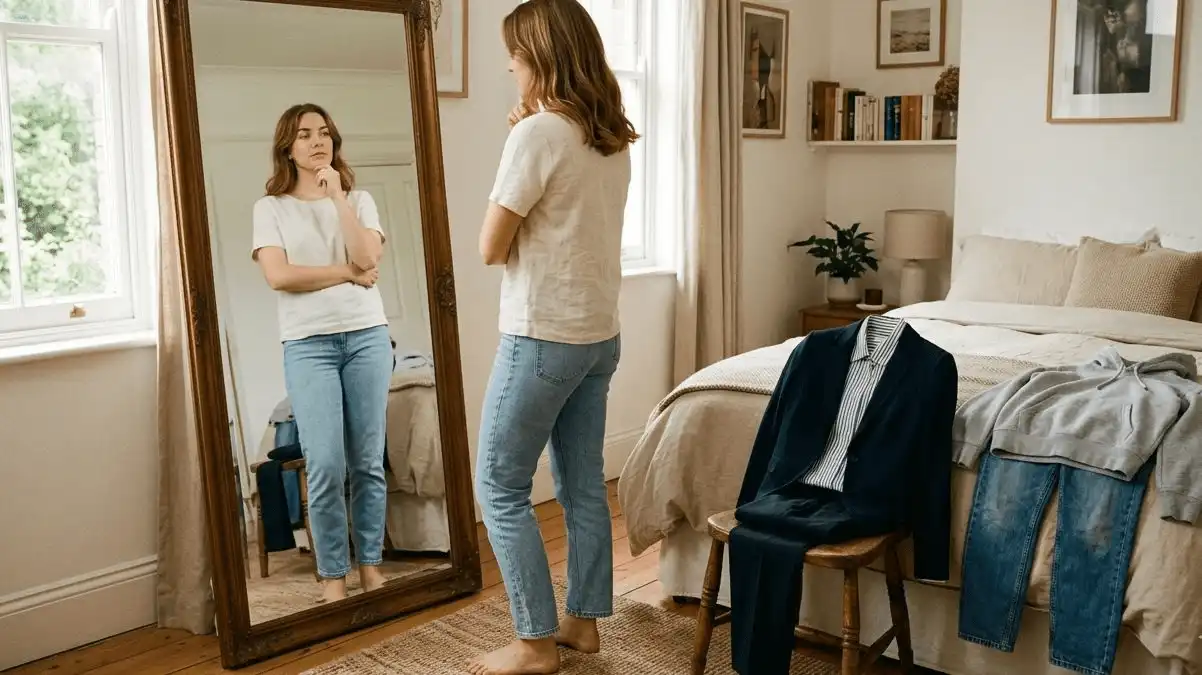
Why Clothing Matters on Dates
On a first date, your outfit is not just fabric. It is a message.
Before you say a word, before you smile, before you pull out a chair, your clothing has already communicated effort level, self‑respect, social awareness, and emotional availability. The person across from you decodes these signals automatically — often without realizing they are doing it.
This is not superficial. It is survival wiring. Your brain needs to assess whether a potential partner is reliable, stable, and interested. Clothing provides the fastest available evidence.
Effort vs. Comfort Psychology
The central tension in first‑date attire is effort versus comfort.
THE ATTIRE SIGNAL MATRIX
- High effort (suit, tie, formal dress, styled hair) signals: “I value this encounter. I am willing to invest.”
- Low effort (sweatpants, stained shirt, unbrushed hair) signals: “I did not prioritize this. You are not special.”
- Comfort‑first (hoodie, sneakers, no styling) signals: “I am being ‘authentic’ — but also possibly lazy.”
The healthiest middle ground is intentional comfort: clothing that feels good but clearly required thought. A well‑fitted sweater, clean jeans without holes, leather boots instead of running shoes. Comfortable enough to be yourself. Polished enough to signal respect.
Overdressing vs. Underdressing
Both extremes carry psychological risk.
| Attire Choice | Signal | Risk |
|---|---|---|
| Formal suit to a casual coffee date | “I am trying too hard” or “I am socially unaware” | Perceived as desperate or arrogant |
| T‑shirt and shorts to a dinner date | “I do not care enough to try” | Perceived as low effort, low interest |
| Restaurant‑appropriate dress to a dive bar | “I did not research the venue” | Perceived as incompatible or oblivious |
| Hoodie to a nice restaurant | “I am testing you” or “I am defiant” | Perceived as disrespectful |
The safe rule: dress one level above the venue’s baseline. If the place is casual (coffee shop, park), wear smart casual. If the place is mid‑range (chain restaurant), wear a collared shirt or a simple dress. If the place is upscale, wear a blazer or cocktail attire.
Color Signals in Dating
Color psychology applies powerfully to first dates.
Red — Increases attraction but also signals dominance or aggression. Best as an accent (scarf, tie, lipstick), not head‑to‑toe.
Black — Signals sophistication and mystery but can feel intimidating or aloof. Works well for evening dates.
Navy and dark blue — Signal trustworthiness and calm authority. Universally safe for first dates.
Earth tones (beige, olive, brown) — Signal warmth and approachability. Excellent for daytime dates.
White — Signals cleanliness and freshness but can feel clinical or try‑hard if overly crisp.
Bright colors (yellow, orange, neon) — Signal extraversion and fun but risk being perceived as immature or attention‑seeking.
Casual Fashion and Emotional Availability
Casual dressing carries hidden subtext about emotional availability.
People who dress extremely casually on a first date are often signaling: “I am not ready to invest emotionally. I am keeping you at a distance.” This is not always conscious. But the brain reads it clearly.
Conversely, people who dress appropriately but not overdressed signal: “I am open to connection. I have done the work to show up.”
The exception: certain subcultures (tech, creative, outdoorsy) have different norms. A hiking date in technical gear is not low effort — it is context‑appropriate. Know your audience.
Luxury Signals and Status Perception
Expensive clothing on a first date sends a mixed signal.
On one hand, luxury (designer watch, high‑end bag, tailored suit) signals resources and success — traits associated with mate value. On the other hand, overt luxury can signal:
WHAT OVERT LUXURY CAN ACCIDENTALLY SIGNAL
- Materialism — “I prioritize possessions over people”
- Insecurity — “I need external validation”
- Intimidation — “You cannot afford my lifestyle”
The most attractive luxury is understated — quality without logos, fit without flash. Quiet luxury signals security without arrogance.
You May Also Like
Learn how the halo effect in fashion shapes first impressions
Authenticity vs. Performance
Your date is scanning for authenticity. Clothing that feels like a costume — borrowed, uncomfortable, wildly outside your normal range — triggers suspicion.
The brain asks: “Is this who they really are, or who they think I want them to be?”
Authenticity does not mean wearing your worst clothes. It means wearing clothes that fit your identity while still showing effort. If you never wear suits, do not wear a suit. If you love vintage, wear your best vintage piece. The goal is polished you, not a fake version of someone else.
How Men and Women Read Outfits Differently
Research suggests slight differences in what men and women prioritize in first‑date attire.
| Cue | Men’s Priority (on a female date) | Women’s Priority (on a male date) |
|---|---|---|
| Fit | High — signals health and self‑care | Very high — signals attention to detail |
| Cleanliness | Very high — signals hygiene | Very high — signals hygiene |
| Appropriateness to venue | Medium | High — signals social awareness |
| Expensive labels | Low‑Medium | Low — can signal insecurity |
| Color | Medium — red increases attraction | Medium — navy and earth tones preferred |
| Shoes | Low (often unnoticed) | High — shoes signal overall conscientiousness |
These are averages, not absolutes. Individual preferences vary widely. But understanding the tendencies helps avoid blind spots.
Must Read
Discover why people behave differently in groups — dating dynamics are a form of group behavior
What First-Date Clothing Actually Communicates
Your outfit answers four questions before the first drink arrives:
KEY TAKEAWAYS: FOUR UNWRITTEN ANSWERS
- ✓ “Do you respect yourself?” — Clean, fitted, intentional clothing says yes.
- ✓ “Do you respect me?” — Effort proportionate to the venue says yes.
- ✓ “Are you emotionally available?” — Appropriate rather than defensive dressing says yes.
- ✓ “Are you trying to impress me or be yourself?” — Authentic polish says both.
The best first‑date outfit is the one that lets your date think: “I like who I am meeting” — not “I like that jacket.”
Final Thoughts
Your first‑date attire is never neutral. It is always communicating.
The question is not whether you are sending signals. The question is whether you are sending the signals you intend. Effort shows interest. Appropriateness shows social intelligence. Authenticity shows safety.
Dress like the person you want them to meet — not the person you think they want. And when in doubt, add one small intentional detail: a clean pair of shoes, a pressed shirt, a subtle accessory. Those details are not vanity. They are respect.
Related Articles


Sponsored


You May Also Like

Industry vs. Inferiority (Erikson’s Fourth Stage of Psychoso…

Why Scent Memories Outlast Visual First Impressions

Why Mental Health Challenges Can Develop Over Time

How Your Frequency of Posting Alters Your Social Value

Atypical Depression The Hidden Type You Might Not Recognize
