Why Clothing Signals Social Status
Humans have used clothing as a status marker for over 5,000 years. In ancient Rome, purple robes were legally reserved for emperors. In medieval Europe, sumptuary laws dictated which fabrics commoners could wear.
Today, no laws exist — but the psychology remains identical.
Your brain is wired to detect resource availability in others within milliseconds. Clothing provides the fastest visible evidence of economic and social standing.
The Psychology of Expensive-Looking Style
Status perception is not about actual cost. It is about perceived cost.
A $50 shirt with excellent fit, simple design, and quality fabric can signal higher status than a $500 shirt covered in logos. This happens because the brain reads:
WHAT THE BRAIN READS
- Clean lines → controlled environment → resources
- Quality fabric → access to better goods → wealth
- Minimalist design → no need to prove anything → high status
Conversely, loud branding can sometimes signal lower status — the need for external validation.
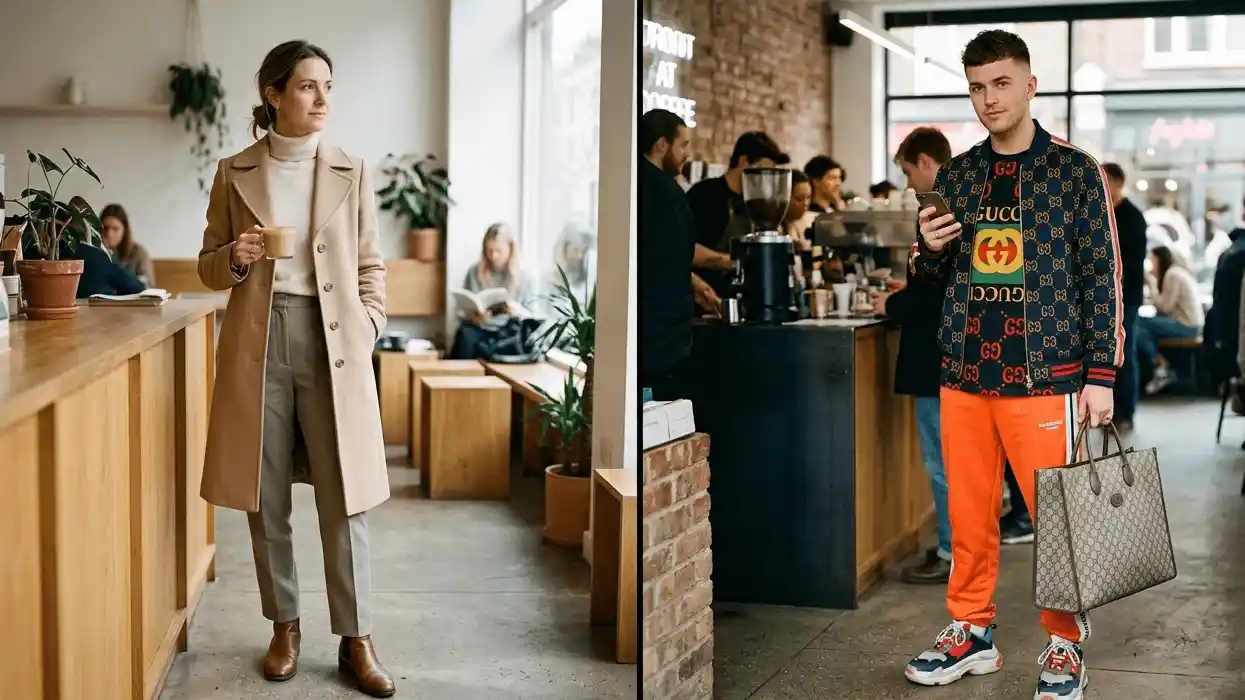
Quiet Luxury vs Loud Branding
| Style Type | Signal | Perception |
|---|---|---|
| Quiet Luxury | “I don’t need to prove anything” | Confident, old money, secure |
| Loud Branding | “Look at what I can afford” | Insecure, new money, compensating |
| No Signal (generic) | “I don’t care about status” | Low priority, invisible |
Quiet luxury wins in high-trust environments. Loud branding wins in low-trust, competitive environments where people need visible proof of success.
How People Judge Wealth From Appearance
Research in social psychology shows that people judge wealth based on three clothing cues in order:
PRIMARY CLOTHING CUES
- ✓ Fit — tailored clothing signals resources to afford alterations
- ✓ Fabric — natural fibers (cotton, wool, linen) vs synthetics
- ✓ Condition — clean, pressed, unworn vs faded, wrinkled, damaged
Notice that logos are not on this list. Most high-status individuals know this. Most low-status individuals do not.
The Confidence Effect of High-Status Clothing
When you wear clothing associated with high status, two things happen:
- Others treat you better — more eye contact, more deference, more patience
- You behave differently — posture improves, speech slows, risk-taking increases
This is the confidence loop. Clothing changes behavior. Behavior changes outcomes. Outcomes reinforce the clothing choice.
You May Also Like
How to build real confidence from the inside out
Why Status Perception Changes Behavior
The Pygmalion effect applies to clothing.
When others believe you have high status, they invest more in you — better service, more opportunities, higher expectations. These investments then produce better outcomes. The prophecy fulfills itself.
This is not manipulation. It is social reality construction.
Final Thoughts
Status signals are unavoidable. Even wearing torn jeans signals a specific status (rebellious, anti-materialist, or careless — context decides).
The question is not whether to signal status. The question is which status you choose to signal — and whether that signal serves your goals.
Related Articles


Sponsored


You May Also Like

Intimacy vs. Isolation (Erikson’s Sixth Stage of Psychosocia…

The Trust Spectrum: How Blue and Earth Tones Lower Social De…

The Comfort Conundrum: Does Dressing Casual Casualize Your W…

The Science Behind Multisensory Perception: How Our Brain In…
Another Word for Overwhelming: 200+ Powerful Alternatives by…